{"title":"Continuous synthesis of PEGylated MIL-101(Cr) nanoparticles for neuroprotection†","authors":"Yuheng Wang and Shuirong Li","doi":"10.1039/D4RA09107H","DOIUrl":null,"url":null,"abstract":"<p >The application of metal organic frameworks (MOFs) in targeted drug delivery for ischemic stroke therapy has emerged as a hot issue recently. Although significant progress has been made in immobilizing neuroprotective agents on MOFs, environmentally friendly large-scale preparation of nano-drug-loaded MOFs with controlled size, morphology, purity and therapeutic effect remains challenging. PEGylation of MIL-101(Cr) nanoparticles with dual ligands that have the 2,2-dimethylthiazolidine (DMTD) structure was developed in this work to mitigate nervous system injury induced by ischemia/reperfusion (IR) during a stroke. A green ultrasound-assisted continuous-flow system was established for efficient production of the versatile MOF nanoparticles. Unified nanoparticles (diameter: ∼250–350 nm) were obtained with both high quality and high space-time yield (5664 kg m<small><sup>−3</sup></small> d<small><sup>−1</sup></small>). The MOF exhibited protective activity in SH-SY5Y cells against oxygen and glucose deprivation and H<small><sub>2</sub></small>O<small><sub>2</sub></small> insults, and prevented reactive oxygen species accumulation. The cellular uptake of the PEGylated MOFs by brain capillary endothelial cells was investigated, showing targeting capability <em>in vitro</em>, which proposes the biomaterial as a promising therapeutic candidate for reducing IR-induced nervous system injury.</p>","PeriodicalId":102,"journal":{"name":"RSC Advances","volume":" 15","pages":" 12020-12027"},"PeriodicalIF":4.6000,"publicationDate":"2025-04-16","publicationTypes":"Journal Article","fieldsOfStudy":null,"isOpenAccess":false,"openAccessPdf":"https://pubs.rsc.org/en/content/articlepdf/2025/ra/d4ra09107h?page=search","citationCount":"0","resultStr":null,"platform":"Semanticscholar","paperid":null,"PeriodicalName":"RSC Advances","FirstCategoryId":"92","ListUrlMain":"https://pubs.rsc.org/en/content/articlelanding/2025/ra/d4ra09107h","RegionNum":3,"RegionCategory":"化学","ArticlePicture":[],"TitleCN":null,"AbstractTextCN":null,"PMCID":null,"EPubDate":"","PubModel":"","JCR":"Q2","JCRName":"CHEMISTRY, MULTIDISCIPLINARY","Score":null,"Total":0}
引用次数: 0
Abstract
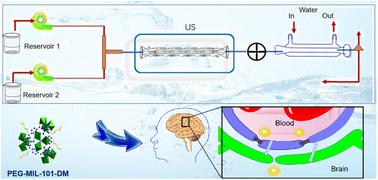
The application of metal organic frameworks (MOFs) in targeted drug delivery for ischemic stroke therapy has emerged as a hot issue recently. Although significant progress has been made in immobilizing neuroprotective agents on MOFs, environmentally friendly large-scale preparation of nano-drug-loaded MOFs with controlled size, morphology, purity and therapeutic effect remains challenging. PEGylation of MIL-101(Cr) nanoparticles with dual ligands that have the 2,2-dimethylthiazolidine (DMTD) structure was developed in this work to mitigate nervous system injury induced by ischemia/reperfusion (IR) during a stroke. A green ultrasound-assisted continuous-flow system was established for efficient production of the versatile MOF nanoparticles. Unified nanoparticles (diameter: ∼250–350 nm) were obtained with both high quality and high space-time yield (5664 kg m−3 d−1). The MOF exhibited protective activity in SH-SY5Y cells against oxygen and glucose deprivation and H2O2 insults, and prevented reactive oxygen species accumulation. The cellular uptake of the PEGylated MOFs by brain capillary endothelial cells was investigated, showing targeting capability in vitro, which proposes the biomaterial as a promising therapeutic candidate for reducing IR-induced nervous system injury.
期刊介绍:
An international, peer-reviewed journal covering all of the chemical sciences, including multidisciplinary and emerging areas. RSC Advances is a gold open access journal allowing researchers free access to research articles, and offering an affordable open access publishing option for authors around the world.




 京公网安备 11010802042870号
京ICP备2023020795号-1
京公网安备 11010802042870号
京ICP备2023020795号-1

 分享
分享
 求助内容:
求助内容: 应助结果提醒方式:
 扫码关注我们
