Yu Wang, Yibo Ma, Xiaowei Dai, Jia Li, Jian Zhang, Hongyu Jiang, Maofeng Wang and Shenglong Yu
{"title":"Nano-foam gold-modified diamond electrochemical aptasensing platform for ultrasensitive monitoring of 17β-estradiol†","authors":"Yu Wang, Yibo Ma, Xiaowei Dai, Jia Li, Jian Zhang, Hongyu Jiang, Maofeng Wang and Shenglong Yu","doi":"10.1039/D5RA01318F","DOIUrl":null,"url":null,"abstract":"<p >This study developed a nano-foam gold modified boron-doped diamond (NFG/BDD-Apt) electrochemical aptasensor through a synergistic electrodeposition-dealloying strategy combined with aptamer functionalization for detecting 17β-estradiol (E2) in aquatic environments. The NFG/BDD-Apt sensor was systematically characterized using SEM, Raman, and EIS to elucidate its surface morphology, molecular structure, and electrochemical properties. SEM analysis revealed the successful formation of a homogeneous three-dimensional porous NFG structure on the BDD surface, which significantly enhanced the specific surface area (1.9-fold increase <em>vs.</em> bare BDD) and electron transfer efficiency. Electrochemical performance evaluation through CV and DPV demonstrated superior E2 detection capabilities. Under optimized conditions, the sensor exhibited a wide linear response range from 1.0 × 10<small><sup>−14</sup></small> to 1.0 × 10<small><sup>−8</sup></small> mol L<small><sup>−1</sup></small> (<em>R</em><small><sup>2</sup></small> = 0.997) with an ultralow detection limit of 1.8 × 10<small><sup>−15</sup></small> mol L<small><sup>−1</sup></small> (S/N = 3). NFG/BDD-Apt demonstrated exceptional selectivity (>92% specificity against common interferents) and long-term stability. This work provides a novel sensing platform combining diamond electrode advantages with nanostructured amplification effects, offering significant potential for rapid and reliable monitoring of endocrine disruptors in environmental water systems.</p>","PeriodicalId":102,"journal":{"name":"RSC Advances","volume":" 16","pages":" 12291-12297"},"PeriodicalIF":4.6000,"publicationDate":"2025-04-17","publicationTypes":"Journal Article","fieldsOfStudy":null,"isOpenAccess":false,"openAccessPdf":"https://pubs.rsc.org/en/content/articlepdf/2025/ra/d5ra01318f?page=search","citationCount":"0","resultStr":null,"platform":"Semanticscholar","paperid":null,"PeriodicalName":"RSC Advances","FirstCategoryId":"92","ListUrlMain":"https://pubs.rsc.org/en/content/articlelanding/2025/ra/d5ra01318f","RegionNum":3,"RegionCategory":"化学","ArticlePicture":[],"TitleCN":null,"AbstractTextCN":null,"PMCID":null,"EPubDate":"","PubModel":"","JCR":"Q2","JCRName":"CHEMISTRY, MULTIDISCIPLINARY","Score":null,"Total":0}
引用次数: 0
Abstract
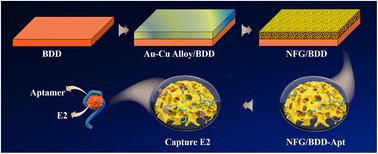
This study developed a nano-foam gold modified boron-doped diamond (NFG/BDD-Apt) electrochemical aptasensor through a synergistic electrodeposition-dealloying strategy combined with aptamer functionalization for detecting 17β-estradiol (E2) in aquatic environments. The NFG/BDD-Apt sensor was systematically characterized using SEM, Raman, and EIS to elucidate its surface morphology, molecular structure, and electrochemical properties. SEM analysis revealed the successful formation of a homogeneous three-dimensional porous NFG structure on the BDD surface, which significantly enhanced the specific surface area (1.9-fold increase vs. bare BDD) and electron transfer efficiency. Electrochemical performance evaluation through CV and DPV demonstrated superior E2 detection capabilities. Under optimized conditions, the sensor exhibited a wide linear response range from 1.0 × 10⁻¹⁴ to 1.0 × 10⁻⁸ mol L−1 (R2 = 0.997) with an ultralow detection limit of 1.8 × 10⁻¹⁵ mol L−1 (S/N = 3). NFG/BDD-Apt demonstrated exceptional selectivity (>92% specificity against common interferents) and long-term stability. This work provides a novel sensing platform combining diamond electrode advantages with nanostructured amplification effects, offering significant potential for rapid and reliable monitoring of endocrine disruptors in environmental water systems.
期刊介绍:
An international, peer-reviewed journal covering all of the chemical sciences, including multidisciplinary and emerging areas. RSC Advances is a gold open access journal allowing researchers free access to research articles, and offering an affordable open access publishing option for authors around the world.




 京公网安备 11010802042870号
京ICP备2023020795号-1
京公网安备 11010802042870号
京ICP备2023020795号-1

 分享
分享
 求助内容:
求助内容: 应助结果提醒方式:
 扫码关注我们
