Arijit Roy, Surendra V. Singh, R. Ramachandran, J. K. Meka, M. Ambresh, T. Vijay, P. Janardhan, V. Jayaram, V. Venkatraman, A. Das, H. Hill, Anil Bhardwaj, N. J. Mason and B. Sivaraman
{"title":"Instantaneous formation of interstellar minerals and mineral quantum dots†","authors":"Arijit Roy, Surendra V. Singh, R. Ramachandran, J. K. Meka, M. Ambresh, T. Vijay, P. Janardhan, V. Jayaram, V. Venkatraman, A. Das, H. Hill, Anil Bhardwaj, N. J. Mason and B. Sivaraman","doi":"10.1039/D5RA01088H","DOIUrl":null,"url":null,"abstract":"<p >Our understanding of the formation pathways of interstellar mineral dust is still evolving. This study investigated the formation of astrophysical mineral dust, such as olivine, by shock processing. Low-velocity (∼1.8 km s<small><sup>−1</sup></small>) interstellar shock conditions were simulated using high-intensity shock tubes. These conditions enabled the examination of various cosmic mineral dust precursors such as the mixtures of Mg, Fe and SiO<small><sub>2</sub></small> under a shock strength of approximately 5.6 M and temperatures around 7300 K. Analysis of the processed samples revealed the presence of Mg-rich olivine, forsterite, MgO quantum dots (QD), and magnetite. These results indicate that shockwaves can rapidly induce dust formation in interstellar space. Furthermore, we demonstrated that shock processing of mineral dust precursors could contribute to the formation of crystalline silicate dust observed in comets and the creation of chondrules, which are observed in chondritic meteorites.</p>","PeriodicalId":102,"journal":{"name":"RSC Advances","volume":" 16","pages":" 12309-12320"},"PeriodicalIF":4.6000,"publicationDate":"2025-04-17","publicationTypes":"Journal Article","fieldsOfStudy":null,"isOpenAccess":false,"openAccessPdf":"https://pubs.rsc.org/en/content/articlepdf/2025/ra/d5ra01088h?page=search","citationCount":"0","resultStr":null,"platform":"Semanticscholar","paperid":null,"PeriodicalName":"RSC Advances","FirstCategoryId":"92","ListUrlMain":"https://pubs.rsc.org/en/content/articlelanding/2025/ra/d5ra01088h","RegionNum":3,"RegionCategory":"化学","ArticlePicture":[],"TitleCN":null,"AbstractTextCN":null,"PMCID":null,"EPubDate":"","PubModel":"","JCR":"Q2","JCRName":"CHEMISTRY, MULTIDISCIPLINARY","Score":null,"Total":0}
引用次数: 0
Abstract
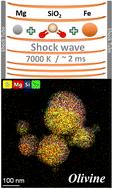
Our understanding of the formation pathways of interstellar mineral dust is still evolving. This study investigated the formation of astrophysical mineral dust, such as olivine, by shock processing. Low-velocity (∼1.8 km s−1) interstellar shock conditions were simulated using high-intensity shock tubes. These conditions enabled the examination of various cosmic mineral dust precursors such as the mixtures of Mg, Fe and SiO2 under a shock strength of approximately 5.6 M and temperatures around 7300 K. Analysis of the processed samples revealed the presence of Mg-rich olivine, forsterite, MgO quantum dots (QD), and magnetite. These results indicate that shockwaves can rapidly induce dust formation in interstellar space. Furthermore, we demonstrated that shock processing of mineral dust precursors could contribute to the formation of crystalline silicate dust observed in comets and the creation of chondrules, which are observed in chondritic meteorites.
期刊介绍:
An international, peer-reviewed journal covering all of the chemical sciences, including multidisciplinary and emerging areas. RSC Advances is a gold open access journal allowing researchers free access to research articles, and offering an affordable open access publishing option for authors around the world.





 京公网安备 11010802042870号
京ICP备2023020795号-1
京公网安备 11010802042870号
京ICP备2023020795号-1

 分享
分享
 求助内容:
求助内容: 应助结果提醒方式:
 扫码关注我们
