Opto-sensing of sotalol using parafilm and poly(methyl methacrylate) micro-plates decorated by silver nanoparticles: state-of-the-art for one-drop pharmaceutical analysis†
Milad Baghal Behyar, Farnaz Bahavarnia, Azadeh Nilghaz, Mohammad Hasanzadeh and Nasrin Shadjou
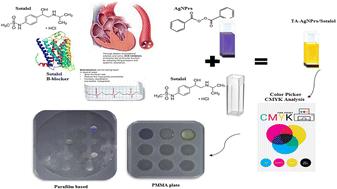
{"title":"Opto-sensing of sotalol using parafilm and poly(methyl methacrylate) micro-plates decorated by silver nanoparticles: state-of-the-art for one-drop pharmaceutical analysis†","authors":"Milad Baghal Behyar, Farnaz Bahavarnia, Azadeh Nilghaz, Mohammad Hasanzadeh and Nasrin Shadjou","doi":"10.1039/D5RA01716E","DOIUrl":null,"url":null,"abstract":"<p >Sotalol is an antiarrhythmic drug with a narrow therapeutic index and potential adverse effects, including hypotension and heart block, requiring continuous and precise blood-level monitoring. In this study, an innovative optical sensor was developed using silver nanoparticle (AgNP)-functionalized parafilm (PF)- and poly methyl methacrylate (PMMA) for the trace-level detection of sotalol in human blood plasma. The detection was performed using CMYK-based colorimetric digital image analysis <em>via</em> the Color Picker software app, achieving a low limit of quantification of 1 μM and a linear range of 0.001 to 20 mM. The selectivity of the sensor was also validated in the presence of potentially interfering cardiovascular drugs. Nanoparticle characterization revealed a shift in zeta potential (<em>Z</em><small><sub>p</sub></small>) from −14.5 to −6.16 mV, confirming a strong interaction between sotalol and AgNPs, as the optical probe. The sensor offers an innovative, cost-effective, portable, and rapid (5-min analysis time) approach for detecting sotalol in blood plasma. This sensor holds significant potential for point-of-care diagnostics and <em>on-site</em> drug monitoring, providing a reliable alternative to conventional, lab-dependent analytical methods for therapeutic drug monitoring.</p>","PeriodicalId":102,"journal":{"name":"RSC Advances","volume":" 16","pages":" 12321-12330"},"PeriodicalIF":4.6000,"publicationDate":"2025-04-17","publicationTypes":"Journal Article","fieldsOfStudy":null,"isOpenAccess":false,"openAccessPdf":"https://pubs.rsc.org/en/content/articlepdf/2025/ra/d5ra01716e?page=search","citationCount":"0","resultStr":null,"platform":"Semanticscholar","paperid":null,"PeriodicalName":"RSC Advances","FirstCategoryId":"92","ListUrlMain":"https://pubs.rsc.org/en/content/articlelanding/2025/ra/d5ra01716e","RegionNum":3,"RegionCategory":"化学","ArticlePicture":[],"TitleCN":null,"AbstractTextCN":null,"PMCID":null,"EPubDate":"","PubModel":"","JCR":"Q2","JCRName":"CHEMISTRY, MULTIDISCIPLINARY","Score":null,"Total":0}
引用次数: 0
Abstract
Sotalol is an antiarrhythmic drug with a narrow therapeutic index and potential adverse effects, including hypotension and heart block, requiring continuous and precise blood-level monitoring. In this study, an innovative optical sensor was developed using silver nanoparticle (AgNP)-functionalized parafilm (PF)- and poly methyl methacrylate (PMMA) for the trace-level detection of sotalol in human blood plasma. The detection was performed using CMYK-based colorimetric digital image analysis via the Color Picker software app, achieving a low limit of quantification of 1 μM and a linear range of 0.001 to 20 mM. The selectivity of the sensor was also validated in the presence of potentially interfering cardiovascular drugs. Nanoparticle characterization revealed a shift in zeta potential (Zp) from −14.5 to −6.16 mV, confirming a strong interaction between sotalol and AgNPs, as the optical probe. The sensor offers an innovative, cost-effective, portable, and rapid (5-min analysis time) approach for detecting sotalol in blood plasma. This sensor holds significant potential for point-of-care diagnostics and on-site drug monitoring, providing a reliable alternative to conventional, lab-dependent analytical methods for therapeutic drug monitoring.
期刊介绍:
An international, peer-reviewed journal covering all of the chemical sciences, including multidisciplinary and emerging areas. RSC Advances is a gold open access journal allowing researchers free access to research articles, and offering an affordable open access publishing option for authors around the world.



 京公网安备 11010802042870号
京ICP备2023020795号-1
京公网安备 11010802042870号
京ICP备2023020795号-1

 分享
分享
 求助内容:
求助内容: 应助结果提醒方式:
 扫码关注我们
