Mubashira Mukta, Md. Khalid Hossain Shishir, Sabrina Sultana, Md. Ashraful Alam, Mohammad Minnatul Karim, Gazi Md. Arifuzzaman Khan
{"title":"Biodegradable Antimicrobial Films of 2,3-Dialdehyde Cellulose Prepared from Okra Biomass: Characterization and Potential Applications","authors":"Mubashira Mukta, Md. Khalid Hossain Shishir, Sabrina Sultana, Md. Ashraful Alam, Mohammad Minnatul Karim, Gazi Md. Arifuzzaman Khan","doi":"10.1002/slct.202500610","DOIUrl":null,"url":null,"abstract":"<p>A biodegradable polymer film made from waste biomass offers multifunctional properties, driving economic growth and promoting environmental research. In this study, okra fiber-based biomass was utilized to synthesize 2,3-dialdehyde cellulose (DAC) through controlled periodate oxidation. Reaction parameters, including the cellulose-to-KIO4 ratio (2:1, 1:1, 1:2, 1:3), reaction time (3.0–5.0 h), and temperature (50.0–70.0 °C), were systematically varied. The resulting samples were characterized using FTIR, XRD, SEM, TGA, and titrimetric methods to quantify aldehyde groups. Aldehyde functionalities were confirmed by carbonyl bands observed at 1740–1720 and 800–1030 cm⁻¹ in the FTIR spectra. SEM imaging revealed distinct morphological changes, and the amorphous content increased with higher aldehyde levels. DAC exhibited lower thermal stability compared to fibrillated cellulose. To enhance antibacterial properties, Ag-sericin (Ag-SS) nanoparticles were incorporated into DAC. DAC and Ag-SS/DAC films were fabricated using the solvent casting method. The Ag-SS/DAC film demonstrated significantly improved tensile strength and modulus. Antimicrobial tests confirmed the composite films effective activity against both Gram-positive (<i>Staphylococcus aureus</i>) and Gram-negative (<i>Escherichia coli</i>) bacteria. The developed film exhibits notable strength and robust antibacterial properties, suggesting its potential use in packaging applications.</p>","PeriodicalId":146,"journal":{"name":"ChemistrySelect","volume":"10 15","pages":""},"PeriodicalIF":2.0000,"publicationDate":"2025-04-16","publicationTypes":"Journal Article","fieldsOfStudy":null,"isOpenAccess":false,"openAccessPdf":"","citationCount":"0","resultStr":null,"platform":"Semanticscholar","paperid":null,"PeriodicalName":"ChemistrySelect","FirstCategoryId":"92","ListUrlMain":"https://chemistry-europe.onlinelibrary.wiley.com/doi/10.1002/slct.202500610","RegionNum":4,"RegionCategory":"化学","ArticlePicture":[],"TitleCN":null,"AbstractTextCN":null,"PMCID":null,"EPubDate":"","PubModel":"","JCR":"Q3","JCRName":"CHEMISTRY, MULTIDISCIPLINARY","Score":null,"Total":0}
引用次数: 0
Abstract
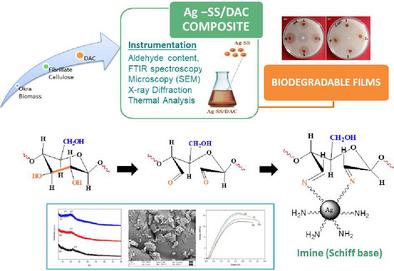
A biodegradable polymer film made from waste biomass offers multifunctional properties, driving economic growth and promoting environmental research. In this study, okra fiber-based biomass was utilized to synthesize 2,3-dialdehyde cellulose (DAC) through controlled periodate oxidation. Reaction parameters, including the cellulose-to-KIO4 ratio (2:1, 1:1, 1:2, 1:3), reaction time (3.0–5.0 h), and temperature (50.0–70.0 °C), were systematically varied. The resulting samples were characterized using FTIR, XRD, SEM, TGA, and titrimetric methods to quantify aldehyde groups. Aldehyde functionalities were confirmed by carbonyl bands observed at 1740–1720 and 800–1030 cm⁻¹ in the FTIR spectra. SEM imaging revealed distinct morphological changes, and the amorphous content increased with higher aldehyde levels. DAC exhibited lower thermal stability compared to fibrillated cellulose. To enhance antibacterial properties, Ag-sericin (Ag-SS) nanoparticles were incorporated into DAC. DAC and Ag-SS/DAC films were fabricated using the solvent casting method. The Ag-SS/DAC film demonstrated significantly improved tensile strength and modulus. Antimicrobial tests confirmed the composite films effective activity against both Gram-positive (Staphylococcus aureus) and Gram-negative (Escherichia coli) bacteria. The developed film exhibits notable strength and robust antibacterial properties, suggesting its potential use in packaging applications.
期刊介绍:
ChemistrySelect is the latest journal from ChemPubSoc Europe and Wiley-VCH. It offers researchers a quality society-owned journal in which to publish their work in all areas of chemistry. Manuscripts are evaluated by active researchers to ensure they add meaningfully to the scientific literature, and those accepted are processed quickly to ensure rapid online publication.







 京公网安备 11010802042870号
京ICP备2023020795号-1
京公网安备 11010802042870号
京ICP备2023020795号-1

 分享
分享
 求助内容:
求助内容: 应助结果提醒方式:
 扫码关注我们
