Wenfeng Huang, Jingyi Zhang, Bo Chen, Xiangyang Gui, Zehong Zhang, Liyang Hu, Jun Liang, Xinde Cao, Xiaoyun Xu
{"title":"Release and Redistribution of Arsenic Associated with Ferrihydrite Driven by Aerobic Humification of Exogenous Soil Organic Matter","authors":"Wenfeng Huang, Jingyi Zhang, Bo Chen, Xiangyang Gui, Zehong Zhang, Liyang Hu, Jun Liang, Xinde Cao, Xiaoyun Xu","doi":"10.1021/acs.est.4c13919","DOIUrl":null,"url":null,"abstract":"Humification of exogenous soil organic matter (ESOM) remodels the organic compositions and microbial communities of soil, thus exerting potential impacts on the biogeochemical transformation of iron (hydr)oxides and associated trace metals. Here, we conducted a 70-day incubation experiment to investigate how aerobic straw humification influenced the repartitioning of arsenic (As) associated with ferrihydrite in paddy soil. Results showed that the humification was characterized by rapid OM degradation (1–14 days) and subsequent slow maturation (14–70 days). During the degradation stage, considerable As (13.1 mg·L<sup>–1</sup>) was released into the aqueous phase, which was reimmobilized to the solid phase in the maturation stage. Meanwhile, the low-crystalline structural As/Fe was converted to a more stable species, with a subtle crystalline phase transformation. The generated highly unsaturated and phenolic compounds and enriched <i>Enterobacter</i> and <i>Sphingomonas</i> induced ferrihydrite (∼3.1%) and As(V) reduction, leading to As release during the degradation stage. In the maturation stage, carboxylic-rich alicyclic molecules facilitated the aqueous As reimmobilization. Throughout the humification process, organo-mineral complexes formed between OM and ferrihydrite via C–O–Fe bond contributed to the solid-phase As/Fe stabilization. Collectively, this work highlighted the ESOM humification-driven iron (hydr)oxide transformation and associated As redistribution, advancing our understanding of the coupled biogeochemical behaviors of C, Fe, and As in soil.","PeriodicalId":36,"journal":{"name":"环境科学与技术","volume":"264 1","pages":""},"PeriodicalIF":11.3000,"publicationDate":"2025-04-17","publicationTypes":"Journal Article","fieldsOfStudy":null,"isOpenAccess":false,"openAccessPdf":"","citationCount":"0","resultStr":null,"platform":"Semanticscholar","paperid":null,"PeriodicalName":"环境科学与技术","FirstCategoryId":"1","ListUrlMain":"https://doi.org/10.1021/acs.est.4c13919","RegionNum":1,"RegionCategory":"环境科学与生态学","ArticlePicture":[],"TitleCN":null,"AbstractTextCN":null,"PMCID":null,"EPubDate":"","PubModel":"","JCR":"Q1","JCRName":"ENGINEERING, ENVIRONMENTAL","Score":null,"Total":0}
引用次数: 0
Abstract
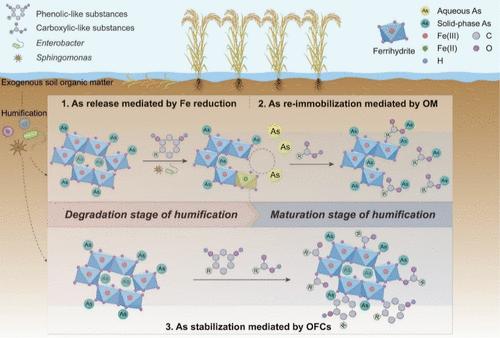
Humification of exogenous soil organic matter (ESOM) remodels the organic compositions and microbial communities of soil, thus exerting potential impacts on the biogeochemical transformation of iron (hydr)oxides and associated trace metals. Here, we conducted a 70-day incubation experiment to investigate how aerobic straw humification influenced the repartitioning of arsenic (As) associated with ferrihydrite in paddy soil. Results showed that the humification was characterized by rapid OM degradation (1–14 days) and subsequent slow maturation (14–70 days). During the degradation stage, considerable As (13.1 mg·L–1) was released into the aqueous phase, which was reimmobilized to the solid phase in the maturation stage. Meanwhile, the low-crystalline structural As/Fe was converted to a more stable species, with a subtle crystalline phase transformation. The generated highly unsaturated and phenolic compounds and enriched Enterobacter and Sphingomonas induced ferrihydrite (∼3.1%) and As(V) reduction, leading to As release during the degradation stage. In the maturation stage, carboxylic-rich alicyclic molecules facilitated the aqueous As reimmobilization. Throughout the humification process, organo-mineral complexes formed between OM and ferrihydrite via C–O–Fe bond contributed to the solid-phase As/Fe stabilization. Collectively, this work highlighted the ESOM humification-driven iron (hydr)oxide transformation and associated As redistribution, advancing our understanding of the coupled biogeochemical behaviors of C, Fe, and As in soil.
期刊介绍:
Environmental Science & Technology (ES&T) is a co-sponsored academic and technical magazine by the Hubei Provincial Environmental Protection Bureau and the Hubei Provincial Academy of Environmental Sciences.
Environmental Science & Technology (ES&T) holds the status of Chinese core journals, scientific papers source journals of China, Chinese Science Citation Database source journals, and Chinese Academic Journal Comprehensive Evaluation Database source journals. This publication focuses on the academic field of environmental protection, featuring articles related to environmental protection and technical advancements.



 京公网安备 11010802042870号
京ICP备2023020795号-1
京公网安备 11010802042870号
京ICP备2023020795号-1

 分享
分享
 求助内容:
求助内容: 应助结果提醒方式:
 扫码关注我们
