Sathish K. R. Padi, Rachel J. Godek, Wolfgang Peti, Rebecca Page
{"title":"Cryo-EM structures of PP2A:B55 with p107 and Eya3 define substrate recruitment","authors":"Sathish K. R. Padi, Rachel J. Godek, Wolfgang Peti, Rebecca Page","doi":"10.1038/s41594-025-01535-3","DOIUrl":null,"url":null,"abstract":"Phosphoprotein phosphatases (PPPs) achieve specificity by binding substrates and regulators using PPP-specific short motifs. Protein phosphatase 2A (PP2A) is a highly conserved phosphatase that regulates cell signaling and is a tumor suppressor. Here, we use cryo-electron microscopy and nuclear magnetic resonance (NMR) spectroscopy to investigate the mechanisms of human p107 substrate and Eya3 regulator recruitment to the PP2A:B55 holoenzyme. We show that, while they associate with B55 using a common set of interaction pockets, the mechanism of substrate and regulator binding differs and is distinct from that observed for PP2A:B56 and other PPPs. We also identify the core B55 recruitment motif in Eya3 proteins, a sequence conserved amongst the Eya family. Lastly, using NMR-based dephosphorylation assays, we demonstrate how B55 recruitment directs PP2A:B55 fidelity through the selective dephosphorylation of specific phosphosites. As PP2A:B55 orchestrates mitosis and DNA damage repair, these data provide a roadmap for pursuing new avenues to therapeutically target this complex by individually blocking a subset of regulators that use different B55 interaction sites. Padi and Godek et al. solve cryo-electron microscopy structures of protein phosphatase 2A (PP2A):B55 bound to p107 and Eya3, which, together with nuclear magnetic resonance dephosphorylation experiments, show how PP2A:B55 recruits specific substrates and how it achieves efficient dephosphorylation of phosphosites with high cellular fidelity.","PeriodicalId":49141,"journal":{"name":"Nature Structural & Molecular Biology","volume":"32 8","pages":"1373-1382"},"PeriodicalIF":10.1000,"publicationDate":"2025-04-17","publicationTypes":"Journal Article","fieldsOfStudy":null,"isOpenAccess":false,"openAccessPdf":"https://www.nature.comhttps://www.nature.com/articles/s41594-025-01535-3.pdf","citationCount":"0","resultStr":null,"platform":"Semanticscholar","paperid":null,"PeriodicalName":"Nature Structural & Molecular Biology","FirstCategoryId":"99","ListUrlMain":"https://www.nature.com/articles/s41594-025-01535-3","RegionNum":1,"RegionCategory":"生物学","ArticlePicture":[],"TitleCN":null,"AbstractTextCN":null,"PMCID":null,"EPubDate":"","PubModel":"","JCR":"Q1","JCRName":"BIOCHEMISTRY & MOLECULAR BIOLOGY","Score":null,"Total":0}
引用次数: 0
Abstract
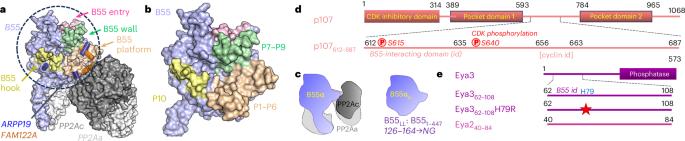
Phosphoprotein phosphatases (PPPs) achieve specificity by binding substrates and regulators using PPP-specific short motifs. Protein phosphatase 2A (PP2A) is a highly conserved phosphatase that regulates cell signaling and is a tumor suppressor. Here, we use cryo-electron microscopy and nuclear magnetic resonance (NMR) spectroscopy to investigate the mechanisms of human p107 substrate and Eya3 regulator recruitment to the PP2A:B55 holoenzyme. We show that, while they associate with B55 using a common set of interaction pockets, the mechanism of substrate and regulator binding differs and is distinct from that observed for PP2A:B56 and other PPPs. We also identify the core B55 recruitment motif in Eya3 proteins, a sequence conserved amongst the Eya family. Lastly, using NMR-based dephosphorylation assays, we demonstrate how B55 recruitment directs PP2A:B55 fidelity through the selective dephosphorylation of specific phosphosites. As PP2A:B55 orchestrates mitosis and DNA damage repair, these data provide a roadmap for pursuing new avenues to therapeutically target this complex by individually blocking a subset of regulators that use different B55 interaction sites. Padi and Godek et al. solve cryo-electron microscopy structures of protein phosphatase 2A (PP2A):B55 bound to p107 and Eya3, which, together with nuclear magnetic resonance dephosphorylation experiments, show how PP2A:B55 recruits specific substrates and how it achieves efficient dephosphorylation of phosphosites with high cellular fidelity.
期刊介绍:
Nature Structural & Molecular Biology is a comprehensive platform that combines structural and molecular research. Our journal focuses on exploring the functional and mechanistic aspects of biological processes, emphasizing how molecular components collaborate to achieve a particular function. While structural data can shed light on these insights, our publication does not require them as a prerequisite.




 京公网安备 11010802042870号
京ICP备2023020795号-1
京公网安备 11010802042870号
京ICP备2023020795号-1

 分享
分享
 求助内容:
求助内容: 应助结果提醒方式:
 扫码关注我们
