Sex-and stage-specific effect of prenatal exposure to organophosphate esters with children's physical growth patterns and adiposity rebound timing: Modification by breastfeeding
Xing Wang , Juan Tong , Han Li , Mengjuan Lu , Yuan Liu , Hong Gan , Yifan Wang , Menglong Geng , Xuejiao Qie , Xiulong Wu , Hui Gao , Beibei Zhu , Shuman Tao , Xingyong Tao , Shuangqin Yan , Guopeng Gao , Xiaoyan Wu , Kun Huang , Yunxia Cao , Fangbiao Tao
{"title":"Sex-and stage-specific effect of prenatal exposure to organophosphate esters with children's physical growth patterns and adiposity rebound timing: Modification by breastfeeding","authors":"Xing Wang , Juan Tong , Han Li , Mengjuan Lu , Yuan Liu , Hong Gan , Yifan Wang , Menglong Geng , Xuejiao Qie , Xiulong Wu , Hui Gao , Beibei Zhu , Shuman Tao , Xingyong Tao , Shuangqin Yan , Guopeng Gao , Xiaoyan Wu , Kun Huang , Yunxia Cao , Fangbiao Tao","doi":"10.1016/j.jhazmat.2025.138309","DOIUrl":null,"url":null,"abstract":"<div><h3>Introduction</h3><div>Exploring the stage-specific effects of prenatal exposure to organophosphate esters (OPEs) on offspring growth and developmental trajectories is critical for early-life health management.</div></div><div><h3>Methods</h3><div>Based on 2519 mother-child dyads from the Ma'anshan Birth Cohort, we examined the concentrations of OPEs in maternal urine during the three trimesters. Seventeen follow-up visits were made to the children, and physical data were collected. A grouped trajectory model was used to fit the growth trajectories.</div></div><div><h3>Results</h3><div>First-trimester bis(2-butoxyethyl) phosphate (BBOEP) was inversely associated with the children's adiposity rebound (AR) timing (<em>β</em> = −0.33, 95 % <em>CI</em>: −0.65, −0.01), and the <em>ORs</em> (95 % <em>CIs</em>) for early age at AR for each doubling of BBOEP and dibutyl phosphate (DBP) were 1.07 (1.00, 1.14) and 1.12 (1.03, 1.22), respectively. BBOEP increased the risk of a high-stable BMI-for-age z score (BMIz) group (<em>OR</em> = 1.18, 95 % <em>CI</em>: 1.01, 1.39), whereas tris(2-chloroethyl) phosphate (TCEP) and bis(2-ethylhexyl) phosphate reduced this risk. Diphenyl phosphate (<em>OR</em> = 0.74, 95 % <em>CI</em>: 0.59, 0.94) and aromatic OPEs (<em>OR</em> = 0.70, 95 % <em>CI</em>: 0.54, 0.90) reduced the odds of an extreme-high body fat group. TCEP also reduced the risk of a high body fat percentage group (<em>p</em> < 0.05). There appeared to be sex and ester bond differences in these associations, and breastfeeding could counteract the association between the OPEs and growth trajectories. No mixed effects of OPEs on BMIz trajectories were found.</div></div><div><h3>Conclusions</h3><div>The present study identified a heterogeneous association between OPE exposure during pregnancy and AR timing and physical growth patterns in offspring. Future studies are needed involving more regions and populations, with consideration of other developmentally toxic compounds, to obtain more reliable and comprehensive results.</div></div>","PeriodicalId":361,"journal":{"name":"Journal of Hazardous Materials","volume":"493 ","pages":"Article 138309"},"PeriodicalIF":11.3000,"publicationDate":"2025-08-05","publicationTypes":"Journal Article","fieldsOfStudy":null,"isOpenAccess":false,"openAccessPdf":"","citationCount":"0","resultStr":null,"platform":"Semanticscholar","paperid":null,"PeriodicalName":"Journal of Hazardous Materials","FirstCategoryId":"93","ListUrlMain":"https://www.sciencedirect.com/science/article/pii/S0304389425012245","RegionNum":1,"RegionCategory":"环境科学与生态学","ArticlePicture":[],"TitleCN":null,"AbstractTextCN":null,"PMCID":null,"EPubDate":"2025/4/17 0:00:00","PubModel":"Epub","JCR":"Q1","JCRName":"ENGINEERING, ENVIRONMENTAL","Score":null,"Total":0}
引用次数: 0
Abstract
Introduction
Exploring the stage-specific effects of prenatal exposure to organophosphate esters (OPEs) on offspring growth and developmental trajectories is critical for early-life health management.
Methods
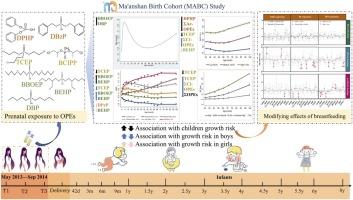
Based on 2519 mother-child dyads from the Ma'anshan Birth Cohort, we examined the concentrations of OPEs in maternal urine during the three trimesters. Seventeen follow-up visits were made to the children, and physical data were collected. A grouped trajectory model was used to fit the growth trajectories.
Results
First-trimester bis(2-butoxyethyl) phosphate (BBOEP) was inversely associated with the children's adiposity rebound (AR) timing (β = −0.33, 95 % CI: −0.65, −0.01), and the ORs (95 % CIs) for early age at AR for each doubling of BBOEP and dibutyl phosphate (DBP) were 1.07 (1.00, 1.14) and 1.12 (1.03, 1.22), respectively. BBOEP increased the risk of a high-stable BMI-for-age z score (BMIz) group (OR = 1.18, 95 % CI: 1.01, 1.39), whereas tris(2-chloroethyl) phosphate (TCEP) and bis(2-ethylhexyl) phosphate reduced this risk. Diphenyl phosphate (OR = 0.74, 95 % CI: 0.59, 0.94) and aromatic OPEs (OR = 0.70, 95 % CI: 0.54, 0.90) reduced the odds of an extreme-high body fat group. TCEP also reduced the risk of a high body fat percentage group (p < 0.05). There appeared to be sex and ester bond differences in these associations, and breastfeeding could counteract the association between the OPEs and growth trajectories. No mixed effects of OPEs on BMIz trajectories were found.
Conclusions
The present study identified a heterogeneous association between OPE exposure during pregnancy and AR timing and physical growth patterns in offspring. Future studies are needed involving more regions and populations, with consideration of other developmentally toxic compounds, to obtain more reliable and comprehensive results.
期刊介绍:
The Journal of Hazardous Materials serves as a global platform for promoting cutting-edge research in the field of Environmental Science and Engineering. Our publication features a wide range of articles, including full-length research papers, review articles, and perspectives, with the aim of enhancing our understanding of the dangers and risks associated with various materials concerning public health and the environment. It is important to note that the term "environmental contaminants" refers specifically to substances that pose hazardous effects through contamination, while excluding those that do not have such impacts on the environment or human health. Moreover, we emphasize the distinction between wastes and hazardous materials in order to provide further clarity on the scope of the journal. We have a keen interest in exploring specific compounds and microbial agents that have adverse effects on the environment.



 京公网安备 11010802042870号
京ICP备2023020795号-1
京公网安备 11010802042870号
京ICP备2023020795号-1

 分享
分享
 求助内容:
求助内容: 应助结果提醒方式:
 扫码关注我们
