Julio Fernández-Arribas, Teresa Moreno, Ethel Eljarrat
{"title":"Plastic additives in the diet: Occurrence and dietary exposure in different population groups","authors":"Julio Fernández-Arribas, Teresa Moreno, Ethel Eljarrat","doi":"10.1016/j.jhazmat.2025.138317","DOIUrl":null,"url":null,"abstract":"<div><div>A total diet study focused on exposure to plastic additives has been performed on 109 food samples. Plasticizers were detected in 85 % of analyzed samples with total concentrations ranging between not detected (nd) and 22.0 µg/g wet weight (ww). Non-phthalate plasticizers (NPPs), such as acetyl tributyl citrate (ATBC) or di(2-ethylhexyl) adipate (DEHA), were detected predominantly in baby foods (nd-3.38 µg/g ww) and meat (nd-15.0 µg/g ww), respectively. Significant differences (p ≤ 0.001) were observed across foods with different packaging types regarding the presence of ATBC and DEHA. ATBC was primarily detected in foods packaged in glass containers, meanwhile DEHA is mainly related to fresh food wrapped in plastic materials. Additionally, transference assays in selected ready to cook meals and fresh vegetables were performed, with NPPs exhibiting a higher transference from packaging to food than other compounds. The data obtained have been used for an assessment of estimated daily intake (EDI) of plastic additives in infants (6–12 months), toddlers (1–3 years), and adults (>18 years), resulting in values ranging 0.29–516 µg/kg body weight (bw)/day. Human risk related to baby food consumption, expressed as hazard quotients (HQs), was found with di(2-ethylhexyl) phthalate (DEHP) in the infant population sub-group.</div></div>","PeriodicalId":361,"journal":{"name":"Journal of Hazardous Materials","volume":"493 ","pages":"Article 138317"},"PeriodicalIF":11.3000,"publicationDate":"2025-08-05","publicationTypes":"Journal Article","fieldsOfStudy":null,"isOpenAccess":false,"openAccessPdf":"","citationCount":"0","resultStr":null,"platform":"Semanticscholar","paperid":null,"PeriodicalName":"Journal of Hazardous Materials","FirstCategoryId":"93","ListUrlMain":"https://www.sciencedirect.com/science/article/pii/S0304389425012324","RegionNum":1,"RegionCategory":"环境科学与生态学","ArticlePicture":[],"TitleCN":null,"AbstractTextCN":null,"PMCID":null,"EPubDate":"2025/4/17 0:00:00","PubModel":"Epub","JCR":"Q1","JCRName":"ENGINEERING, ENVIRONMENTAL","Score":null,"Total":0}
引用次数: 0
Abstract
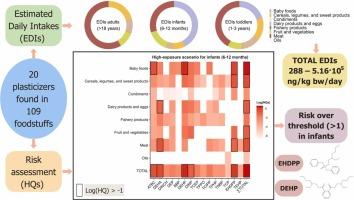
A total diet study focused on exposure to plastic additives has been performed on 109 food samples. Plasticizers were detected in 85 % of analyzed samples with total concentrations ranging between not detected (nd) and 22.0 µg/g wet weight (ww). Non-phthalate plasticizers (NPPs), such as acetyl tributyl citrate (ATBC) or di(2-ethylhexyl) adipate (DEHA), were detected predominantly in baby foods (nd-3.38 µg/g ww) and meat (nd-15.0 µg/g ww), respectively. Significant differences (p ≤ 0.001) were observed across foods with different packaging types regarding the presence of ATBC and DEHA. ATBC was primarily detected in foods packaged in glass containers, meanwhile DEHA is mainly related to fresh food wrapped in plastic materials. Additionally, transference assays in selected ready to cook meals and fresh vegetables were performed, with NPPs exhibiting a higher transference from packaging to food than other compounds. The data obtained have been used for an assessment of estimated daily intake (EDI) of plastic additives in infants (6–12 months), toddlers (1–3 years), and adults (>18 years), resulting in values ranging 0.29–516 µg/kg body weight (bw)/day. Human risk related to baby food consumption, expressed as hazard quotients (HQs), was found with di(2-ethylhexyl) phthalate (DEHP) in the infant population sub-group.
期刊介绍:
The Journal of Hazardous Materials serves as a global platform for promoting cutting-edge research in the field of Environmental Science and Engineering. Our publication features a wide range of articles, including full-length research papers, review articles, and perspectives, with the aim of enhancing our understanding of the dangers and risks associated with various materials concerning public health and the environment. It is important to note that the term "environmental contaminants" refers specifically to substances that pose hazardous effects through contamination, while excluding those that do not have such impacts on the environment or human health. Moreover, we emphasize the distinction between wastes and hazardous materials in order to provide further clarity on the scope of the journal. We have a keen interest in exploring specific compounds and microbial agents that have adverse effects on the environment.



 京公网安备 11010802042870号
京ICP备2023020795号-1
京公网安备 11010802042870号
京ICP备2023020795号-1

 分享
分享
 求助内容:
求助内容: 应助结果提醒方式:
 扫码关注我们
