Yating Lu , Fuqing He , Xu Zhu , Jing Tang , Yue Lu , Jiajia Wang , Jiangfang Yu , Li Chen , Xingyang Cheng , Tianhao Liu , Lin Tang
{"title":"On-site tracking of trace Aflatoxin B1 in food waste composting via a portable colorimetric sensing platform with nanozymes","authors":"Yating Lu , Fuqing He , Xu Zhu , Jing Tang , Yue Lu , Jiajia Wang , Jiangfang Yu , Li Chen , Xingyang Cheng , Tianhao Liu , Lin Tang","doi":"10.1016/j.jhazmat.2025.138333","DOIUrl":null,"url":null,"abstract":"<div><div>Rapid, on-site accurate tracking of harmful mycotoxin in food waste composting is essential to provide instant content information for efficient supervision. However, on-site analytical tools especially colorimetric sensors currently suffer from low sensitivity/selectivity and poor environment robustness, posing hurdles for their applications. In this work, we have proposed a portable paper-based colorimetric sensor to detect the representative mycotoxin (aflatoxin B1, AFB1) in the composting process, where the superior catalytic velocity (6-fold higher than the natural enzyme) and well-regulated catalytic activity of nanozyme by the aptamers ensure the high sensitivity (a wide linear range: 0.1–1000 ng/mL; an ultra-low limit of detection: 0.082 ng/mL) and good selectivity of the colorimetric sensing, respectively. The smartphone-based platform exhibits high accuracy with the relative standard deviation within 3.67 % compared commercial enzyme-linked immunosorbent assay. Finally, on-site tracking of the AFB1 content in food waste during the composting process with or without the oxidant (potassium persulfate) has been carried out using the developed colorimetric sensor. It is concluded that reducing the AFB1 generation in the food waste is more meaningful than the compost treatment. This study offers a promising method for in situ analysis of trace AFB1 in food waste compost to ensure environmental and human health safety.</div></div>","PeriodicalId":361,"journal":{"name":"Journal of Hazardous Materials","volume":"493 ","pages":"Article 138333"},"PeriodicalIF":11.3000,"publicationDate":"2025-08-05","publicationTypes":"Journal Article","fieldsOfStudy":null,"isOpenAccess":false,"openAccessPdf":"","citationCount":"0","resultStr":null,"platform":"Semanticscholar","paperid":null,"PeriodicalName":"Journal of Hazardous Materials","FirstCategoryId":"93","ListUrlMain":"https://www.sciencedirect.com/science/article/pii/S0304389425012488","RegionNum":1,"RegionCategory":"环境科学与生态学","ArticlePicture":[],"TitleCN":null,"AbstractTextCN":null,"PMCID":null,"EPubDate":"2025/4/17 0:00:00","PubModel":"Epub","JCR":"Q1","JCRName":"ENGINEERING, ENVIRONMENTAL","Score":null,"Total":0}
引用次数: 0
Abstract
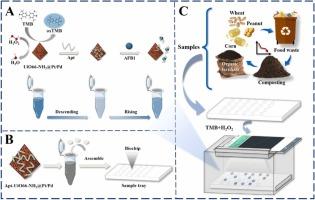
Rapid, on-site accurate tracking of harmful mycotoxin in food waste composting is essential to provide instant content information for efficient supervision. However, on-site analytical tools especially colorimetric sensors currently suffer from low sensitivity/selectivity and poor environment robustness, posing hurdles for their applications. In this work, we have proposed a portable paper-based colorimetric sensor to detect the representative mycotoxin (aflatoxin B1, AFB1) in the composting process, where the superior catalytic velocity (6-fold higher than the natural enzyme) and well-regulated catalytic activity of nanozyme by the aptamers ensure the high sensitivity (a wide linear range: 0.1–1000 ng/mL; an ultra-low limit of detection: 0.082 ng/mL) and good selectivity of the colorimetric sensing, respectively. The smartphone-based platform exhibits high accuracy with the relative standard deviation within 3.67 % compared commercial enzyme-linked immunosorbent assay. Finally, on-site tracking of the AFB1 content in food waste during the composting process with or without the oxidant (potassium persulfate) has been carried out using the developed colorimetric sensor. It is concluded that reducing the AFB1 generation in the food waste is more meaningful than the compost treatment. This study offers a promising method for in situ analysis of trace AFB1 in food waste compost to ensure environmental and human health safety.
期刊介绍:
The Journal of Hazardous Materials serves as a global platform for promoting cutting-edge research in the field of Environmental Science and Engineering. Our publication features a wide range of articles, including full-length research papers, review articles, and perspectives, with the aim of enhancing our understanding of the dangers and risks associated with various materials concerning public health and the environment. It is important to note that the term "environmental contaminants" refers specifically to substances that pose hazardous effects through contamination, while excluding those that do not have such impacts on the environment or human health. Moreover, we emphasize the distinction between wastes and hazardous materials in order to provide further clarity on the scope of the journal. We have a keen interest in exploring specific compounds and microbial agents that have adverse effects on the environment.



 京公网安备 11010802042870号
京ICP备2023020795号-1
京公网安备 11010802042870号
京ICP备2023020795号-1

 分享
分享
 求助内容:
求助内容: 应助结果提醒方式:
 扫码关注我们
