Karen Valencia G., Agileo Hernández-Gordillo, Lorena Cerezo and Sandra E. Rodil
{"title":"Blue-light hydrogen production via CdS/g-C3N4 heterojunctions†","authors":"Karen Valencia G., Agileo Hernández-Gordillo, Lorena Cerezo and Sandra E. Rodil","doi":"10.1039/D5DT00187K","DOIUrl":null,"url":null,"abstract":"<p >This study introduced advanced photocatalytic heterojunctions by integrating CdS nanofibers with defect-rich polymeric carbon nitride (g-C<small><sub>3</sub></small>N<small><sub>4</sub></small>-V<small><sub>0</sub></small>). Two g-C<small><sub>3</sub></small>N<small><sub>4</sub></small>-V<small><sub>0</sub></small> variants (<strong>CN1</strong> and <strong>CN2</strong>) with varying nitrogen vacancy concentrations were synthesized, which enhanced visible and near-infrared light absorption. Eight heterojunctions with different <strong>CN1</strong> and <strong>CN2</strong> contents (5–20 wt%) were prepared and tested for the hydrogen evolution reaction (HER) in ethanol–water solutions without a Pt co-catalyst. Under optimized conditions (photocatalyst mass: 0.0125 g L<small><sup>−1</sup></small>, light intensity: 10 mW cm<small><sup>−2</sup></small>), the <strong>CS/CN1-15</strong> and <strong>CS/CN2-10</strong> heterojunctions achieved HER rate of 4.43 and 5.25 mmol h<small><sup>−1</sup></small> g<small><sup>−1</sup></small>, respectively—doubling the efficiency of comparable systems. Their superior performance was attributed to enhanced light absorption, efficient charge separation, and reduced charge transfer resistance. The <strong>CS/CN2-10</strong> heterojunction also demonstrated long-term stability, emphasizing its promise for sustainable hydrogen production.</p>","PeriodicalId":71,"journal":{"name":"Dalton Transactions","volume":" 21","pages":" 8483-8497"},"PeriodicalIF":3.3000,"publicationDate":"2025-04-17","publicationTypes":"Journal Article","fieldsOfStudy":null,"isOpenAccess":false,"openAccessPdf":"","citationCount":"0","resultStr":null,"platform":"Semanticscholar","paperid":null,"PeriodicalName":"Dalton Transactions","FirstCategoryId":"92","ListUrlMain":"https://pubs.rsc.org/en/content/articlelanding/2025/dt/d5dt00187k","RegionNum":3,"RegionCategory":"化学","ArticlePicture":[],"TitleCN":null,"AbstractTextCN":null,"PMCID":null,"EPubDate":"","PubModel":"","JCR":"Q2","JCRName":"CHEMISTRY, INORGANIC & NUCLEAR","Score":null,"Total":0}
引用次数: 0
Abstract
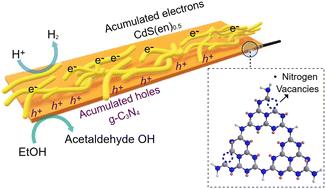
This study introduced advanced photocatalytic heterojunctions by integrating CdS nanofibers with defect-rich polymeric carbon nitride (g-C3N4-V0). Two g-C3N4-V0 variants (CN1 and CN2) with varying nitrogen vacancy concentrations were synthesized, which enhanced visible and near-infrared light absorption. Eight heterojunctions with different CN1 and CN2 contents (5–20 wt%) were prepared and tested for the hydrogen evolution reaction (HER) in ethanol–water solutions without a Pt co-catalyst. Under optimized conditions (photocatalyst mass: 0.0125 g L−1, light intensity: 10 mW cm−2), the CS/CN1-15 and CS/CN2-10 heterojunctions achieved HER rate of 4.43 and 5.25 mmol h−1 g−1, respectively—doubling the efficiency of comparable systems. Their superior performance was attributed to enhanced light absorption, efficient charge separation, and reduced charge transfer resistance. The CS/CN2-10 heterojunction also demonstrated long-term stability, emphasizing its promise for sustainable hydrogen production.
期刊介绍:
Dalton Transactions is a journal for all areas of inorganic chemistry, which encompasses the organometallic, bioinorganic and materials chemistry of the elements, with applications including synthesis, catalysis, energy conversion/storage, electrical devices and medicine. Dalton Transactions welcomes high-quality, original submissions in all of these areas and more, where the advancement of knowledge in inorganic chemistry is significant.



 京公网安备 11010802042870号
京ICP备2023020795号-1
京公网安备 11010802042870号
京ICP备2023020795号-1

 分享
分享
 求助内容:
求助内容: 应助结果提醒方式:
 扫码关注我们
