{"title":"Single-component white-light-emitting materials based on lanthanide coordination assemblies","authors":"M. L. P. Reddy and K. S. Bejoymohandas","doi":"10.1039/D5DT00172B","DOIUrl":null,"url":null,"abstract":"<p >White light-emitting materials (WLEMs) offer significant advantages over traditional incandescent light bulbs and compact fluorescent lamps due to their ability to provide pure white-light emission, low energy consumption, and suitability for large-area thin-film fabrication. White light can be obtained using several types of materials involving lanthanide ions and their combinations, but single component emitters based on lanthanide coordination assemblies remain rare and desirable for thinner devices that are, therefore, easier to control and that require fewer manufacturing steps. Over the past decade, single-component lanthanide coordination assemblies have garnered considerable attention as white-light-emitting photoluminescent materials, leading to notable advancements. The current review provides an overview of recent progress in this field, emphasizing WLEMs and photoluminescent colour-tuning properties realized in single-component lanthanide coordination assemblies (Sm<small><sup>3+</sup></small>, Eu<small><sup>3+</sup></small> or Dy<small><sup>3+</sup></small>), which covers the origin, generation, and manipulation of different types of photoluminescence derived from ligand-centered fluorescence in the blue range and metal centered emissions in the visible region.</p>","PeriodicalId":71,"journal":{"name":"Dalton Transactions","volume":" 24","pages":" 9441-9452"},"PeriodicalIF":3.3000,"publicationDate":"2025-04-17","publicationTypes":"Journal Article","fieldsOfStudy":null,"isOpenAccess":false,"openAccessPdf":"","citationCount":"0","resultStr":null,"platform":"Semanticscholar","paperid":null,"PeriodicalName":"Dalton Transactions","FirstCategoryId":"92","ListUrlMain":"https://pubs.rsc.org/en/content/articlelanding/2025/dt/d5dt00172b","RegionNum":3,"RegionCategory":"化学","ArticlePicture":[],"TitleCN":null,"AbstractTextCN":null,"PMCID":null,"EPubDate":"","PubModel":"","JCR":"Q2","JCRName":"CHEMISTRY, INORGANIC & NUCLEAR","Score":null,"Total":0}
引用次数: 0
Abstract
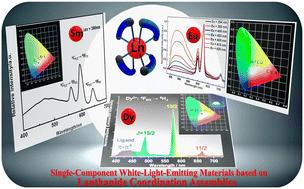
White light-emitting materials (WLEMs) offer significant advantages over traditional incandescent light bulbs and compact fluorescent lamps due to their ability to provide pure white-light emission, low energy consumption, and suitability for large-area thin-film fabrication. White light can be obtained using several types of materials involving lanthanide ions and their combinations, but single component emitters based on lanthanide coordination assemblies remain rare and desirable for thinner devices that are, therefore, easier to control and that require fewer manufacturing steps. Over the past decade, single-component lanthanide coordination assemblies have garnered considerable attention as white-light-emitting photoluminescent materials, leading to notable advancements. The current review provides an overview of recent progress in this field, emphasizing WLEMs and photoluminescent colour-tuning properties realized in single-component lanthanide coordination assemblies (Sm3+, Eu3+ or Dy3+), which covers the origin, generation, and manipulation of different types of photoluminescence derived from ligand-centered fluorescence in the blue range and metal centered emissions in the visible region.
期刊介绍:
Dalton Transactions is a journal for all areas of inorganic chemistry, which encompasses the organometallic, bioinorganic and materials chemistry of the elements, with applications including synthesis, catalysis, energy conversion/storage, electrical devices and medicine. Dalton Transactions welcomes high-quality, original submissions in all of these areas and more, where the advancement of knowledge in inorganic chemistry is significant.



 京公网安备 11010802042870号
京ICP备2023020795号-1
京公网安备 11010802042870号
京ICP备2023020795号-1

 分享
分享
 求助内容:
求助内容: 应助结果提醒方式:
 扫码关注我们
