Marco F. Gatto, Sara Sangtarash, David Jago, R. Tom Abram, Eleanor Barrett, Amit Sil, George A. Koutsantonis, Simon J. Higgins, Craig M. Robertson, Richard J. Nichols, Hatef Sadeghi and Andrea Vezzoli
{"title":"Metal ion independent conductance through bis-chelated metal complex molecular wires based on a bis(diphenylphosphino)aniline derivative†","authors":"Marco F. Gatto, Sara Sangtarash, David Jago, R. Tom Abram, Eleanor Barrett, Amit Sil, George A. Koutsantonis, Simon J. Higgins, Craig M. Robertson, Richard J. Nichols, Hatef Sadeghi and Andrea Vezzoli","doi":"10.1039/D5DT00292C","DOIUrl":null,"url":null,"abstract":"<p >It is becoming increasingly evident that transition metal complexes impart desirable qualities in single-molecule electronics, and testing metallic centres in combination with appropriate ligands is salient to building the next generation of single-molecule devices. Metal-phosphine complexes have been the subject of very few studies, despite their extensive use in other areas of chemistry. In this contribution, we fabricated and studied robust single-molecule junctions using linear bis-chelated ligand–metal–ligand complexes of the type [M(PNP)<small><sub>2</sub></small>]PF<small><sub>6</sub></small> (M = Cu(<small>I</small>), Ag(<small>I</small>) or Au(<small>I</small>); PNP = bis(diphenylphosphino)aniline functionalised with methylthio contact groups). The robustness of the devices was evinced by surface-enhanced Raman spectroscopy (SERS) and scanning-tunnelling microscopy break junction (STM-BJ) methods, and the conductance of the devices was found to be independent of the central transition metal. Quantum transport calculations show consistent HOMO–LUMO gaps between the studied complexes in the transmission plots, supporting the experimental findings. This study shows that bis-chelation is a viable approach to the fabrication of stable and robust metal-phosphine devices.</p>","PeriodicalId":71,"journal":{"name":"Dalton Transactions","volume":" 19","pages":" 7874-7881"},"PeriodicalIF":3.3000,"publicationDate":"2025-04-16","publicationTypes":"Journal Article","fieldsOfStudy":null,"isOpenAccess":false,"openAccessPdf":"https://pubs.rsc.org/en/content/articlepdf/2025/dt/d5dt00292c?page=search","citationCount":"0","resultStr":null,"platform":"Semanticscholar","paperid":null,"PeriodicalName":"Dalton Transactions","FirstCategoryId":"92","ListUrlMain":"https://pubs.rsc.org/en/content/articlelanding/2025/dt/d5dt00292c","RegionNum":3,"RegionCategory":"化学","ArticlePicture":[],"TitleCN":null,"AbstractTextCN":null,"PMCID":null,"EPubDate":"","PubModel":"","JCR":"Q2","JCRName":"CHEMISTRY, INORGANIC & NUCLEAR","Score":null,"Total":0}
引用次数: 0
Abstract
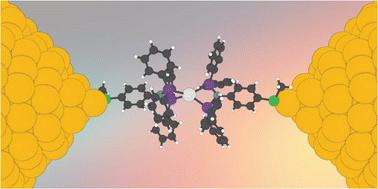
It is becoming increasingly evident that transition metal complexes impart desirable qualities in single-molecule electronics, and testing metallic centres in combination with appropriate ligands is salient to building the next generation of single-molecule devices. Metal-phosphine complexes have been the subject of very few studies, despite their extensive use in other areas of chemistry. In this contribution, we fabricated and studied robust single-molecule junctions using linear bis-chelated ligand–metal–ligand complexes of the type [M(PNP)2]PF6 (M = Cu(I), Ag(I) or Au(I); PNP = bis(diphenylphosphino)aniline functionalised with methylthio contact groups). The robustness of the devices was evinced by surface-enhanced Raman spectroscopy (SERS) and scanning-tunnelling microscopy break junction (STM-BJ) methods, and the conductance of the devices was found to be independent of the central transition metal. Quantum transport calculations show consistent HOMO–LUMO gaps between the studied complexes in the transmission plots, supporting the experimental findings. This study shows that bis-chelation is a viable approach to the fabrication of stable and robust metal-phosphine devices.
期刊介绍:
Dalton Transactions is a journal for all areas of inorganic chemistry, which encompasses the organometallic, bioinorganic and materials chemistry of the elements, with applications including synthesis, catalysis, energy conversion/storage, electrical devices and medicine. Dalton Transactions welcomes high-quality, original submissions in all of these areas and more, where the advancement of knowledge in inorganic chemistry is significant.



 京公网安备 11010802042870号
京ICP备2023020795号-1
京公网安备 11010802042870号
京ICP备2023020795号-1

 分享
分享
 求助内容:
求助内容: 应助结果提醒方式:
 扫码关注我们
