{"title":"Going bananas: how transgene-free editing is contributing to a fruitful future","authors":"Lennart Hoengenaert, Chantal Anders, Wout Boerjan","doi":"10.1111/nph.70150","DOIUrl":null,"url":null,"abstract":"<p>A key advantage of the transient expression strategy is its broad applicability, provided the target species is susceptible to <i>Agrobacterium tumefaciens</i> infection (Fig. 1). Beyond its utility for sterile crops like banana, this approach is also useful for perennial and vegetatively propagated species. Many elite tree varieties, for instance, are clonally propagated. Given most tree species are outbreeding and highly heterozygous, eliminating the T-DNA through crossing would disrupt their elite genetic constitution.</p><p>While the study by Van den Broeck <i>et al</i>. demonstrates a promising method for transgene-free gene editing in banana, there are several areas for potential improvement. First, enhancing the efficiency of multiplex gene editing is crucial, especially for complex traits that require the simultaneous editing of multiple genes to enhance the trait. High-throughput platforms, such as Iterative Testing of Editing Reagents (ITER), have been developed to enable the simultaneous testing of multiple reagents from the gene-editing toolbox in a multi-well setup, allowing the systematic improvement of editing configurations (Gaillochet <i>et al</i>., <span>2023</span>). In addition, the use of alternative promoters to drive guide RNA (gRNA) expression has been shown to significantly increase the gene-editing efficiency (Li <i>et al</i>., <span>2021</span>). For example, in poplar, using the <i>AtU3</i> promoter to drive gRNA expression resulted in consistently higher base-editing efficiencies compared to the <i>AtU6</i> promoter (Li <i>et al</i>., <span>2021</span>).</p><p>Second, further increasing the number of transgene-free genome-editing events remains a priority to optimize T-DNA-free gene-editing pipelines. In their study, Van den Broeck <i>et al</i>. report that 3.2% of their <i>ALS</i>-edited shoots were transgene-free. Recently, we developed a similar co-editing system using <i>ALS</i> genes in poplar. In our study, 49% of the <i>ALS-</i>edited shoots were transgene-free (Hoengenaert <i>et al</i>., <span>2025</span>). It is likely that the frequency of obtaining transgene-free <i>ALS</i>-edited lines, resulting from the transient expression of the cytosine base editor, correlates with the efficiency of the base editor. Less efficient base editors, such as APOBEC1 used by Van de Broeck <i>et al</i>., will naturally induce fewer C-to-T conversions during their transient expression window compared to more efficient ones. As a result, a lower percentage of transgene-free shoots will be recovered upon chlorsulfuron selection (Fig. 2). To help eliminate stable transformants, a marker gene can be incorporated in the T-DNA cassette. A study by Huang <i>et al</i>. (<span>2023</span>) demonstrated this principle by including a <i>GFP</i> reporter gene on the T-DNA cassette, enabling easy identification and elimination of stably transformed fluorescent shoots. Alternatively, adding the <i>RUBY</i> reporter gene, which encodes the synthesis of betalain, a bright red natural product, would allow visual differentiation between stable transformants and transgene-free lines by eye (He <i>et al</i>., <span>2020</span>). Furthermore, negative selection markers that convert a nontoxic compound into a toxic analog, such as <i>CodA</i>, could be implemented to select for shoots devoid of the T-DNA, as demonstrated in poplar (Hoengenaert <i>et al</i>., <span>2025</span>).</p><p>Third, improvements are needed to overcome the bottleneck of plant transformation and regeneration itself. Although <i>Agrobacterium</i>-mediated transformation, biolistics transformation, and protoplast transfection work for a handful of species, transforming and regenerating elite varieties often remains difficult. One approach could explore the use of alternative <i>Agrobacterium</i> strains and the use of ternary vector systems, which enhance bacterial virulence and thus promote the delivery of transgenes (Anand <i>et al</i>., <span>2018</span>). In addition, harnessing morphogenic regulators that promote regeneration might facilitate the genetic improvement of elite varieties (Lowe <i>et al</i>., <span>2016</span>; Shivani <i>et al</i>., <span>2017</span>). Recent genome-wide association studies in poplar have identified numerous genes associated with transformation and/or regeneration efficiency. Interestingly, only a few of these genes overlap with those currently known to enhance transformation in crops (Nagle <i>et al</i>., <span>2024a</span>,<span>b</span>).</p><p>The development of transgene-free gene-editing technologies can significantly accelerate the breeding of novel crop varieties and facilitate regulatory approval. It is essential that regulatory frameworks are grounded in scientific evidence, focusing on the safety and benefits of the final product rather than the methods used to create it. The recent European Council's negotiating mandate on regulating plants obtained through new genomic techniques (NGTs) marks a significant step toward accepting transgene-free gene-edited crops in Europe (Council of the European Union, <span>2025</span>). However, the current proposal excludes edits for herbicide tolerance, hence also when used solely for selection purposes, as in the methods described for banana by Van den Broeck <i>et al</i>., and for other important crops like potato, poplar and citrus (Veillet <i>et al</i>., <span>2019</span>; Huang <i>et al</i>., <span>2023</span>; Hoengenaert <i>et al</i>., <span>2025</span>). As a result, transgene-free crops developed through these elegant methods would still be subject to the legislation on genetically modified organisms, significantly limiting their market introduction. Adopting a science-based regulatory approach will ensure that innovative breeding techniques can be fully leveraged to address urgent agricultural and environmental challenges (Boerjan & Strauss, <span>2024</span>).</p><p>The New Phytologist Foundation remains neutral with regard to jurisdictional claims in maps and in any institutional affiliations.</p>","PeriodicalId":214,"journal":{"name":"New Phytologist","volume":"247 4","pages":"1557-1560"},"PeriodicalIF":8.1000,"publicationDate":"2025-04-16","publicationTypes":"Journal Article","fieldsOfStudy":null,"isOpenAccess":false,"openAccessPdf":"https://onlinelibrary.wiley.com/doi/epdf/10.1111/nph.70150","citationCount":"0","resultStr":null,"platform":"Semanticscholar","paperid":null,"PeriodicalName":"New Phytologist","FirstCategoryId":"99","ListUrlMain":"https://nph.onlinelibrary.wiley.com/doi/10.1111/nph.70150","RegionNum":1,"RegionCategory":"生物学","ArticlePicture":[],"TitleCN":null,"AbstractTextCN":null,"PMCID":null,"EPubDate":"","PubModel":"","JCR":"Q1","JCRName":"PLANT SCIENCES","Score":null,"Total":0}
引用次数: 0
Abstract
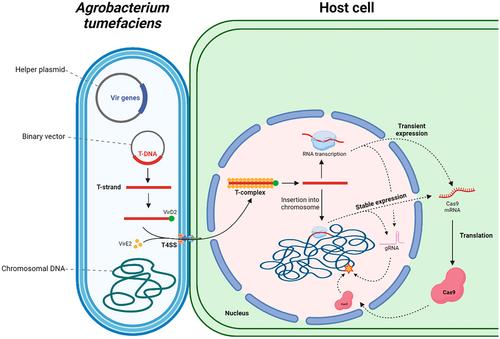
A key advantage of the transient expression strategy is its broad applicability, provided the target species is susceptible to Agrobacterium tumefaciens infection (Fig. 1). Beyond its utility for sterile crops like banana, this approach is also useful for perennial and vegetatively propagated species. Many elite tree varieties, for instance, are clonally propagated. Given most tree species are outbreeding and highly heterozygous, eliminating the T-DNA through crossing would disrupt their elite genetic constitution.
While the study by Van den Broeck et al. demonstrates a promising method for transgene-free gene editing in banana, there are several areas for potential improvement. First, enhancing the efficiency of multiplex gene editing is crucial, especially for complex traits that require the simultaneous editing of multiple genes to enhance the trait. High-throughput platforms, such as Iterative Testing of Editing Reagents (ITER), have been developed to enable the simultaneous testing of multiple reagents from the gene-editing toolbox in a multi-well setup, allowing the systematic improvement of editing configurations (Gaillochet et al., 2023). In addition, the use of alternative promoters to drive guide RNA (gRNA) expression has been shown to significantly increase the gene-editing efficiency (Li et al., 2021). For example, in poplar, using the AtU3 promoter to drive gRNA expression resulted in consistently higher base-editing efficiencies compared to the AtU6 promoter (Li et al., 2021).
Second, further increasing the number of transgene-free genome-editing events remains a priority to optimize T-DNA-free gene-editing pipelines. In their study, Van den Broeck et al. report that 3.2% of their ALS-edited shoots were transgene-free. Recently, we developed a similar co-editing system using ALS genes in poplar. In our study, 49% of the ALS-edited shoots were transgene-free (Hoengenaert et al., 2025). It is likely that the frequency of obtaining transgene-free ALS-edited lines, resulting from the transient expression of the cytosine base editor, correlates with the efficiency of the base editor. Less efficient base editors, such as APOBEC1 used by Van de Broeck et al., will naturally induce fewer C-to-T conversions during their transient expression window compared to more efficient ones. As a result, a lower percentage of transgene-free shoots will be recovered upon chlorsulfuron selection (Fig. 2). To help eliminate stable transformants, a marker gene can be incorporated in the T-DNA cassette. A study by Huang et al. (2023) demonstrated this principle by including a GFP reporter gene on the T-DNA cassette, enabling easy identification and elimination of stably transformed fluorescent shoots. Alternatively, adding the RUBY reporter gene, which encodes the synthesis of betalain, a bright red natural product, would allow visual differentiation between stable transformants and transgene-free lines by eye (He et al., 2020). Furthermore, negative selection markers that convert a nontoxic compound into a toxic analog, such as CodA, could be implemented to select for shoots devoid of the T-DNA, as demonstrated in poplar (Hoengenaert et al., 2025).
Third, improvements are needed to overcome the bottleneck of plant transformation and regeneration itself. Although Agrobacterium-mediated transformation, biolistics transformation, and protoplast transfection work for a handful of species, transforming and regenerating elite varieties often remains difficult. One approach could explore the use of alternative Agrobacterium strains and the use of ternary vector systems, which enhance bacterial virulence and thus promote the delivery of transgenes (Anand et al., 2018). In addition, harnessing morphogenic regulators that promote regeneration might facilitate the genetic improvement of elite varieties (Lowe et al., 2016; Shivani et al., 2017). Recent genome-wide association studies in poplar have identified numerous genes associated with transformation and/or regeneration efficiency. Interestingly, only a few of these genes overlap with those currently known to enhance transformation in crops (Nagle et al., 2024a,b).
The development of transgene-free gene-editing technologies can significantly accelerate the breeding of novel crop varieties and facilitate regulatory approval. It is essential that regulatory frameworks are grounded in scientific evidence, focusing on the safety and benefits of the final product rather than the methods used to create it. The recent European Council's negotiating mandate on regulating plants obtained through new genomic techniques (NGTs) marks a significant step toward accepting transgene-free gene-edited crops in Europe (Council of the European Union, 2025). However, the current proposal excludes edits for herbicide tolerance, hence also when used solely for selection purposes, as in the methods described for banana by Van den Broeck et al., and for other important crops like potato, poplar and citrus (Veillet et al., 2019; Huang et al., 2023; Hoengenaert et al., 2025). As a result, transgene-free crops developed through these elegant methods would still be subject to the legislation on genetically modified organisms, significantly limiting their market introduction. Adopting a science-based regulatory approach will ensure that innovative breeding techniques can be fully leveraged to address urgent agricultural and environmental challenges (Boerjan & Strauss, 2024).
The New Phytologist Foundation remains neutral with regard to jurisdictional claims in maps and in any institutional affiliations.
通过基因组编辑诱导精确基因修饰的能力大大增强了作物改良的努力。然而,转基因作物的存在需要监管部门批准才能进入市场(Gao, 2021)。通常,无转基因基因组编辑是通过将编码核酸酶的T-DNA盒插入植物基因组中来实现的,随后通过孟德尔分离将其移除。然而,在许多多年生、不育或无性繁殖的作物物种中,异种杂交是不可能的或不可取的,这突出表明需要其他策略来实现这些作物的无转基因基因组编辑。在最近发表在《新植物学家》上的一篇文章中,Van den Broeck等人(2025;Doi: 10.1111/nph.70044)提出了一种在不育香蕉中进行无转基因基因编辑的直接方法。作为世界上最重要的水果作物,香蕉极易受到病虫害的影响,这使得基因组编辑成为开发更具抗灾能力品种的宝贵工具。作者在香蕉细胞培养中采用农杆菌介导的细胞嘧啶碱基编辑器靶向乙酰actate SYNTHASE (ALS)基因。这些基因中任何一个特定的胞嘧啶脱胺导致功能获得突变,赋予对除草剂氯磺隆的抗性。在除草剂选择后,作者检测到再生香蕉芽的ALS基因中有效的C-to-T转化。他们使用PCR和全基因组测序技术筛选了400多个抗氯磺隆品系,发现至少有一个ALS基因被编辑的品系中,高达3.2%的品系没有T-DNA盒。两种ALS基因的无转基因碱基编辑效率(用作估计多重编辑效率的代理)为1.0%。这组作者估计,一个全职人员每年可以进行18次香蕉转化,产生多达16株不含转基因、抗氯磺隆的香蕉植株,这些香蕉植株也可以在选择的目标基因中进行编辑。采用基于科学的监管方法将确保能够充分利用创新育种技术来应对紧迫的农业和环境挑战。瞬时表达策略的一个关键优势是其广泛的适用性,前提是目标物种对农杆菌感染敏感(图1)。除了适用于香蕉等不育作物外,这种方法也适用于多年生和无性繁殖的物种。例如,许多优良树种都是无性繁殖的。考虑到大多数树种都是近亲繁殖和高度杂合的,通过杂交消除T-DNA将破坏它们的精英遗传结构。从农杆菌中将编码cas9的T-DNA转移到宿主细胞中导致基因编辑。当农杆菌毒力(Vir)基因(位于辅助质粒上)表达后,T-DNA作为单链DNA分子转移到植物细胞核中。这种转移伴随着效应蛋白,如VirD2和VirE2,通过IV型分泌系统(T4SS)进行。在宿主细胞内,形成t复合物以保护T-DNA不被降解。在植物细胞核中,T-DNA被转化为双链的转录活性形式,既可以短暂表达,也可以整合到宿主基因组中,从而实现稳定表达。瞬时表达和稳定表达均可导致Cas9酶和引导RNA (gRNA)的合成,它们共同编辑靶基因(黄色星号)。这张图是用BioRender (BioRender.com/b99g511)创建的,之前发表过(Hoengenaert et al., 2025)。虽然Van den Broeck等人的研究展示了一种很有前途的香蕉无转基因基因编辑方法,但仍有几个领域有待改进。首先,提高多重基因编辑的效率是至关重要的,特别是对于需要同时编辑多个基因来增强性状的复杂性状。高通量平台,如编辑试剂迭代测试(ITER),已经开发出来,可以在多井设置中同时测试基因编辑工具箱中的多种试剂,从而允许系统地改进编辑配置(Gaillochet等人,2023)。此外,使用替代启动子驱动引导RNA (gRNA)表达已被证明可显著提高基因编辑效率(Li et al., 2021)。例如,在杨树中,与AtU6启动子相比,使用AtU3启动子驱动gRNA表达的碱基编辑效率始终更高(Li et al., 2021)。其次,进一步增加无转基因基因组编辑事件的数量仍然是优化无t - dna基因编辑管道的优先事项。在他们的研究中,Van den Broeck等人报告说,他们的als编辑芽中有3.2%是无转基因的。 最近,我们利用杨树的ALS基因开发了一个类似的协同编辑系统。在我们的研究中,49%的als编辑芽是无转基因的(Hoengenaert et al., 2025)。由于胞嘧啶碱基编辑器的瞬时表达,获得无转基因als编辑系的频率可能与碱基编辑器的效率相关。效率较低的碱基编辑器,如Van de Broeck等人使用的APOBEC1,与效率更高的编辑器相比,在其瞬时表达窗口中自然会诱导更少的C-to-T转换。因此,选择氯磺隆后,无转基因芽的恢复率较低(图2)。为了帮助消除稳定的转化子,可以在T-DNA盒中加入一个标记基因。Huang等人(2023)的研究证明了这一原理,他们在T-DNA盒上加入了一个GFP报告基因,从而可以轻松识别和消除稳定转化的荧光芽。或者,添加编码betalain合成的RUBY报告基因(betalain是一种鲜红色的天然产物),可以通过肉眼区分稳定的转化子和无转基因的系(He etal ., 2020)。此外,将无毒化合物转化为有毒类似物的负选择标记,如CodA,可以用于选择缺乏T-DNA的芽,如杨树(Hoengenaert et al., 2025)。无论哪种物种,转化和后续编辑的效率都是不同的,这影响了可以获得的无t - dna再生芽的数量。当使用农杆菌进行转化时,细胞可以稳定转化(黄色,内部有一个红蓝相间的DNA螺旋),瞬间转化(黄色,内部有两个独立的DNA螺旋)或不转化(蓝色,内部有一个蓝色的DNA螺旋)。在选择介质上,稳定转化更有可能产生所需的突变,从而促进茎的发育。相比之下,由于细胞中基因编辑试剂的有限存在,瞬时转化细胞产生所需突变的可能性较低。从这些瞬时转化的细胞中获得突变芽的效率在很大程度上取决于所使用的基因编辑试剂的有效性,如核酸酶、核定位序列或引导rna。为了有效地产生无t - dna的突变体,要么必须使用高效的基因编辑试剂,要么应该采用有效的负选择策略来消除稳定的(含t - dna的)突变体。这张图是用BioRender (BioRender.com/jbqt5ut).Third)创建的,需要改进以克服植物转化和再生本身的瓶颈。虽然农杆菌介导的转化、生物学转化和原生质体转染对少数物种有效,但转化和再生优良品种往往仍然很困难。一种方法可以探索使用替代农杆菌菌株和使用三元载体系统,这可以增强细菌的毒力,从而促进转基因的传递(Anand等人,2018)。此外,利用促进再生的形态发生调节因子可能有助于优良品种的遗传改良(Lowe等人,2016;Shivani et al., 2017)。最近在杨树全基因组关联研究中发现了许多与转化和/或再生效率相关的基因。有趣的是,这些基因中只有少数与目前已知的促进作物转化的基因重叠(Nagle et al., 2024a,b)。无转基因基因编辑技术的发展可以显著加快作物新品种的选育,方便监管审批。至关重要的是,监管框架必须以科学证据为基础,关注最终产品的安全性和益处,而不是用于制造产品的方法。最近欧洲理事会关于监管通过新基因组技术获得的植物的谈判授权标志着欧洲向接受无转基因基因编辑作物迈出了重要的一步(欧盟理事会,2025年)。然而,目前的提案不包括除草剂耐受性的编辑,因此也不包括仅用于选择目的的编辑,如Van den Broeck等人对香蕉所描述的方法,以及马铃薯、杨树和柑橘等其他重要作物(Veillet等人,2019;黄等人,2023;Hoengenaert et al., 2025)。因此,通过这些优雅的方法开发的无转基因作物仍将受到转基因生物立法的约束,这大大限制了它们的市场推广。采用基于科学的监管方法将确保创新育种技术能够充分利用,以应对紧迫的农业和环境挑战(Boerjan &;施特劳斯,2024)。
期刊介绍:
New Phytologist is an international electronic journal published 24 times a year. It is owned by the New Phytologist Foundation, a non-profit-making charitable organization dedicated to promoting plant science. The journal publishes excellent, novel, rigorous, and timely research and scholarship in plant science and its applications. The articles cover topics in five sections: Physiology & Development, Environment, Interaction, Evolution, and Transformative Plant Biotechnology. These sections encompass intracellular processes, global environmental change, and encourage cross-disciplinary approaches. The journal recognizes the use of techniques from molecular and cell biology, functional genomics, modeling, and system-based approaches in plant science. Abstracting and Indexing Information for New Phytologist includes Academic Search, AgBiotech News & Information, Agroforestry Abstracts, Biochemistry & Biophysics Citation Index, Botanical Pesticides, CAB Abstracts®, Environment Index, Global Health, and Plant Breeding Abstracts, and others.





 京公网安备 11010802042870号
京ICP备2023020795号-1
京公网安备 11010802042870号
京ICP备2023020795号-1

 分享
分享
 求助内容:
求助内容: 应助结果提醒方式:
 扫码关注我们
