{"title":"Altering 15-Lipoxygenases to 18-Lipoxygenases and Their Application to the Production of 5,18-Dihydroxyeicosapentaenoic Acids","authors":"Jin Lee, Su-Hwan Kang, Tae-Eui Lee, Deok-Kun Oh","doi":"10.1002/bit.28995","DOIUrl":null,"url":null,"abstract":"<p>Resolvin E2 (RvE2), 5<i>S</i>,18<i>R</i>-dihydroxyeicosapentaenoic acid (5<i>S</i>,18<i>R-</i>DiHEPE), and 18<i>S</i>-RvE2 (5<i>S</i>,18<i>S</i>-DiHEPE) are specialized pro-resolving mediators that function in the resolution of inflammation. These SPMs have been produced in trace amounts from eicosapentaenoic acid (EPA) using acetylated cyclooxygenase-2 or cytochrome P450 and 5-lipoxygenase (5-LOX) via 18<i>R</i>- and 18<i>S</i>-hydroxyeicosapentaenoic acid (18<i>R</i>- and 18<i>S</i>-HEPE) intermediates. In this study, we engineered 15<i>R</i>-LOX from <i>Sorangium cellulosum</i> and 15<i>S</i>-LOX from <i>Archangium violaceum</i> into 18<i>R</i>-LOX (L423W/L424M/L568M variant of 15<i>R</i>-LOX) and 18<i>S</i>-LOX (L429W/L430M/L575M variant of 15<i>S</i>-LOX), respectively, via structure-guided enzyme engineering. The engineered 18<i>R</i>-LOX converted EPA into 72.5% 18<i>R</i>-HEPE and 27.5% 15<i>R</i>-HEPE, while the engineered 18<i>S</i>-LOX formed 81.8% 18<i>S</i>-HEPE and 18.2% 15<i>S</i>-HEPE. <i>Escherichia coli</i> expressing the engineered 18<i>R</i>- or 18<i>S</i>-LOX converted 4.0 or 3.0 mM EPA into 2.0 mM (641 mg/L) 18<i>R</i>-HEPE or 1.8 mM (577 mg/L) 18<i>S</i>-HEPE in 20 min, respectively, achieving concentrations that were > 10<sup>5</sup>-fold higher than those reported previously. Furthermore, 5<i>S</i>-LOX from <i>Danio rerio</i> (zebrafish) converted a concentration of 0.5 mM of the prepared 18<i>R</i>- or 18<i>S</i>-HEPE into 0.24 mM (81 mg/L) RvE2 or 0.22 mM (74 mg/L) 18<i>S</i>-RvE2 in 30 min, respectively. To the best of our knowledge, this represents the first identification of 18-LOXs and first qualitative production of RvE2 and 18<i>S</i>-RvE2.</p>","PeriodicalId":9168,"journal":{"name":"Biotechnology and Bioengineering","volume":"122 7","pages":"1759-1769"},"PeriodicalIF":3.6000,"publicationDate":"2025-04-16","publicationTypes":"Journal Article","fieldsOfStudy":null,"isOpenAccess":false,"openAccessPdf":"https://onlinelibrary.wiley.com/doi/epdf/10.1002/bit.28995","citationCount":"0","resultStr":null,"platform":"Semanticscholar","paperid":null,"PeriodicalName":"Biotechnology and Bioengineering","FirstCategoryId":"5","ListUrlMain":"https://analyticalsciencejournals.onlinelibrary.wiley.com/doi/10.1002/bit.28995","RegionNum":2,"RegionCategory":"生物学","ArticlePicture":[],"TitleCN":null,"AbstractTextCN":null,"PMCID":null,"EPubDate":"","PubModel":"","JCR":"Q2","JCRName":"BIOTECHNOLOGY & APPLIED MICROBIOLOGY","Score":null,"Total":0}
引用次数: 0
Abstract
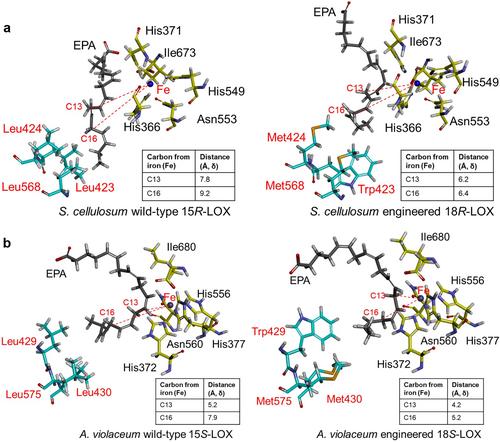
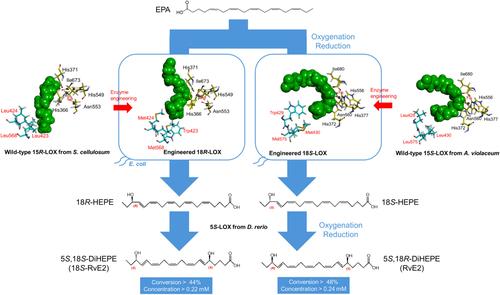
Resolvin E2 (RvE2), 5S,18R-dihydroxyeicosapentaenoic acid (5S,18R-DiHEPE), and 18S-RvE2 (5S,18S-DiHEPE) are specialized pro-resolving mediators that function in the resolution of inflammation. These SPMs have been produced in trace amounts from eicosapentaenoic acid (EPA) using acetylated cyclooxygenase-2 or cytochrome P450 and 5-lipoxygenase (5-LOX) via 18R- and 18S-hydroxyeicosapentaenoic acid (18R- and 18S-HEPE) intermediates. In this study, we engineered 15R-LOX from Sorangium cellulosum and 15S-LOX from Archangium violaceum into 18R-LOX (L423W/L424M/L568M variant of 15R-LOX) and 18S-LOX (L429W/L430M/L575M variant of 15S-LOX), respectively, via structure-guided enzyme engineering. The engineered 18R-LOX converted EPA into 72.5% 18R-HEPE and 27.5% 15R-HEPE, while the engineered 18S-LOX formed 81.8% 18S-HEPE and 18.2% 15S-HEPE. Escherichia coli expressing the engineered 18R- or 18S-LOX converted 4.0 or 3.0 mM EPA into 2.0 mM (641 mg/L) 18R-HEPE or 1.8 mM (577 mg/L) 18S-HEPE in 20 min, respectively, achieving concentrations that were > 105-fold higher than those reported previously. Furthermore, 5S-LOX from Danio rerio (zebrafish) converted a concentration of 0.5 mM of the prepared 18R- or 18S-HEPE into 0.24 mM (81 mg/L) RvE2 or 0.22 mM (74 mg/L) 18S-RvE2 in 30 min, respectively. To the best of our knowledge, this represents the first identification of 18-LOXs and first qualitative production of RvE2 and 18S-RvE2.
期刊介绍:
Biotechnology & Bioengineering publishes Perspectives, Articles, Reviews, Mini-Reviews, and Communications to the Editor that embrace all aspects of biotechnology. These include:
-Enzyme systems and their applications, including enzyme reactors, purification, and applied aspects of protein engineering
-Animal-cell biotechnology, including media development
-Applied aspects of cellular physiology, metabolism, and energetics
-Biocatalysis and applied enzymology, including enzyme reactors, protein engineering, and nanobiotechnology
-Biothermodynamics
-Biofuels, including biomass and renewable resource engineering
-Biomaterials, including delivery systems and materials for tissue engineering
-Bioprocess engineering, including kinetics and modeling of biological systems, transport phenomena in bioreactors, bioreactor design, monitoring, and control
-Biosensors and instrumentation
-Computational and systems biology, including bioinformatics and genomic/proteomic studies
-Environmental biotechnology, including biofilms, algal systems, and bioremediation
-Metabolic and cellular engineering
-Plant-cell biotechnology
-Spectroscopic and other analytical techniques for biotechnological applications
-Synthetic biology
-Tissue engineering, stem-cell bioengineering, regenerative medicine, gene therapy and delivery systems
The editors will consider papers for publication based on novelty, their immediate or future impact on biotechnological processes, and their contribution to the advancement of biochemical engineering science. Submission of papers dealing with routine aspects of bioprocessing, description of established equipment, and routine applications of established methodologies (e.g., control strategies, modeling, experimental methods) is discouraged. Theoretical papers will be judged based on the novelty of the approach and their potential impact, or on their novel capability to predict and elucidate experimental observations.






 京公网安备 11010802042870号
京ICP备2023020795号-1
京公网安备 11010802042870号
京ICP备2023020795号-1

 分享
分享
 求助内容:
求助内容: 应助结果提醒方式:
 扫码关注我们
