Hyun-Woo Kim , Jieun Lee , Seongmin Kim , Seung-Do Yun , Ki Jung Kim , Min-Ju Seo , Hyeoncheol Francis Son , Dong-Jun Lee , Chungoo Park , Won Seok Chi , Soo-Jin Yeom
{"title":"Exploring a Novel Metallophosphoesterase for Polycarbonate Degradation via Transcriptome Analysis","authors":"Hyun-Woo Kim , Jieun Lee , Seongmin Kim , Seung-Do Yun , Ki Jung Kim , Min-Ju Seo , Hyeoncheol Francis Son , Dong-Jun Lee , Chungoo Park , Won Seok Chi , Soo-Jin Yeom","doi":"10.1016/j.jhazmat.2025.138330","DOIUrl":null,"url":null,"abstract":"<div><div>Polycarbonate (PC), a widely used thermoplastic, poses significant environmental challenges due to its persistence and the release of bisphenol A (BPA), a known xenoestrogen. Here, we report the isolation of <em>Bacillus subtilis</em> JNU01 (BsJNU01), capable of utilizing PC as its sole carbon source. Through transcriptomic analysis, we identified metallophosphoesterase from BsJNU01 (BsMPPE), the first reported metallophosphoesterase capable of degrading polycarbonate by catalyzing the hydrolysis of carbonate ester bonds. This enzyme operates under mild aqueous conditions (30 °C, pH 7), releasing 30 μmol of BPA as a monomer and demonstrating effective PC degradation under environmentally friendly conditions. PC biodegradation was confirmed by Fourier transform infrared spectroscopy (FT-IR), nuclear magnetic resonance (NMR), and gas chromatography-mass spectrometry (GC-MS). Furthermore, surface and mechanical analyses revealed significant degradation and structural changes in PC films following BsMPPE treatment, with toughness showing a 40–70 % decrease compared to untreated PC films. This study represents a breakthrough in microbial plastic degradation, establishing a sustainable biocatalytic platform for PC recycling and upcycling technologies.</div></div>","PeriodicalId":361,"journal":{"name":"Journal of Hazardous Materials","volume":"493 ","pages":"Article 138330"},"PeriodicalIF":11.3000,"publicationDate":"2025-08-05","publicationTypes":"Journal Article","fieldsOfStudy":null,"isOpenAccess":false,"openAccessPdf":"","citationCount":"0","resultStr":null,"platform":"Semanticscholar","paperid":null,"PeriodicalName":"Journal of Hazardous Materials","FirstCategoryId":"93","ListUrlMain":"https://www.sciencedirect.com/science/article/pii/S0304389425012452","RegionNum":1,"RegionCategory":"环境科学与生态学","ArticlePicture":[],"TitleCN":null,"AbstractTextCN":null,"PMCID":null,"EPubDate":"2025/4/17 0:00:00","PubModel":"Epub","JCR":"Q1","JCRName":"ENGINEERING, ENVIRONMENTAL","Score":null,"Total":0}
引用次数: 0
Abstract
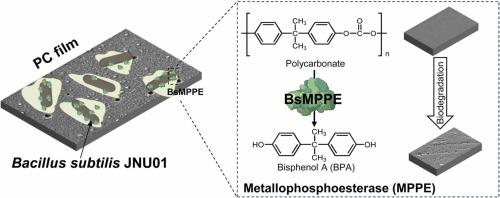
Polycarbonate (PC), a widely used thermoplastic, poses significant environmental challenges due to its persistence and the release of bisphenol A (BPA), a known xenoestrogen. Here, we report the isolation of Bacillus subtilis JNU01 (BsJNU01), capable of utilizing PC as its sole carbon source. Through transcriptomic analysis, we identified metallophosphoesterase from BsJNU01 (BsMPPE), the first reported metallophosphoesterase capable of degrading polycarbonate by catalyzing the hydrolysis of carbonate ester bonds. This enzyme operates under mild aqueous conditions (30 °C, pH 7), releasing 30 μmol of BPA as a monomer and demonstrating effective PC degradation under environmentally friendly conditions. PC biodegradation was confirmed by Fourier transform infrared spectroscopy (FT-IR), nuclear magnetic resonance (NMR), and gas chromatography-mass spectrometry (GC-MS). Furthermore, surface and mechanical analyses revealed significant degradation and structural changes in PC films following BsMPPE treatment, with toughness showing a 40–70 % decrease compared to untreated PC films. This study represents a breakthrough in microbial plastic degradation, establishing a sustainable biocatalytic platform for PC recycling and upcycling technologies.
期刊介绍:
The Journal of Hazardous Materials serves as a global platform for promoting cutting-edge research in the field of Environmental Science and Engineering. Our publication features a wide range of articles, including full-length research papers, review articles, and perspectives, with the aim of enhancing our understanding of the dangers and risks associated with various materials concerning public health and the environment. It is important to note that the term "environmental contaminants" refers specifically to substances that pose hazardous effects through contamination, while excluding those that do not have such impacts on the environment or human health. Moreover, we emphasize the distinction between wastes and hazardous materials in order to provide further clarity on the scope of the journal. We have a keen interest in exploring specific compounds and microbial agents that have adverse effects on the environment.



 京公网安备 11010802042870号
京ICP备2023020795号-1
京公网安备 11010802042870号
京ICP备2023020795号-1

 分享
分享
 求助内容:
求助内容: 应助结果提醒方式:
 扫码关注我们
