Mengyuan Xiao , Yongqing Yang , Hanin Alahmadi , Allison Harbolic , Gina M. Moreno , Terry Yu , Jerry Liu , Alex Guo , Genoa R. Warner , Phoebe A. Stapleton , Hao Chen
{"title":"Rapid detection of microplastics and nanoplastics in seconds by mass spectrometry","authors":"Mengyuan Xiao , Yongqing Yang , Hanin Alahmadi , Allison Harbolic , Gina M. Moreno , Terry Yu , Jerry Liu , Alex Guo , Genoa R. Warner , Phoebe A. Stapleton , Hao Chen","doi":"10.1016/j.jhazmat.2025.138322","DOIUrl":null,"url":null,"abstract":"<div><div>Microplastics (MPs) and nanoplastics (NPs) are pervasive pollutants and their analyses by traditional mass spectrometric methods require time-intensive sample preparation (e.g., extraction, digestion, and separation). This study presents a rapid and novel method for detecting MPs and NPs using flame ionization mass spectrometry (FI-MS) in which a dried sample (e.g., powder, soil and tissue) is directly burnt or heated with a flame in front of the MS inlet. FI-MS enables decomposition and ionization of various plastics such as polyethylene terephthalate (PET) and polystyrene (PS), allowing for analysis to be completed as fast as 10 seconds per sample. As a demonstration of application of this technique, PET contaminants in 1 L of bottled water or in 0.65 L of apple juice contained in plastic bottles were quickly detected from a filter paper after sample filtration and brief drying. A 0.89 mg soil sample spiked with 6000 ppm PET microplastics was measured to contain 4.98 µg of PET (5595 ppm, quantitation error: 6.8 %). Strikingly, PS nanoplastics (200 nm size) in mouse placentas were successfully identified and quantified, highlighting the method's ability to analyze biological tissue without tedious sample preparation. Overall, this study demonstrates the high potential of FI-MS for real-world sample analysis of MPs and NPs in environmental, biological, or consumer product samples.</div></div>","PeriodicalId":361,"journal":{"name":"Journal of Hazardous Materials","volume":"493 ","pages":"Article 138322"},"PeriodicalIF":11.3000,"publicationDate":"2025-08-05","publicationTypes":"Journal Article","fieldsOfStudy":null,"isOpenAccess":false,"openAccessPdf":"","citationCount":"0","resultStr":null,"platform":"Semanticscholar","paperid":null,"PeriodicalName":"Journal of Hazardous Materials","FirstCategoryId":"93","ListUrlMain":"https://www.sciencedirect.com/science/article/pii/S0304389425012373","RegionNum":1,"RegionCategory":"环境科学与生态学","ArticlePicture":[],"TitleCN":null,"AbstractTextCN":null,"PMCID":null,"EPubDate":"2025/4/17 0:00:00","PubModel":"Epub","JCR":"Q1","JCRName":"ENGINEERING, ENVIRONMENTAL","Score":null,"Total":0}
引用次数: 0
Abstract
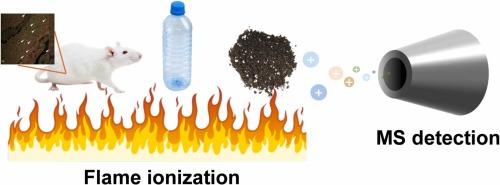
Microplastics (MPs) and nanoplastics (NPs) are pervasive pollutants and their analyses by traditional mass spectrometric methods require time-intensive sample preparation (e.g., extraction, digestion, and separation). This study presents a rapid and novel method for detecting MPs and NPs using flame ionization mass spectrometry (FI-MS) in which a dried sample (e.g., powder, soil and tissue) is directly burnt or heated with a flame in front of the MS inlet. FI-MS enables decomposition and ionization of various plastics such as polyethylene terephthalate (PET) and polystyrene (PS), allowing for analysis to be completed as fast as 10 seconds per sample. As a demonstration of application of this technique, PET contaminants in 1 L of bottled water or in 0.65 L of apple juice contained in plastic bottles were quickly detected from a filter paper after sample filtration and brief drying. A 0.89 mg soil sample spiked with 6000 ppm PET microplastics was measured to contain 4.98 µg of PET (5595 ppm, quantitation error: 6.8 %). Strikingly, PS nanoplastics (200 nm size) in mouse placentas were successfully identified and quantified, highlighting the method's ability to analyze biological tissue without tedious sample preparation. Overall, this study demonstrates the high potential of FI-MS for real-world sample analysis of MPs and NPs in environmental, biological, or consumer product samples.
期刊介绍:
The Journal of Hazardous Materials serves as a global platform for promoting cutting-edge research in the field of Environmental Science and Engineering. Our publication features a wide range of articles, including full-length research papers, review articles, and perspectives, with the aim of enhancing our understanding of the dangers and risks associated with various materials concerning public health and the environment. It is important to note that the term "environmental contaminants" refers specifically to substances that pose hazardous effects through contamination, while excluding those that do not have such impacts on the environment or human health. Moreover, we emphasize the distinction between wastes and hazardous materials in order to provide further clarity on the scope of the journal. We have a keen interest in exploring specific compounds and microbial agents that have adverse effects on the environment.



 京公网安备 11010802042870号
京ICP备2023020795号-1
京公网安备 11010802042870号
京ICP备2023020795号-1

 分享
分享
 求助内容:
求助内容: 应助结果提醒方式:
 扫码关注我们
