Guanzhi Wang, Haoyi Li, Finn Babbe, Andrew Tricker, Ethan J. Crumlin, Junko Yano, Rangachary Mukundan, Xiong Peng
{"title":"Probing Electrode Transformation under Dynamic Operation for Alkaline Water Electrolysis","authors":"Guanzhi Wang, Haoyi Li, Finn Babbe, Andrew Tricker, Ethan J. Crumlin, Junko Yano, Rangachary Mukundan, Xiong Peng","doi":"10.1002/aenm.202500886","DOIUrl":null,"url":null,"abstract":"<p>Alkaline water electrolyzers (AWEs) play a pivotal role in the realm of large-scale hydrogen production. However, AWEs face significant challenges in electrode degradation particularly under dynamic operating conditions, induced by reverse current phenomenon during frequent startup/shutdown. Herein, this study aims to rationalize the degradation mechanisms of AWEs under these conditions. A three-electrode membrane electrode assembly (MEA) setup is first utilized to decouple polarization behaviors of anode and cathode in AWEs. Following a proposed accelerated stress testing protocol, the setup allows for tracking individual electrode performance transformations during frequent reverse current operation. Integrating <i>operando</i> cell studies with in situ and post-mortem characterizations, it is showed that continuous formation of highly active species, nickel (oxy)hydroxides, improves the anode performance for oxygen evolution reaction. On the contrary, irreversible oxidation of nickel to β-nickel hydroxide results in a severe degradation of cathode, leading to material dissolution, poor electrical conductivity and loss of catalytic activity for hydrogen evolution reaction. These results provide insights in nickel-based electrode transformation mechanisms for alkaline water electrolysis and indicate that cathode with higher redox reversibility can potentially improve durability of AWEs under dynamic conditions.</p>","PeriodicalId":111,"journal":{"name":"Advanced Energy Materials","volume":"15 28","pages":""},"PeriodicalIF":26.0000,"publicationDate":"2025-04-17","publicationTypes":"Journal Article","fieldsOfStudy":null,"isOpenAccess":false,"openAccessPdf":"https://onlinelibrary.wiley.com/doi/epdf/10.1002/aenm.202500886","citationCount":"0","resultStr":null,"platform":"Semanticscholar","paperid":null,"PeriodicalName":"Advanced Energy Materials","FirstCategoryId":"88","ListUrlMain":"https://advanced.onlinelibrary.wiley.com/doi/10.1002/aenm.202500886","RegionNum":1,"RegionCategory":"材料科学","ArticlePicture":[],"TitleCN":null,"AbstractTextCN":null,"PMCID":null,"EPubDate":"","PubModel":"","JCR":"Q1","JCRName":"CHEMISTRY, PHYSICAL","Score":null,"Total":0}
引用次数: 0
Abstract
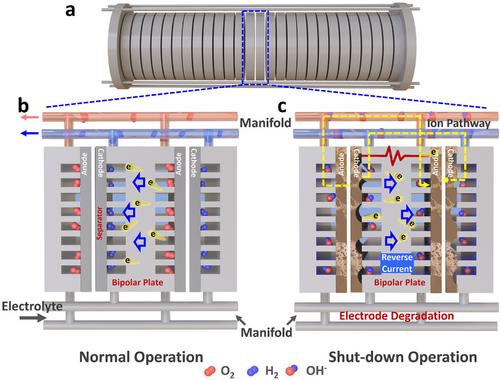
Alkaline water electrolyzers (AWEs) play a pivotal role in the realm of large-scale hydrogen production. However, AWEs face significant challenges in electrode degradation particularly under dynamic operating conditions, induced by reverse current phenomenon during frequent startup/shutdown. Herein, this study aims to rationalize the degradation mechanisms of AWEs under these conditions. A three-electrode membrane electrode assembly (MEA) setup is first utilized to decouple polarization behaviors of anode and cathode in AWEs. Following a proposed accelerated stress testing protocol, the setup allows for tracking individual electrode performance transformations during frequent reverse current operation. Integrating operando cell studies with in situ and post-mortem characterizations, it is showed that continuous formation of highly active species, nickel (oxy)hydroxides, improves the anode performance for oxygen evolution reaction. On the contrary, irreversible oxidation of nickel to β-nickel hydroxide results in a severe degradation of cathode, leading to material dissolution, poor electrical conductivity and loss of catalytic activity for hydrogen evolution reaction. These results provide insights in nickel-based electrode transformation mechanisms for alkaline water electrolysis and indicate that cathode with higher redox reversibility can potentially improve durability of AWEs under dynamic conditions.
期刊介绍:
Established in 2011, Advanced Energy Materials is an international, interdisciplinary, English-language journal that focuses on materials used in energy harvesting, conversion, and storage. It is regarded as a top-quality journal alongside Advanced Materials, Advanced Functional Materials, and Small.
With a 2022 Impact Factor of 27.8, Advanced Energy Materials is considered a prime source for the best energy-related research. The journal covers a wide range of topics in energy-related research, including organic and inorganic photovoltaics, batteries and supercapacitors, fuel cells, hydrogen generation and storage, thermoelectrics, water splitting and photocatalysis, solar fuels and thermosolar power, magnetocalorics, and piezoelectronics.
The readership of Advanced Energy Materials includes materials scientists, chemists, physicists, and engineers in both academia and industry. The journal is indexed in various databases and collections, such as Advanced Technologies & Aerospace Database, FIZ Karlsruhe, INSPEC (IET), Science Citation Index Expanded, Technology Collection, and Web of Science, among others.





 京公网安备 11010802042870号
京ICP备2023020795号-1
京公网安备 11010802042870号
京ICP备2023020795号-1

 分享
分享
 求助内容:
求助内容: 应助结果提醒方式:
 扫码关注我们
