Modeling the Migration and Growth of Shewanella Oneidensis MR-1 in a Diffusion-Dominated Microfluidic Gradient Chamber Under the Influence of an Antibiotic Concentration Gradient
Somayeh G. Esfahani, Reinaldo E. Alcalde, Albert J. Valocchi, Robert A. Sanford, Charles J. Werth
{"title":"Modeling the Migration and Growth of Shewanella Oneidensis MR-1 in a Diffusion-Dominated Microfluidic Gradient Chamber Under the Influence of an Antibiotic Concentration Gradient","authors":"Somayeh G. Esfahani, Reinaldo E. Alcalde, Albert J. Valocchi, Robert A. Sanford, Charles J. Werth","doi":"10.1002/bit.28991","DOIUrl":null,"url":null,"abstract":"<p>Motility and chemotaxis allow bacteria to migrate from areas that become depleted in energy yielding substrates to more favorable locations, possibly enhancing the biodegradation of pollutants in soil and groundwater. However, in some cases substrates are co-mingled with one or more toxic solutes that inhibit pollutant degradation and/or microbial growth, and the impacts on motility and chemotaxis represent a knowledge gap. In this study, a one-dimensional diffusion reaction model is developed and used to simulate dissimilatory biological reduction of nitrate to ammonia (DNRA) presented in a previously published microfluidic gradient chamber (MGC) experiment, where spatial abundances of <i>Shewanella oneidensis</i> MR-1 cells were recorded over 5 days in a diffusion limited porous media domain as it degraded nitrate and lactate introduced from opposite boundaries, and at one boundary co-mixed with the antibiotic ciprofloxacin. The model considers <i>S. oneidensis</i> chemotaxis toward nitrate and nitrite, random motility, and growth inhibition by ciprofloxacin. Parameters were adjusted within ranges commonly reported in the literature to obtain results that agreed with the data. Simulation results indicate that motility and not chemotaxis, in combination with inhibition of cell growth by ciprofloxacin, controls the distribution of cells in the toxic region (containing ciprofloxacin) of the MGC. This suggests that cell motility may facilitate nitrate removal in soil and groundwater by enabling microorganisms to migrate toward nitrate contaminated regions with elevated antibiotic concentrations.</p>","PeriodicalId":9168,"journal":{"name":"Biotechnology and Bioengineering","volume":"122 7","pages":"1840-1855"},"PeriodicalIF":3.6000,"publicationDate":"2025-04-16","publicationTypes":"Journal Article","fieldsOfStudy":null,"isOpenAccess":false,"openAccessPdf":"https://onlinelibrary.wiley.com/doi/epdf/10.1002/bit.28991","citationCount":"0","resultStr":null,"platform":"Semanticscholar","paperid":null,"PeriodicalName":"Biotechnology and Bioengineering","FirstCategoryId":"5","ListUrlMain":"https://analyticalsciencejournals.onlinelibrary.wiley.com/doi/10.1002/bit.28991","RegionNum":2,"RegionCategory":"生物学","ArticlePicture":[],"TitleCN":null,"AbstractTextCN":null,"PMCID":null,"EPubDate":"","PubModel":"","JCR":"Q2","JCRName":"BIOTECHNOLOGY & APPLIED MICROBIOLOGY","Score":null,"Total":0}
引用次数: 0
Abstract
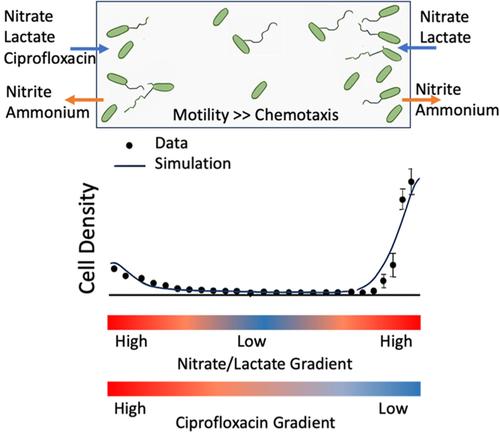
Motility and chemotaxis allow bacteria to migrate from areas that become depleted in energy yielding substrates to more favorable locations, possibly enhancing the biodegradation of pollutants in soil and groundwater. However, in some cases substrates are co-mingled with one or more toxic solutes that inhibit pollutant degradation and/or microbial growth, and the impacts on motility and chemotaxis represent a knowledge gap. In this study, a one-dimensional diffusion reaction model is developed and used to simulate dissimilatory biological reduction of nitrate to ammonia (DNRA) presented in a previously published microfluidic gradient chamber (MGC) experiment, where spatial abundances of Shewanella oneidensis MR-1 cells were recorded over 5 days in a diffusion limited porous media domain as it degraded nitrate and lactate introduced from opposite boundaries, and at one boundary co-mixed with the antibiotic ciprofloxacin. The model considers S. oneidensis chemotaxis toward nitrate and nitrite, random motility, and growth inhibition by ciprofloxacin. Parameters were adjusted within ranges commonly reported in the literature to obtain results that agreed with the data. Simulation results indicate that motility and not chemotaxis, in combination with inhibition of cell growth by ciprofloxacin, controls the distribution of cells in the toxic region (containing ciprofloxacin) of the MGC. This suggests that cell motility may facilitate nitrate removal in soil and groundwater by enabling microorganisms to migrate toward nitrate contaminated regions with elevated antibiotic concentrations.
期刊介绍:
Biotechnology & Bioengineering publishes Perspectives, Articles, Reviews, Mini-Reviews, and Communications to the Editor that embrace all aspects of biotechnology. These include:
-Enzyme systems and their applications, including enzyme reactors, purification, and applied aspects of protein engineering
-Animal-cell biotechnology, including media development
-Applied aspects of cellular physiology, metabolism, and energetics
-Biocatalysis and applied enzymology, including enzyme reactors, protein engineering, and nanobiotechnology
-Biothermodynamics
-Biofuels, including biomass and renewable resource engineering
-Biomaterials, including delivery systems and materials for tissue engineering
-Bioprocess engineering, including kinetics and modeling of biological systems, transport phenomena in bioreactors, bioreactor design, monitoring, and control
-Biosensors and instrumentation
-Computational and systems biology, including bioinformatics and genomic/proteomic studies
-Environmental biotechnology, including biofilms, algal systems, and bioremediation
-Metabolic and cellular engineering
-Plant-cell biotechnology
-Spectroscopic and other analytical techniques for biotechnological applications
-Synthetic biology
-Tissue engineering, stem-cell bioengineering, regenerative medicine, gene therapy and delivery systems
The editors will consider papers for publication based on novelty, their immediate or future impact on biotechnological processes, and their contribution to the advancement of biochemical engineering science. Submission of papers dealing with routine aspects of bioprocessing, description of established equipment, and routine applications of established methodologies (e.g., control strategies, modeling, experimental methods) is discouraged. Theoretical papers will be judged based on the novelty of the approach and their potential impact, or on their novel capability to predict and elucidate experimental observations.







 京公网安备 11010802042870号
京ICP备2023020795号-1
京公网安备 11010802042870号
京ICP备2023020795号-1

 分享
分享
 求助内容:
求助内容: 应助结果提醒方式:
 扫码关注我们
