Xiancheng Wang, Bao Zhang, Zihe Chen, Shiyu Liu, Wenyu Wang, Shuibin Tu, Renming Zhan, Li Wang and Yongming Sun
{"title":"Achieving a higher lithium density in anodes surpassing that of pure metallic lithium for high-energy-density batteries†","authors":"Xiancheng Wang, Bao Zhang, Zihe Chen, Shiyu Liu, Wenyu Wang, Shuibin Tu, Renming Zhan, Li Wang and Yongming Sun","doi":"10.1039/D4EE05289G","DOIUrl":null,"url":null,"abstract":"<p >The low-density, high-porosity lithium (Li) plating layer at the anode is one of the principal determinants of the overall volumetric expansion in rechargeable high-energy-density Li metal batteries, which accounts for a significant cause of battery performance degradation. In this study, we elucidated Li densification at the anode through the formation of a high-Li-density solid solution with tailed components and a dense Li deposit structure, representing an alternative concept for the low-expansion Li metal anode. Specifically, we revealed that a Li–Ag solid solution with a Li/Ag atomic ratio ranging from 12/1 to 18/1 demonstrated a significantly higher volumetric Li density, referring to the volumetric Li storage capability, compared to bulk metallic Li. A Li metal anode with a specific-thickness Ag upper layer could be elaborately designed to produce such a high-Li-density Li–Ag solid solution after intake of active Li from Li-containing cathodes during the battery charging process, suppressing the overall volume change of the cell. Impressively, a 50 μm-thick Li/Ag anode demonstrated minimal volume expansion of only 11% after 50 cycles at 1 mA cm<small><sup>−2</sup></small> and 4 mA h cm<small><sup>−2</sup></small>. This is significantly lower than the expansion observed in its counterpart with pure Li, which exceeded 220%. Remarkably, an Ah-class Li metal pouch cell (∼421 W h kg<small><sup>−1</sup></small>), assembled with the ultrathin Li/Ag anode (40 μm) and the LiNi<small><sub>0.6</sub></small>Co<small><sub>0.2</sub></small>Mn<small><sub>0.2</sub></small>O<small><sub>2</sub></small> (NCM622, 4.1 mA h cm<small><sup>−2</sup></small>) cathode, demonstrated a lifespan exceeding 320 cycles under harsh conditions with a low negative/positive capacity (N/P) ratio of 1.95 and an electrolyte/capacity (E/C) ratio of 1.71 g A h<small><sup>−1</sup></small>.</p>","PeriodicalId":72,"journal":{"name":"Energy & Environmental Science","volume":" 11","pages":" 5365-5377"},"PeriodicalIF":30.8000,"publicationDate":"2025-04-17","publicationTypes":"Journal Article","fieldsOfStudy":null,"isOpenAccess":false,"openAccessPdf":"","citationCount":"0","resultStr":null,"platform":"Semanticscholar","paperid":null,"PeriodicalName":"Energy & Environmental Science","FirstCategoryId":"88","ListUrlMain":"https://pubs.rsc.org/en/content/articlelanding/2025/ee/d4ee05289g","RegionNum":1,"RegionCategory":"材料科学","ArticlePicture":[],"TitleCN":null,"AbstractTextCN":null,"PMCID":null,"EPubDate":"","PubModel":"","JCR":"Q1","JCRName":"CHEMISTRY, MULTIDISCIPLINARY","Score":null,"Total":0}
引用次数: 0
Abstract
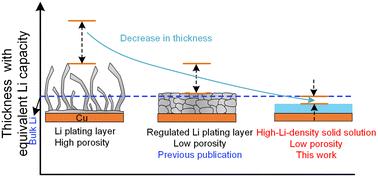
The low-density, high-porosity lithium (Li) plating layer at the anode is one of the principal determinants of the overall volumetric expansion in rechargeable high-energy-density Li metal batteries, which accounts for a significant cause of battery performance degradation. In this study, we elucidated Li densification at the anode through the formation of a high-Li-density solid solution with tailed components and a dense Li deposit structure, representing an alternative concept for the low-expansion Li metal anode. Specifically, we revealed that a Li–Ag solid solution with a Li/Ag atomic ratio ranging from 12/1 to 18/1 demonstrated a significantly higher volumetric Li density, referring to the volumetric Li storage capability, compared to bulk metallic Li. A Li metal anode with a specific-thickness Ag upper layer could be elaborately designed to produce such a high-Li-density Li–Ag solid solution after intake of active Li from Li-containing cathodes during the battery charging process, suppressing the overall volume change of the cell. Impressively, a 50 μm-thick Li/Ag anode demonstrated minimal volume expansion of only 11% after 50 cycles at 1 mA cm−2 and 4 mA h cm−2. This is significantly lower than the expansion observed in its counterpart with pure Li, which exceeded 220%. Remarkably, an Ah-class Li metal pouch cell (∼421 W h kg−1), assembled with the ultrathin Li/Ag anode (40 μm) and the LiNi0.6Co0.2Mn0.2O2 (NCM622, 4.1 mA h cm−2) cathode, demonstrated a lifespan exceeding 320 cycles under harsh conditions with a low negative/positive capacity (N/P) ratio of 1.95 and an electrolyte/capacity (E/C) ratio of 1.71 g A h−1.
期刊介绍:
Energy & Environmental Science, a peer-reviewed scientific journal, publishes original research and review articles covering interdisciplinary topics in the (bio)chemical and (bio)physical sciences, as well as chemical engineering disciplines. Published monthly by the Royal Society of Chemistry (RSC), a not-for-profit publisher, Energy & Environmental Science is recognized as a leading journal. It boasts an impressive impact factor of 8.500 as of 2009, ranking 8th among 140 journals in the category "Chemistry, Multidisciplinary," second among 71 journals in "Energy & Fuels," second among 128 journals in "Engineering, Chemical," and first among 181 scientific journals in "Environmental Sciences."
Energy & Environmental Science publishes various types of articles, including Research Papers (original scientific work), Review Articles, Perspectives, and Minireviews (feature review-type articles of broad interest), Communications (original scientific work of an urgent nature), Opinions (personal, often speculative viewpoints or hypotheses on current topics), and Analysis Articles (in-depth examination of energy-related issues).



 京公网安备 11010802042870号
京ICP备2023020795号-1
京公网安备 11010802042870号
京ICP备2023020795号-1

 分享
分享
 求助内容:
求助内容: 应助结果提醒方式:
 扫码关注我们
