Ze Jin, Cheng Shen, Haotian Hu, Chengcheng Han, Yongqi Bai, Mengjin Yang, Quan Liu and Ziyi Ge
{"title":"Fully evaporated interfacial layers for high-performance and batch-to-batch reproducible organic solar modules†","authors":"Ze Jin, Cheng Shen, Haotian Hu, Chengcheng Han, Yongqi Bai, Mengjin Yang, Quan Liu and Ziyi Ge","doi":"10.1039/D5EE00014A","DOIUrl":null,"url":null,"abstract":"<p >Significant advancements in research have been made in recent years, with single-junction organic solar cells achieving efficiencies exceeding 20%. However, scaling up laboratory prototypes to large-area commercial modules remains challenging due to the absence of high-quality thin-film deposition techniques, particularly for ultra-thin interfacial layers. Herein, we demonstrate a fully vacuum-processed approach utilizing InCl<small><sub>3</sub></small> as a hole-contact and C<small><sub>60</sub></small>/BCP as an electron-contact interlayer, respectively, which act as dense and uniform charge transporting layers, while also ensuring consistent batch-to-batch reproducibility of module performance. In addition, such an ultra-thin InCl<small><sub>3</sub></small> layer significantly reduces the surface free energy of ITO substrates, thereby inhibiting the coffee ring effect during the active layer deposition and obtaining a more homogeneous film in a large-scale size. As a result, we measured a power conversion efficiency of 16.5% (certified efficiency: 15.8%) under 1-sun illumination for the best-performing organic solar modules (aperture area = 15.6 cm<small><sup>2</sup></small>) with a geometric fill factor of 95.5%, making them highly competitive amongst recently reported modules of similar size. Most importantly, our vacuum-processed interlayers exhibit excellent reproducibility and scale-up ability, paving the way to accelerate the industrialization of organic photovoltaic technology.</p>","PeriodicalId":72,"journal":{"name":"Energy & Environmental Science","volume":" 11","pages":" 5552-5563"},"PeriodicalIF":30.8000,"publicationDate":"2025-04-17","publicationTypes":"Journal Article","fieldsOfStudy":null,"isOpenAccess":false,"openAccessPdf":"","citationCount":"0","resultStr":null,"platform":"Semanticscholar","paperid":null,"PeriodicalName":"Energy & Environmental Science","FirstCategoryId":"88","ListUrlMain":"https://pubs.rsc.org/en/content/articlelanding/2025/ee/d5ee00014a","RegionNum":1,"RegionCategory":"材料科学","ArticlePicture":[],"TitleCN":null,"AbstractTextCN":null,"PMCID":null,"EPubDate":"","PubModel":"","JCR":"Q1","JCRName":"CHEMISTRY, MULTIDISCIPLINARY","Score":null,"Total":0}
引用次数: 0
Abstract
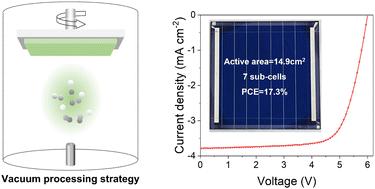
Significant advancements in research have been made in recent years, with single-junction organic solar cells achieving efficiencies exceeding 20%. However, scaling up laboratory prototypes to large-area commercial modules remains challenging due to the absence of high-quality thin-film deposition techniques, particularly for ultra-thin interfacial layers. Herein, we demonstrate a fully vacuum-processed approach utilizing InCl3 as a hole-contact and C60/BCP as an electron-contact interlayer, respectively, which act as dense and uniform charge transporting layers, while also ensuring consistent batch-to-batch reproducibility of module performance. In addition, such an ultra-thin InCl3 layer significantly reduces the surface free energy of ITO substrates, thereby inhibiting the coffee ring effect during the active layer deposition and obtaining a more homogeneous film in a large-scale size. As a result, we measured a power conversion efficiency of 16.5% (certified efficiency: 15.8%) under 1-sun illumination for the best-performing organic solar modules (aperture area = 15.6 cm2) with a geometric fill factor of 95.5%, making them highly competitive amongst recently reported modules of similar size. Most importantly, our vacuum-processed interlayers exhibit excellent reproducibility and scale-up ability, paving the way to accelerate the industrialization of organic photovoltaic technology.
期刊介绍:
Energy & Environmental Science, a peer-reviewed scientific journal, publishes original research and review articles covering interdisciplinary topics in the (bio)chemical and (bio)physical sciences, as well as chemical engineering disciplines. Published monthly by the Royal Society of Chemistry (RSC), a not-for-profit publisher, Energy & Environmental Science is recognized as a leading journal. It boasts an impressive impact factor of 8.500 as of 2009, ranking 8th among 140 journals in the category "Chemistry, Multidisciplinary," second among 71 journals in "Energy & Fuels," second among 128 journals in "Engineering, Chemical," and first among 181 scientific journals in "Environmental Sciences."
Energy & Environmental Science publishes various types of articles, including Research Papers (original scientific work), Review Articles, Perspectives, and Minireviews (feature review-type articles of broad interest), Communications (original scientific work of an urgent nature), Opinions (personal, often speculative viewpoints or hypotheses on current topics), and Analysis Articles (in-depth examination of energy-related issues).



 京公网安备 11010802042870号
京ICP备2023020795号-1
京公网安备 11010802042870号
京ICP备2023020795号-1

 分享
分享
 求助内容:
求助内容: 应助结果提醒方式:
 扫码关注我们
