Lihui Cui , Rongkun Du , Yiming Yan , Yizhuo Feng , Jiaxin Chen , Aipeng Li , Qunhui Wang , Yingqun Ma
{"title":"Development of a recyclable multienzyme strengthens food waste bioconversion and health risks reduction: Performance and mechanism decipherment","authors":"Lihui Cui , Rongkun Du , Yiming Yan , Yizhuo Feng , Jiaxin Chen , Aipeng Li , Qunhui Wang , Yingqun Ma","doi":"10.1016/j.jclepro.2025.145537","DOIUrl":null,"url":null,"abstract":"<div><div>This study developed a recyclable multienzyme (RM) for strengthening food waste (FW) hydrolysis, methane production and health risks reduction during FW bioconversion process, and the performance and mechanism were also deciphered thoroughly. Results showed that RM-Agar FWDBC presented the highest protease, amylase, and cellulase activities of 16.31 U·g<sup>−1</sup>, 882.66 U·g<sup>−1</sup> and 14.83 U·g<sup>−1</sup>, respectively, and the methane production reached 417.70 mL/g VS, an increase of 35.49% compared with the control. Mechanism analysis indicated that RM-Agar FWDBC caused more biodegradable components releasing from solid phase to liquid phase, and the structure of main components of starch, protein and lipid was destructed. Even more, RM-Agar FWDBC pretreatment effectively removed 97.54% of targeted antibiotic resistance genes (ARGs), and the total ARGs were further removed as well as the pathogen growth were concurrently inhibited in subsequent anaerobic digestion (AD) process. In-depth analysis showed that the abundance of <em>intI1</em> and potential ARGs hosts were reduced by 89.46% and 32.36% causing the decrease in the frequency of horizontal gene transfer and vertical gene transfer of ARGs, while macrogenomic analysis elucidated that RM-Agar FWDBC down-regulated the abundance of genes encoding enzymes involved in two-component systems and quorum sensing as well as the abundance of genes involved in conjugative transfer, resulting in low abundance of genes related to virulence proteins and resistance proteins, thereby achieve maximized ARGs removal and pathogen growth inhibition. Ultimately, variation partitioning analysis revealed that the microbial community (84.3%) was the dominant contributor to the ARGs changes, followed by abiotic factors (76.6%) and <em>intI1</em> (63.6%).</div></div>","PeriodicalId":349,"journal":{"name":"Journal of Cleaner Production","volume":"506 ","pages":"Article 145537"},"PeriodicalIF":10.0000,"publicationDate":"2025-05-15","publicationTypes":"Journal Article","fieldsOfStudy":null,"isOpenAccess":false,"openAccessPdf":"","citationCount":"0","resultStr":null,"platform":"Semanticscholar","paperid":null,"PeriodicalName":"Journal of Cleaner Production","FirstCategoryId":"93","ListUrlMain":"https://www.sciencedirect.com/science/article/pii/S095965262500887X","RegionNum":1,"RegionCategory":"环境科学与生态学","ArticlePicture":[],"TitleCN":null,"AbstractTextCN":null,"PMCID":null,"EPubDate":"2025/4/17 0:00:00","PubModel":"Epub","JCR":"Q1","JCRName":"ENGINEERING, ENVIRONMENTAL","Score":null,"Total":0}
引用次数: 0
Abstract
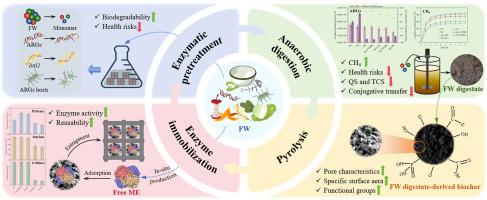
This study developed a recyclable multienzyme (RM) for strengthening food waste (FW) hydrolysis, methane production and health risks reduction during FW bioconversion process, and the performance and mechanism were also deciphered thoroughly. Results showed that RM-Agar FWDBC presented the highest protease, amylase, and cellulase activities of 16.31 U·g−1, 882.66 U·g−1 and 14.83 U·g−1, respectively, and the methane production reached 417.70 mL/g VS, an increase of 35.49% compared with the control. Mechanism analysis indicated that RM-Agar FWDBC caused more biodegradable components releasing from solid phase to liquid phase, and the structure of main components of starch, protein and lipid was destructed. Even more, RM-Agar FWDBC pretreatment effectively removed 97.54% of targeted antibiotic resistance genes (ARGs), and the total ARGs were further removed as well as the pathogen growth were concurrently inhibited in subsequent anaerobic digestion (AD) process. In-depth analysis showed that the abundance of intI1 and potential ARGs hosts were reduced by 89.46% and 32.36% causing the decrease in the frequency of horizontal gene transfer and vertical gene transfer of ARGs, while macrogenomic analysis elucidated that RM-Agar FWDBC down-regulated the abundance of genes encoding enzymes involved in two-component systems and quorum sensing as well as the abundance of genes involved in conjugative transfer, resulting in low abundance of genes related to virulence proteins and resistance proteins, thereby achieve maximized ARGs removal and pathogen growth inhibition. Ultimately, variation partitioning analysis revealed that the microbial community (84.3%) was the dominant contributor to the ARGs changes, followed by abiotic factors (76.6%) and intI1 (63.6%).
期刊介绍:
The Journal of Cleaner Production is an international, transdisciplinary journal that addresses and discusses theoretical and practical Cleaner Production, Environmental, and Sustainability issues. It aims to help societies become more sustainable by focusing on the concept of 'Cleaner Production', which aims at preventing waste production and increasing efficiencies in energy, water, resources, and human capital use. The journal serves as a platform for corporations, governments, education institutions, regions, and societies to engage in discussions and research related to Cleaner Production, environmental, and sustainability practices.




 京公网安备 11010802042870号
京ICP备2023020795号-1
京公网安备 11010802042870号
京ICP备2023020795号-1

 分享
分享
 求助内容:
求助内容: 应助结果提醒方式:
 扫码关注我们
