Gagan K. Jalandhra, Lauryn Srethbhakdi, James Davies, Chi Cong Nguyen, Phuoc Thien Phan, Zachary Och, Aditya Ashok, Khoon S. Lim, Hoang-Phuong Phan, Thanh Nho Do, Nigel H. Lovell, Jelena Rnjak-Kovacina
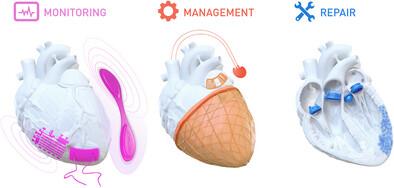
{"title":"Materials Advances in Devices for Heart Disease Interventions","authors":"Gagan K. Jalandhra, Lauryn Srethbhakdi, James Davies, Chi Cong Nguyen, Phuoc Thien Phan, Zachary Och, Aditya Ashok, Khoon S. Lim, Hoang-Phuong Phan, Thanh Nho Do, Nigel H. Lovell, Jelena Rnjak-Kovacina","doi":"10.1002/adma.202420114","DOIUrl":null,"url":null,"abstract":"<p>Heart disease encompasses a range of conditions that affect the heart, including coronary artery disease, arrhythmias, congenital heart defects, heart valve disease, and conditions that affect the heart muscle. Intervention strategies can be categorized according to when they are administered and include: 1) Monitoring cardiac function using sensor technology to inform diagnosis and treatment, 2) Managing symptoms by restoring cardiac output, electrophysiology, and hemodynamics, and often serving as bridge-to-recovery or bridge-to-transplantation strategies, and 3) Repairing damaged tissue, including myocardium and heart valves, when management strategies are insufficient. Each intervention approach and technology require specific material properties to function optimally, relying on materials that support their action and interface with the body, with new technologies increasingly depending on advances in materials science and engineering. This review explores material properties and requirements driving innovation in advanced intervention strategies for heart disease and highlights key examples of recent progress in the field driven by advances in materials research.</p>","PeriodicalId":114,"journal":{"name":"Advanced Materials","volume":"37 27","pages":""},"PeriodicalIF":26.8000,"publicationDate":"2025-04-17","publicationTypes":"Journal Article","fieldsOfStudy":null,"isOpenAccess":false,"openAccessPdf":"https://onlinelibrary.wiley.com/doi/epdf/10.1002/adma.202420114","citationCount":"0","resultStr":null,"platform":"Semanticscholar","paperid":null,"PeriodicalName":"Advanced Materials","FirstCategoryId":"88","ListUrlMain":"https://advanced.onlinelibrary.wiley.com/doi/10.1002/adma.202420114","RegionNum":1,"RegionCategory":"材料科学","ArticlePicture":[],"TitleCN":null,"AbstractTextCN":null,"PMCID":null,"EPubDate":"","PubModel":"","JCR":"Q1","JCRName":"CHEMISTRY, MULTIDISCIPLINARY","Score":null,"Total":0}
引用次数: 0
Abstract
Heart disease encompasses a range of conditions that affect the heart, including coronary artery disease, arrhythmias, congenital heart defects, heart valve disease, and conditions that affect the heart muscle. Intervention strategies can be categorized according to when they are administered and include: 1) Monitoring cardiac function using sensor technology to inform diagnosis and treatment, 2) Managing symptoms by restoring cardiac output, electrophysiology, and hemodynamics, and often serving as bridge-to-recovery or bridge-to-transplantation strategies, and 3) Repairing damaged tissue, including myocardium and heart valves, when management strategies are insufficient. Each intervention approach and technology require specific material properties to function optimally, relying on materials that support their action and interface with the body, with new technologies increasingly depending on advances in materials science and engineering. This review explores material properties and requirements driving innovation in advanced intervention strategies for heart disease and highlights key examples of recent progress in the field driven by advances in materials research.
期刊介绍:
Advanced Materials, one of the world's most prestigious journals and the foundation of the Advanced portfolio, is the home of choice for best-in-class materials science for more than 30 years. Following this fast-growing and interdisciplinary field, we are considering and publishing the most important discoveries on any and all materials from materials scientists, chemists, physicists, engineers as well as health and life scientists and bringing you the latest results and trends in modern materials-related research every week.






 京公网安备 11010802042870号
京ICP备2023020795号-1
京公网安备 11010802042870号
京ICP备2023020795号-1

 分享
分享
 求助内容:
求助内容: 应助结果提醒方式:
 扫码关注我们
