Jiachang Liu, Zhexuan Liu, Zhiqiang Xiao, Yifei Zhu, Junxiong Wang, Guanjun Ji, Yinna Liu, Bo Sun, Guangmin Zhou
{"title":"Iodine-Mediated Redox Strategy for Sustainable Lithium Extraction From Spent LiFePO4 Cathodes","authors":"Jiachang Liu, Zhexuan Liu, Zhiqiang Xiao, Yifei Zhu, Junxiong Wang, Guanjun Ji, Yinna Liu, Bo Sun, Guangmin Zhou","doi":"10.1002/adma.202503450","DOIUrl":null,"url":null,"abstract":"<p>With the widespread application of lithium-ion batteries, the recycling of spent batteries, especially those involving LiFePO<sub>4</sub> (LFP) cathodes for their low-cost and high safety, has become an urgent environmental and resource challenge. Traditional recycling methods (hydrometallurgy and pyrometallurgy) struggle to achieve green and efficient recycling. Herein, this study proposes an iodine-mediated electrochemical strategy to utilize a recyclable I<sub>3</sub><sup>−</sup>/I<sup>−</sup> redox system and efficiently extract Li<sup>+</sup> from spent LFP through liquid-phase reactions on one side (achieving a 93% leaching rate and recovery as lithium carbonate), while simultaneously producing metallic zinc through electrodeposition, which can be directly used in Zn-air batteries or hydrogen production. Furthermore, the delithiated LFP is upcycled into an oxygen evolution reaction (OER) catalyst, achieving an overpotential of only 250 mV at 10 mA cm<sup>−2</sup>, superior to commercial RuO<sub>2</sub> catalysts. Eventually, this system reduces energy consumption by 32% (9.2 MJ kg<sup>−1</sup>) compared to traditional hydrometallurgical processes, decreases greenhouse gas emissions by 35% compared to traditional pyrometallurgical processes, while achieving a net profit of ≈$0.44 per kg. This work establishes a novel, scalable recycling system, providing a robust sustainable solution for spent LFP cathodes recycling and clean energy storage.</p>","PeriodicalId":114,"journal":{"name":"Advanced Materials","volume":"37 26","pages":""},"PeriodicalIF":26.8000,"publicationDate":"2025-04-17","publicationTypes":"Journal Article","fieldsOfStudy":null,"isOpenAccess":false,"openAccessPdf":"","citationCount":"0","resultStr":null,"platform":"Semanticscholar","paperid":null,"PeriodicalName":"Advanced Materials","FirstCategoryId":"88","ListUrlMain":"https://advanced.onlinelibrary.wiley.com/doi/10.1002/adma.202503450","RegionNum":1,"RegionCategory":"材料科学","ArticlePicture":[],"TitleCN":null,"AbstractTextCN":null,"PMCID":null,"EPubDate":"","PubModel":"","JCR":"Q1","JCRName":"CHEMISTRY, MULTIDISCIPLINARY","Score":null,"Total":0}
引用次数: 0
Abstract
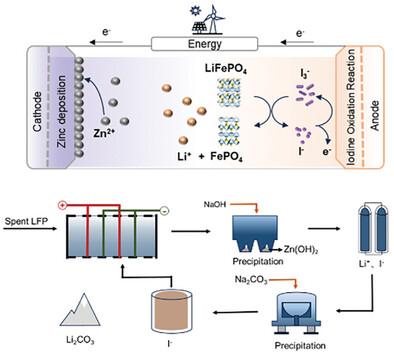
With the widespread application of lithium-ion batteries, the recycling of spent batteries, especially those involving LiFePO4 (LFP) cathodes for their low-cost and high safety, has become an urgent environmental and resource challenge. Traditional recycling methods (hydrometallurgy and pyrometallurgy) struggle to achieve green and efficient recycling. Herein, this study proposes an iodine-mediated electrochemical strategy to utilize a recyclable I3−/I− redox system and efficiently extract Li+ from spent LFP through liquid-phase reactions on one side (achieving a 93% leaching rate and recovery as lithium carbonate), while simultaneously producing metallic zinc through electrodeposition, which can be directly used in Zn-air batteries or hydrogen production. Furthermore, the delithiated LFP is upcycled into an oxygen evolution reaction (OER) catalyst, achieving an overpotential of only 250 mV at 10 mA cm−2, superior to commercial RuO2 catalysts. Eventually, this system reduces energy consumption by 32% (9.2 MJ kg−1) compared to traditional hydrometallurgical processes, decreases greenhouse gas emissions by 35% compared to traditional pyrometallurgical processes, while achieving a net profit of ≈$0.44 per kg. This work establishes a novel, scalable recycling system, providing a robust sustainable solution for spent LFP cathodes recycling and clean energy storage.
随着锂离子电池的广泛应用,废旧电池的回收利用,特别是涉及低成本和高安全性的LiFePO4 (LFP)阴极,已成为一个紧迫的环境和资源挑战。传统的回收方法(湿法冶金和火法冶金)难以实现绿色高效的回收。本研究提出了一种以碘为媒介的电化学策略,利用可回收的I3−/I−氧化还原体系,通过液相反应从废LFP中高效提取Li+(达到93%的浸出率并回收为碳酸锂),同时通过电沉积生产金属锌,可直接用于锌空气电池或制氢。此外,将稀释后的LFP升级为析氧反应(OER)催化剂,在10 mA cm - 2下获得仅250 mV的过电位,优于商用RuO2催化剂。最终,与传统的湿法冶金工艺相比,该系统可减少32%的能耗(9.2 MJ kg−1),与传统的火法冶金工艺相比,可减少35%的温室气体排放,同时实现每公斤约0.44美元的净利润。这项工作建立了一个新颖的、可扩展的回收系统,为废LFP阴极的回收和清洁能源储存提供了一个强大的可持续解决方案。
期刊介绍:
Advanced Materials, one of the world's most prestigious journals and the foundation of the Advanced portfolio, is the home of choice for best-in-class materials science for more than 30 years. Following this fast-growing and interdisciplinary field, we are considering and publishing the most important discoveries on any and all materials from materials scientists, chemists, physicists, engineers as well as health and life scientists and bringing you the latest results and trends in modern materials-related research every week.






 京公网安备 11010802042870号
京ICP备2023020795号-1
京公网安备 11010802042870号
京ICP备2023020795号-1

 分享
分享
 求助内容:
求助内容: 应助结果提醒方式:
 扫码关注我们
