Haifa A. Alyousef, Shaimaa A. M. Abdelmohsen, Areej Saleh Alqarny, Najla Alotaibi, Younis Ejaz, Muhammad Imran, Hafiz Muhammad Farid
{"title":"Specifying the Mo doped CaFeO3 electrode material for the application in supercapacitor","authors":"Haifa A. Alyousef, Shaimaa A. M. Abdelmohsen, Areej Saleh Alqarny, Najla Alotaibi, Younis Ejaz, Muhammad Imran, Hafiz Muhammad Farid","doi":"10.1007/s00339-025-08501-2","DOIUrl":null,"url":null,"abstract":"<div><p>The innovation in energy storage technology is crucial to solving the world’s energy problems. Renewable resources have drawn the interest of researchers because the non-renewable resources are limited. Supercapacitors are revolutionary storage and energy conversion devices that are gaining popularity due to their higher specific power. The present study is about the fabrication of CaFeO<sub>3</sub> and Mo-doped CaFeO<sub>3</sub> through sustainable hydrothermal technique. To verify its electrochemical properties, different techniques were used, including charge-discharge as well as electrochemical surface area. The capacitance of the resulting Mo-doped CaFeO<sub>3</sub> material is 1722.5 F/g, which is greater than that of the CaFeO<sub>3</sub> material with capacitance of 897.8 F/g. The produced Mo-doped CaFeO<sub>3</sub> material has 237.5 W/kg of specific power and 54.1 Wh/kg of specific energy. The produced CaFeO<sub>3</sub> doped with Mo showed remarkable retention after undergoing 5000<sup>th</sup> cycle. The electrochemical performance and the specific surface area of pure material was improved by doping. The results showed that the doped material’s electrochemical activity was enhanced and charges were stored more effectively than the pure material. The exceptional performance of Mo-doped CaFeO<sub>3</sub> nanomaterial indicates their significant potential for future energy storage technology.</p></div>","PeriodicalId":473,"journal":{"name":"Applied Physics A","volume":"131 5","pages":""},"PeriodicalIF":2.8000,"publicationDate":"2025-04-18","publicationTypes":"Journal Article","fieldsOfStudy":null,"isOpenAccess":false,"openAccessPdf":"","citationCount":"0","resultStr":null,"platform":"Semanticscholar","paperid":null,"PeriodicalName":"Applied Physics A","FirstCategoryId":"4","ListUrlMain":"https://link.springer.com/article/10.1007/s00339-025-08501-2","RegionNum":4,"RegionCategory":"材料科学","ArticlePicture":[],"TitleCN":null,"AbstractTextCN":null,"PMCID":null,"EPubDate":"","PubModel":"","JCR":"Q3","JCRName":"MATERIALS SCIENCE, MULTIDISCIPLINARY","Score":null,"Total":0}
引用次数: 0
Abstract
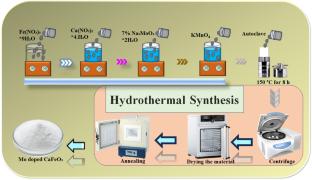
The innovation in energy storage technology is crucial to solving the world’s energy problems. Renewable resources have drawn the interest of researchers because the non-renewable resources are limited. Supercapacitors are revolutionary storage and energy conversion devices that are gaining popularity due to their higher specific power. The present study is about the fabrication of CaFeO3 and Mo-doped CaFeO3 through sustainable hydrothermal technique. To verify its electrochemical properties, different techniques were used, including charge-discharge as well as electrochemical surface area. The capacitance of the resulting Mo-doped CaFeO3 material is 1722.5 F/g, which is greater than that of the CaFeO3 material with capacitance of 897.8 F/g. The produced Mo-doped CaFeO3 material has 237.5 W/kg of specific power and 54.1 Wh/kg of specific energy. The produced CaFeO3 doped with Mo showed remarkable retention after undergoing 5000th cycle. The electrochemical performance and the specific surface area of pure material was improved by doping. The results showed that the doped material’s electrochemical activity was enhanced and charges were stored more effectively than the pure material. The exceptional performance of Mo-doped CaFeO3 nanomaterial indicates their significant potential for future energy storage technology.
期刊介绍:
Applied Physics A publishes experimental and theoretical investigations in applied physics as regular articles, rapid communications, and invited papers. The distinguished 30-member Board of Editors reflects the interdisciplinary approach of the journal and ensures the highest quality of peer review.



 京公网安备 11010802042870号
京ICP备2023020795号-1
京公网安备 11010802042870号
京ICP备2023020795号-1

 分享
分享
 求助内容:
求助内容: 应助结果提醒方式:
 扫码关注我们
