{"title":"Evaluation of selective recovery of fine cassiterite from copper/zinc tailings: Comprehensive utilization of tailings resources","authors":"Weiming Wu , Feng Zhang , Sen Li , Leming Ou","doi":"10.1016/j.seppur.2025.133103","DOIUrl":null,"url":null,"abstract":"<div><div>In practical production, cassiterite flotation is typically conducted at the end of the mineral processing circuit, resulting in significant losses of fine-grained cassiterite to tailings, which not only wastes valuable resources but also poses environmental risks. This study aims to selectively recover fine cassiterite from copper/zinc tailings (CZT) using <em>tert</em>-butyl benzohydroxamic acid (TBHA) as a novel collector. Bench-scale flotation tests demonstrated that TBHA significantly outperformed conventional benzohydroxamic acid (BHA). At a collector dosage of 600 g/t, TBHA increased the tin grade from 0.81 % to 1.62 % and the recovery from 40.2 % to 49.8 %. The addition of zinc sulfate (600 g/t) further enhanced selectivity, raising the tin grade to 1.87 % and recovery to 65.8 %. Mechanistic studies, including adsorption measurements, Fourier transform infrared spectroscopy (FTIR), X-ray photoelectron spectroscopy (XPS), scanning electron microscopy (SEM), and density functional theory (DFT) calculations, revealed that Zn<sup>2+</sup> facilitated the adsorption of TBHA on the cassiterite surface by forming a stable five-membered chelate ring, rendering the (110) surface hydrophobic. These findings highlight the synergistic role of TBHA and Zn<sup>2+</sup> in cassiterite flotation, offering a promising approach for the efficient recovery of fine cassiterite from tailings and contributing to the sustainable utilization of mineral resources.</div></div>","PeriodicalId":427,"journal":{"name":"Separation and Purification Technology","volume":"368 ","pages":"Article 133103"},"PeriodicalIF":9.0000,"publicationDate":"2025-09-17","publicationTypes":"Journal Article","fieldsOfStudy":null,"isOpenAccess":false,"openAccessPdf":"","citationCount":"0","resultStr":null,"platform":"Semanticscholar","paperid":null,"PeriodicalName":"Separation and Purification Technology","FirstCategoryId":"5","ListUrlMain":"https://www.sciencedirect.com/science/article/pii/S1383586625017009","RegionNum":1,"RegionCategory":"工程技术","ArticlePicture":[],"TitleCN":null,"AbstractTextCN":null,"PMCID":null,"EPubDate":"2025/4/18 0:00:00","PubModel":"Epub","JCR":"Q1","JCRName":"ENGINEERING, CHEMICAL","Score":null,"Total":0}
引用次数: 0
Abstract
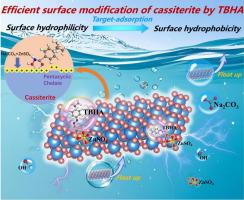
In practical production, cassiterite flotation is typically conducted at the end of the mineral processing circuit, resulting in significant losses of fine-grained cassiterite to tailings, which not only wastes valuable resources but also poses environmental risks. This study aims to selectively recover fine cassiterite from copper/zinc tailings (CZT) using tert-butyl benzohydroxamic acid (TBHA) as a novel collector. Bench-scale flotation tests demonstrated that TBHA significantly outperformed conventional benzohydroxamic acid (BHA). At a collector dosage of 600 g/t, TBHA increased the tin grade from 0.81 % to 1.62 % and the recovery from 40.2 % to 49.8 %. The addition of zinc sulfate (600 g/t) further enhanced selectivity, raising the tin grade to 1.87 % and recovery to 65.8 %. Mechanistic studies, including adsorption measurements, Fourier transform infrared spectroscopy (FTIR), X-ray photoelectron spectroscopy (XPS), scanning electron microscopy (SEM), and density functional theory (DFT) calculations, revealed that Zn2+ facilitated the adsorption of TBHA on the cassiterite surface by forming a stable five-membered chelate ring, rendering the (110) surface hydrophobic. These findings highlight the synergistic role of TBHA and Zn2+ in cassiterite flotation, offering a promising approach for the efficient recovery of fine cassiterite from tailings and contributing to the sustainable utilization of mineral resources.
期刊介绍:
Separation and Purification Technology is a premier journal committed to sharing innovative methods for separation and purification in chemical and environmental engineering, encompassing both homogeneous solutions and heterogeneous mixtures. Our scope includes the separation and/or purification of liquids, vapors, and gases, as well as carbon capture and separation techniques. However, it's important to note that methods solely intended for analytical purposes are not within the scope of the journal. Additionally, disciplines such as soil science, polymer science, and metallurgy fall outside the purview of Separation and Purification Technology. Join us in advancing the field of separation and purification methods for sustainable solutions in chemical and environmental engineering.




 京公网安备 11010802042870号
京ICP备2023020795号-1
京公网安备 11010802042870号
京ICP备2023020795号-1

 分享
分享
 求助内容:
求助内容: 应助结果提醒方式:
 扫码关注我们
