{"title":"Synergistic effect of calcite plugging and mixed collectors on carbon-ash separation and enhanced carbon recovery from coal gasification slag","authors":"Shihai Guo, Jingfeng He, Yuhao Liu, Bin Yang, Xinyao Wang, Hailong Tang","doi":"10.1016/j.seppur.2025.133108","DOIUrl":null,"url":null,"abstract":"<div><div>Coal gasification slag (CGS) is considered as a potential fuel due to its high carbon content, but the high ash content limits its fuel application. Separation of carbon and ash fractions is the key to efficient utilization of CGS. However, the traditional carbon flotation process suffers from high dosages of collectors, low separation efficiency, and low recovery rate due to the enriched pore structure of carbon. The study recommended the use of kerosene-sodium oleate (NaOL) as combined collector and calcite as a pore-plugging medium to improve the flotation recovery of carbon in CGS. Scanning electron microscopy (SEM) revealed that calcite, acting as a plugging medium, successfully entered and plugged the carbon pores. Flotation results indicated that the method could reduce reagent consumption by 75 % while achieving the same recovery. The contact angle test revealed that the kerosene-NaOL treatment increased the carbon-calcite contact angle from 57.75° to 95.25°, while the zeta potential shifted from 3.35 mV to −7.50 mV. In contrast, the contact angle and zeta potential of the ash were almost unchanged. This indicated that kerosene-NaOL was selectively adsorbed onto carbon-calcite. Fourier infrared spectroscopy (FTIR) and X-ray Photoelectron Spectroscopy (XPS) results further confirmed that kerosene-NaOL was adsorbed on the carbon surface though –COOH groups. Moreover, calcite could not only save reagents by plugging pores, but also enhance the NaOL adsorption by forming COOCa bonds with NaOL. Simultaneously, kerosene could also facilitate the adsorption of NaOL on the calcite surface, thus improving the overall flotation efficiency. Calculations based on the E-DLVO theory revealed that kerosene-NaOL treatment could significantly improve the adhesion between carbon-calcite and bubbles.</div></div>","PeriodicalId":427,"journal":{"name":"Separation and Purification Technology","volume":"370 ","pages":"Article 133108"},"PeriodicalIF":9.0000,"publicationDate":"2025-10-18","publicationTypes":"Journal Article","fieldsOfStudy":null,"isOpenAccess":false,"openAccessPdf":"","citationCount":"0","resultStr":null,"platform":"Semanticscholar","paperid":null,"PeriodicalName":"Separation and Purification Technology","FirstCategoryId":"5","ListUrlMain":"https://www.sciencedirect.com/science/article/pii/S1383586625017058","RegionNum":1,"RegionCategory":"工程技术","ArticlePicture":[],"TitleCN":null,"AbstractTextCN":null,"PMCID":null,"EPubDate":"2025/4/18 0:00:00","PubModel":"Epub","JCR":"Q1","JCRName":"ENGINEERING, CHEMICAL","Score":null,"Total":0}
引用次数: 0
Abstract
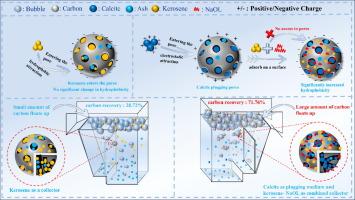
Coal gasification slag (CGS) is considered as a potential fuel due to its high carbon content, but the high ash content limits its fuel application. Separation of carbon and ash fractions is the key to efficient utilization of CGS. However, the traditional carbon flotation process suffers from high dosages of collectors, low separation efficiency, and low recovery rate due to the enriched pore structure of carbon. The study recommended the use of kerosene-sodium oleate (NaOL) as combined collector and calcite as a pore-plugging medium to improve the flotation recovery of carbon in CGS. Scanning electron microscopy (SEM) revealed that calcite, acting as a plugging medium, successfully entered and plugged the carbon pores. Flotation results indicated that the method could reduce reagent consumption by 75 % while achieving the same recovery. The contact angle test revealed that the kerosene-NaOL treatment increased the carbon-calcite contact angle from 57.75° to 95.25°, while the zeta potential shifted from 3.35 mV to −7.50 mV. In contrast, the contact angle and zeta potential of the ash were almost unchanged. This indicated that kerosene-NaOL was selectively adsorbed onto carbon-calcite. Fourier infrared spectroscopy (FTIR) and X-ray Photoelectron Spectroscopy (XPS) results further confirmed that kerosene-NaOL was adsorbed on the carbon surface though –COOH groups. Moreover, calcite could not only save reagents by plugging pores, but also enhance the NaOL adsorption by forming COOCa bonds with NaOL. Simultaneously, kerosene could also facilitate the adsorption of NaOL on the calcite surface, thus improving the overall flotation efficiency. Calculations based on the E-DLVO theory revealed that kerosene-NaOL treatment could significantly improve the adhesion between carbon-calcite and bubbles.
期刊介绍:
Separation and Purification Technology is a premier journal committed to sharing innovative methods for separation and purification in chemical and environmental engineering, encompassing both homogeneous solutions and heterogeneous mixtures. Our scope includes the separation and/or purification of liquids, vapors, and gases, as well as carbon capture and separation techniques. However, it's important to note that methods solely intended for analytical purposes are not within the scope of the journal. Additionally, disciplines such as soil science, polymer science, and metallurgy fall outside the purview of Separation and Purification Technology. Join us in advancing the field of separation and purification methods for sustainable solutions in chemical and environmental engineering.




 京公网安备 11010802042870号
京ICP备2023020795号-1
京公网安备 11010802042870号
京ICP备2023020795号-1

 分享
分享
 求助内容:
求助内容: 应助结果提醒方式:
 扫码关注我们
