{"title":"Reaction Kinetics and Mass Transfer Synergistically Enhanced Electrodes for High-Performance Zinc–Bromine Flow Batteries","authors":"Jiayi Li, Zeyu Xu, Maochun Wu","doi":"10.1021/acsami.4c22329","DOIUrl":null,"url":null,"abstract":"Zinc–bromine flow batteries (ZBFBs) hold great promise for grid-scale energy storage owing to their high theoretical energy density and cost-effectiveness. However, conventional ZBFBs suffer from inhomogeneous zinc deposition and sluggish Br<sub>2</sub>/Br<sup>–</sup> redox kinetics, resulting in a short cycle life and low power density. Herein, a multiscale porous electrode with abundant nitrogen-containing functional groups is developed by growing zeolitic imidazolate framework-8 in situ on graphite felts, followed by a facile carbonization process to simultaneously tackle both the challenges. Theoretical and experimental results reveal that nitrogen-containing functional groups exhibit a high adsorption energy toward zinc atoms, while the microstructures promote pore-level mass transport, thereby resulting in compact and uniform zinc deposition. In the meantime, the electrode boosts the Br<sub>2</sub>/Br<sup>–</sup> reaction kinetics due to its high catalytic activity and large surface area. As a result, the ZBFBs equipped with optimized electrodes at both negative and positive sides can operate at an ultrahigh current density of 250 mA cm<sup>–2</sup> while maintaining an energy efficiency of 68.0%, far surpassing that with pristine graphite felts (50.7%). Remarkably, the battery exhibits excellent cycling stability over 2000 cycles without obvious decay. This study provides a simple yet effective method for developing high-performance electrodes to tackle the critical challenges in ZBFBs, thereby promoting the commercialization of this promising energy storage technology.","PeriodicalId":5,"journal":{"name":"ACS Applied Materials & Interfaces","volume":"40 1","pages":""},"PeriodicalIF":8.2000,"publicationDate":"2025-04-18","publicationTypes":"Journal Article","fieldsOfStudy":null,"isOpenAccess":false,"openAccessPdf":"","citationCount":"0","resultStr":null,"platform":"Semanticscholar","paperid":null,"PeriodicalName":"ACS Applied Materials & Interfaces","FirstCategoryId":"88","ListUrlMain":"https://doi.org/10.1021/acsami.4c22329","RegionNum":2,"RegionCategory":"材料科学","ArticlePicture":[],"TitleCN":null,"AbstractTextCN":null,"PMCID":null,"EPubDate":"","PubModel":"","JCR":"Q1","JCRName":"MATERIALS SCIENCE, MULTIDISCIPLINARY","Score":null,"Total":0}
引用次数: 0
Abstract
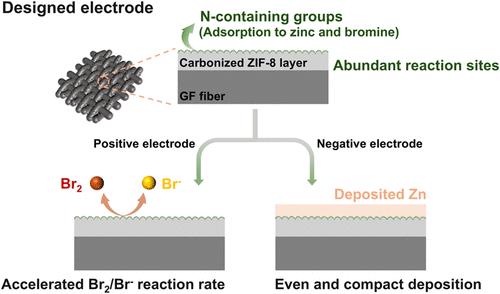
Zinc–bromine flow batteries (ZBFBs) hold great promise for grid-scale energy storage owing to their high theoretical energy density and cost-effectiveness. However, conventional ZBFBs suffer from inhomogeneous zinc deposition and sluggish Br2/Br– redox kinetics, resulting in a short cycle life and low power density. Herein, a multiscale porous electrode with abundant nitrogen-containing functional groups is developed by growing zeolitic imidazolate framework-8 in situ on graphite felts, followed by a facile carbonization process to simultaneously tackle both the challenges. Theoretical and experimental results reveal that nitrogen-containing functional groups exhibit a high adsorption energy toward zinc atoms, while the microstructures promote pore-level mass transport, thereby resulting in compact and uniform zinc deposition. In the meantime, the electrode boosts the Br2/Br– reaction kinetics due to its high catalytic activity and large surface area. As a result, the ZBFBs equipped with optimized electrodes at both negative and positive sides can operate at an ultrahigh current density of 250 mA cm–2 while maintaining an energy efficiency of 68.0%, far surpassing that with pristine graphite felts (50.7%). Remarkably, the battery exhibits excellent cycling stability over 2000 cycles without obvious decay. This study provides a simple yet effective method for developing high-performance electrodes to tackle the critical challenges in ZBFBs, thereby promoting the commercialization of this promising energy storage technology.
锌溴液流电池(ZBFBs)由于其较高的理论能量密度和成本效益,在电网规模储能方面具有很大的前景。然而,传统的ZBFBs存在锌沉积不均匀和Br2/Br -氧化还原动力学缓慢的问题,导致循环寿命短,功率密度低。本文通过在石墨毡上原位生长沸石咪唑酸框架-8,然后进行简单的碳化过程,开发了一种具有丰富含氮官能团的多尺度多孔电极,同时解决了这两个挑战。理论和实验结果表明,含氮官能团对锌原子具有较高的吸附能,而微观结构促进了孔级质量传递,从而使锌沉积致密均匀。同时,该电极具有较高的催化活性和较大的表面积,促进了Br2/Br -反应动力学。因此,在负极和正极均配置了优化电极的zbfb可以在250 mA cm-2的超高电流密度下工作,同时保持68.0%的能量效率,远远超过原始石墨毡(50.7%)。值得注意的是,该电池在2000次循环中表现出优异的循环稳定性,没有明显的衰减。这项研究为开发高性能电极提供了一种简单而有效的方法,以解决zbfb中的关键挑战,从而促进这一有前途的储能技术的商业化。
期刊介绍:
ACS Applied Materials & Interfaces is a leading interdisciplinary journal that brings together chemists, engineers, physicists, and biologists to explore the development and utilization of newly-discovered materials and interfacial processes for specific applications. Our journal has experienced remarkable growth since its establishment in 2009, both in terms of the number of articles published and the impact of the research showcased. We are proud to foster a truly global community, with the majority of published articles originating from outside the United States, reflecting the rapid growth of applied research worldwide.



 京公网安备 11010802042870号
京ICP备2023020795号-1
京公网安备 11010802042870号
京ICP备2023020795号-1

 分享
分享
 求助内容:
求助内容: 应助结果提醒方式:
 扫码关注我们
