Sören Otto, Beate Berkelmann-Löhnertz, Bianca May, Randolf Kauer, Ralf Schweiggert
{"title":"Impact of Spray Concentration and Application Frequency to Modulate Phosphonic Acid Residues in Container-Grown Grapevines","authors":"Sören Otto, Beate Berkelmann-Löhnertz, Bianca May, Randolf Kauer, Ralf Schweiggert","doi":"10.1021/acs.jafc.4c12228","DOIUrl":null,"url":null,"abstract":"This study investigated the translocation and persistence of inorganic phosphonate in container-grown vines of <i>Vitis vinifera</i> L. cv. Riesling after foliar and soil applications over two consecutive years. Phosphonate concentrations were monitored in leaves, petioles, grape canes, shoot tips, inflorescences, and berries during the season, applying an identical total amount of 3 or 4 sprays of 0.54 or 0.4% (w/v, aq) phosphonate, respectively. The overall uptake of inorganic phosphonate into the leaves was either identical (year 1) or substantially lower (year 2) when spraying 3 times (0.54%) instead of 4 times (0.4%) as expressed by the area under the concentration vs time curve. Residues found in leaves at the end of the vegetation period were also lower when spraying 3 times. Across both years, residues in berries were also significantly lower when applying the 0.54% phosphonate solution (20.2–30.9 mg/kg) 3 times as compared with the 4× application of 0.4% phosphonate (38.5–40.6 mg/kg). Soil applications resulted in a comparably low overall uptake but still yielding measurable residues in berries (6.0 ± 1.2 mg/kg). Further data on grape cane, shoot tips, and inflorescences supported the hypothesis that phosphonate residues in the plant and, ultimately, in the berries and the resulting products might be significantly reduced when spraying 3 times (0.54%) instead of 4 times (0.4%).","PeriodicalId":41,"journal":{"name":"Journal of Agricultural and Food Chemistry","volume":"75 1","pages":""},"PeriodicalIF":6.2000,"publicationDate":"2025-04-18","publicationTypes":"Journal Article","fieldsOfStudy":null,"isOpenAccess":false,"openAccessPdf":"","citationCount":"0","resultStr":null,"platform":"Semanticscholar","paperid":null,"PeriodicalName":"Journal of Agricultural and Food Chemistry","FirstCategoryId":"97","ListUrlMain":"https://doi.org/10.1021/acs.jafc.4c12228","RegionNum":1,"RegionCategory":"农林科学","ArticlePicture":[],"TitleCN":null,"AbstractTextCN":null,"PMCID":null,"EPubDate":"","PubModel":"","JCR":"Q1","JCRName":"AGRICULTURE, MULTIDISCIPLINARY","Score":null,"Total":0}
引用次数: 0
Abstract
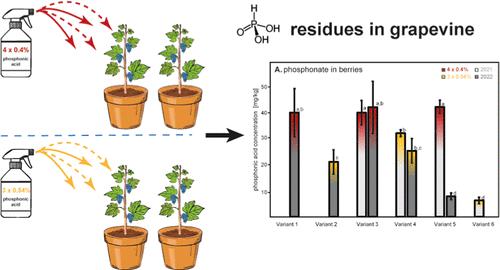
This study investigated the translocation and persistence of inorganic phosphonate in container-grown vines of Vitis vinifera L. cv. Riesling after foliar and soil applications over two consecutive years. Phosphonate concentrations were monitored in leaves, petioles, grape canes, shoot tips, inflorescences, and berries during the season, applying an identical total amount of 3 or 4 sprays of 0.54 or 0.4% (w/v, aq) phosphonate, respectively. The overall uptake of inorganic phosphonate into the leaves was either identical (year 1) or substantially lower (year 2) when spraying 3 times (0.54%) instead of 4 times (0.4%) as expressed by the area under the concentration vs time curve. Residues found in leaves at the end of the vegetation period were also lower when spraying 3 times. Across both years, residues in berries were also significantly lower when applying the 0.54% phosphonate solution (20.2–30.9 mg/kg) 3 times as compared with the 4× application of 0.4% phosphonate (38.5–40.6 mg/kg). Soil applications resulted in a comparably low overall uptake but still yielding measurable residues in berries (6.0 ± 1.2 mg/kg). Further data on grape cane, shoot tips, and inflorescences supported the hypothesis that phosphonate residues in the plant and, ultimately, in the berries and the resulting products might be significantly reduced when spraying 3 times (0.54%) instead of 4 times (0.4%).
期刊介绍:
The Journal of Agricultural and Food Chemistry publishes high-quality, cutting edge original research representing complete studies and research advances dealing with the chemistry and biochemistry of agriculture and food. The Journal also encourages papers with chemistry and/or biochemistry as a major component combined with biological/sensory/nutritional/toxicological evaluation related to agriculture and/or food.




 京公网安备 11010802042870号
京ICP备2023020795号-1
京公网安备 11010802042870号
京ICP备2023020795号-1

 分享
分享
 求助内容:
求助内容: 应助结果提醒方式:
 扫码关注我们
