Kadsada Sala, Salila Pengthaisong, Chamaipon Beagbandee, James R. Ketudat Cairns
{"title":"Expression and Characterization of a Rice β-Xylosidase with Xylooligosaccharide Hydrolysis and Transglycosylation Activities","authors":"Kadsada Sala, Salila Pengthaisong, Chamaipon Beagbandee, James R. Ketudat Cairns","doi":"10.1021/acs.jafc.4c13281","DOIUrl":null,"url":null,"abstract":"Plant β-xylosidases are less well characterized for hemicellulose degradation than their microbial counterparts. To address this, a broadly expressed rice (<i>Oryza sativa</i>) glycoside hydrolase family 3 (GH3) β-xylosidase designated OsXyl1 was expressed in heterologous <i>Pichia pastoris</i>. OsXyl1 showed maximal enzyme activity at pH 4.0 and 60 °C. It was relatively stable at 30–50 °C. It hydrolyzed 4NP-β-<span><i>d</i></span>-xylopyranoside (4NPXyl) and β-1,4-linked xylooligosaccharides (XOS) with degrees of polymerization (DP) of 2–6. OsXyl1 hydrolylsis of 4NPXyl was much more rapid and specific than that of other 4NP glycosides with an apparent <i>k</i><sub>cat</sub>/<i>K</i><sub>m</sub> value of 19.0 mM<sup>–1</sup> s<sup>–1</sup>. OsXyl1 had similar specificity toward XOS having DP values of 2–5 with apparent <i>k</i><sub>cat</sub>/<i>K</i><sub>m</sub> values of 2.6–4.2 mM<sup>–1</sup> s<sup>–1</sup>. OsXyl1 was also efficient at transglycosylating short alcohols with 4NPXyl and XOS xylosyl donors. Therefore, rice OsXyl1 β-xylosidase may function in recycling of xylans in plant cell wall recycling and it may be applied for transglycosylation of alcohol acceptors.","PeriodicalId":41,"journal":{"name":"Journal of Agricultural and Food Chemistry","volume":"75 5 1","pages":""},"PeriodicalIF":6.2000,"publicationDate":"2025-04-18","publicationTypes":"Journal Article","fieldsOfStudy":null,"isOpenAccess":false,"openAccessPdf":"","citationCount":"0","resultStr":null,"platform":"Semanticscholar","paperid":null,"PeriodicalName":"Journal of Agricultural and Food Chemistry","FirstCategoryId":"97","ListUrlMain":"https://doi.org/10.1021/acs.jafc.4c13281","RegionNum":1,"RegionCategory":"农林科学","ArticlePicture":[],"TitleCN":null,"AbstractTextCN":null,"PMCID":null,"EPubDate":"","PubModel":"","JCR":"Q1","JCRName":"AGRICULTURE, MULTIDISCIPLINARY","Score":null,"Total":0}
引用次数: 0
Abstract
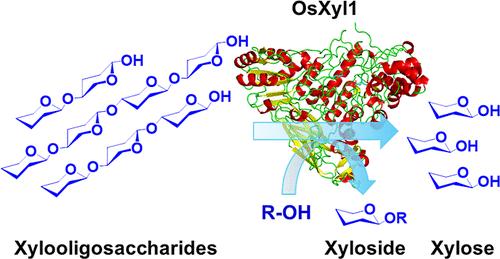
Plant β-xylosidases are less well characterized for hemicellulose degradation than their microbial counterparts. To address this, a broadly expressed rice (Oryza sativa) glycoside hydrolase family 3 (GH3) β-xylosidase designated OsXyl1 was expressed in heterologous Pichia pastoris. OsXyl1 showed maximal enzyme activity at pH 4.0 and 60 °C. It was relatively stable at 30–50 °C. It hydrolyzed 4NP-β-d-xylopyranoside (4NPXyl) and β-1,4-linked xylooligosaccharides (XOS) with degrees of polymerization (DP) of 2–6. OsXyl1 hydrolylsis of 4NPXyl was much more rapid and specific than that of other 4NP glycosides with an apparent kcat/Km value of 19.0 mM–1 s–1. OsXyl1 had similar specificity toward XOS having DP values of 2–5 with apparent kcat/Km values of 2.6–4.2 mM–1 s–1. OsXyl1 was also efficient at transglycosylating short alcohols with 4NPXyl and XOS xylosyl donors. Therefore, rice OsXyl1 β-xylosidase may function in recycling of xylans in plant cell wall recycling and it may be applied for transglycosylation of alcohol acceptors.
期刊介绍:
The Journal of Agricultural and Food Chemistry publishes high-quality, cutting edge original research representing complete studies and research advances dealing with the chemistry and biochemistry of agriculture and food. The Journal also encourages papers with chemistry and/or biochemistry as a major component combined with biological/sensory/nutritional/toxicological evaluation related to agriculture and/or food.



 京公网安备 11010802042870号
京ICP备2023020795号-1
京公网安备 11010802042870号
京ICP备2023020795号-1

 分享
分享
 求助内容:
求助内容: 应助结果提醒方式:
 扫码关注我们
