Henan Peng , Fengqin Hong , Pan Chen , Chunhai Chen , Daming Wang , Hongwei Zhou
{"title":"Preparation of organic solvent-resistant nanofiltration membranes through copper sulfate (CuSO4)/hydrogen peroxide (H2O2) oxidation triggered polydopamine (PDA)/polyethyleneimine (PEI) deposition interlayer","authors":"Henan Peng , Fengqin Hong , Pan Chen , Chunhai Chen , Daming Wang , Hongwei Zhou","doi":"10.1016/j.seppur.2025.133090","DOIUrl":null,"url":null,"abstract":"<div><div>In this study, a novel organic solvent-resistant nanofiltration membrane was prepared on a polyimide ultrafiltration base membrane using a copper sulfate (CuSO<sub>4</sub>)/hydrogen peroxide (H<sub>2</sub>O<sub>2</sub>) oxidation triggered polydopamine (PDA)/polyethyleneimine (PEI) deposition interlayer. The PDA/PEI interlayer exhibits strong adhesion with base membrane, effectively connecting the ultrafiltration base membrane to the polyamide active layer, thus enhancing the solvent resistance of the nanofiltration membrane. The CuSO<sub>4</sub>/H<sub>2</sub>O<sub>2</sub> catalyst significantly reduces the deposition time of PDA/PEI on polyimide base membrane. Additionally, copper (II) ions (Cu<sup>2+</sup>) can form complexes with the amino groups (NH<sub>2</sub>) of the aqueous phase monomer m-phenylenediamine (MPD), thereby slowing the diffusion rate of MPD into the organic phase. The interlayer contains a significant number of hydroxyl and amino groups, which can engage in hydrogen bonding interactions with MPD, thereby further regulating the reaction rate. The resulting nanofiltration membranes exhibit excellent hydrophilicity, as demonstrated by their minimal water contact angle, and are capable of positively influencing the permeance of polar solvents. Notably, the nanofiltration membrane prepared with a deposition time of 15 min and a CuSO<sub>4</sub> concentration of 45 mmol/L exhibited optimal performance, achieving a methanol permeance of 16.20 L m<sup>-2</sup>h<sup>−1</sup> bar<sup>−1</sup> and Rhodamine B dye rejection rate of 96.9 %. The permeance of different solvents was determined to rely on the inherent characteristics of those solvents. Furthermore, the membrane maintained good separation performance after being immersed in N, N-dimethylformamide at 80 °C for 6 days. This method offers a novel perspective for the development of nanofiltration membranes that are resistant to organic solvents.</div></div>","PeriodicalId":427,"journal":{"name":"Separation and Purification Technology","volume":"369 ","pages":"Article 133090"},"PeriodicalIF":9.0000,"publicationDate":"2025-10-07","publicationTypes":"Journal Article","fieldsOfStudy":null,"isOpenAccess":false,"openAccessPdf":"","citationCount":"0","resultStr":null,"platform":"Semanticscholar","paperid":null,"PeriodicalName":"Separation and Purification Technology","FirstCategoryId":"5","ListUrlMain":"https://www.sciencedirect.com/science/article/pii/S1383586625016879","RegionNum":1,"RegionCategory":"工程技术","ArticlePicture":[],"TitleCN":null,"AbstractTextCN":null,"PMCID":null,"EPubDate":"2025/4/18 0:00:00","PubModel":"Epub","JCR":"Q1","JCRName":"ENGINEERING, CHEMICAL","Score":null,"Total":0}
引用次数: 0
Abstract
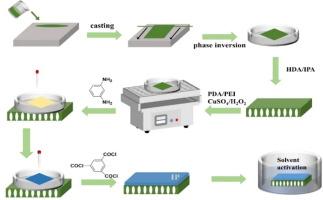
In this study, a novel organic solvent-resistant nanofiltration membrane was prepared on a polyimide ultrafiltration base membrane using a copper sulfate (CuSO4)/hydrogen peroxide (H2O2) oxidation triggered polydopamine (PDA)/polyethyleneimine (PEI) deposition interlayer. The PDA/PEI interlayer exhibits strong adhesion with base membrane, effectively connecting the ultrafiltration base membrane to the polyamide active layer, thus enhancing the solvent resistance of the nanofiltration membrane. The CuSO4/H2O2 catalyst significantly reduces the deposition time of PDA/PEI on polyimide base membrane. Additionally, copper (II) ions (Cu2+) can form complexes with the amino groups (NH2) of the aqueous phase monomer m-phenylenediamine (MPD), thereby slowing the diffusion rate of MPD into the organic phase. The interlayer contains a significant number of hydroxyl and amino groups, which can engage in hydrogen bonding interactions with MPD, thereby further regulating the reaction rate. The resulting nanofiltration membranes exhibit excellent hydrophilicity, as demonstrated by their minimal water contact angle, and are capable of positively influencing the permeance of polar solvents. Notably, the nanofiltration membrane prepared with a deposition time of 15 min and a CuSO4 concentration of 45 mmol/L exhibited optimal performance, achieving a methanol permeance of 16.20 L m-2h−1 bar−1 and Rhodamine B dye rejection rate of 96.9 %. The permeance of different solvents was determined to rely on the inherent characteristics of those solvents. Furthermore, the membrane maintained good separation performance after being immersed in N, N-dimethylformamide at 80 °C for 6 days. This method offers a novel perspective for the development of nanofiltration membranes that are resistant to organic solvents.
期刊介绍:
Separation and Purification Technology is a premier journal committed to sharing innovative methods for separation and purification in chemical and environmental engineering, encompassing both homogeneous solutions and heterogeneous mixtures. Our scope includes the separation and/or purification of liquids, vapors, and gases, as well as carbon capture and separation techniques. However, it's important to note that methods solely intended for analytical purposes are not within the scope of the journal. Additionally, disciplines such as soil science, polymer science, and metallurgy fall outside the purview of Separation and Purification Technology. Join us in advancing the field of separation and purification methods for sustainable solutions in chemical and environmental engineering.




 京公网安备 11010802042870号
京ICP备2023020795号-1
京公网安备 11010802042870号
京ICP备2023020795号-1

 分享
分享
 求助内容:
求助内容: 应助结果提醒方式:
 扫码关注我们
