John Nightingale, Stefan Trapp, Andrea Garduño-Jiménez, Laura Carter
{"title":"A framework to assess pharmaceutical accumulation in crops: from wastewater irrigation to consumption","authors":"John Nightingale, Stefan Trapp, Andrea Garduño-Jiménez, Laura Carter","doi":"10.1016/j.jhazmat.2025.138297","DOIUrl":null,"url":null,"abstract":"The reuse of treated wastewater for irrigation can inadvertently introduce a suite of emerging contaminants such as pharmaceuticals into agri-ecosystems. However, current monitoring efforts to characterize exposure usually focus on a limited range of analytes. A modelling framework was developed that employs a sequence of pre-developed models to predict accumulative potential in a model crop, <em>Zea mays</em> (corn), using chemical structure and excretion rate as the only model inputs. <em>Z. mays</em> was selected as the model crop as it is a major food source, stands as one of the highest cultivated crops globally, and is characterized as having a medium uptake potential. The framework was used to predict uptake in <em>Z. mays</em> in three regions characteristic of high wastewater reuse (Australia, the US and the Middle East). Despite regional and plant specific differences, 66.7% of the calculated concentrations were within a factor of ten of those reported in the literature. Topiramate, furosemide, and gemfibrozil were observed to accumulate to the greatest extent in <em>Z. mays</em>, predicted concentrations ranged between 50.27-418.0 (ng/g dw) for the top 10. Acids predominantly accumulated in leaves and fruit whereas a higher proportion of bases were predicted to accumulate in the roots. To the best of our knowledge 56.7% of the 30 highest-ranked pharmaceuticals have not been previously documented in existing literature or monitoring campaigns. This presented framework demonstrates a method to assess risk posed by pharmaceutical compounds with limited experimental data.","PeriodicalId":361,"journal":{"name":"Journal of Hazardous Materials","volume":"17 1","pages":""},"PeriodicalIF":11.3000,"publicationDate":"2025-04-18","publicationTypes":"Journal Article","fieldsOfStudy":null,"isOpenAccess":false,"openAccessPdf":"","citationCount":"0","resultStr":null,"platform":"Semanticscholar","paperid":null,"PeriodicalName":"Journal of Hazardous Materials","FirstCategoryId":"93","ListUrlMain":"https://doi.org/10.1016/j.jhazmat.2025.138297","RegionNum":1,"RegionCategory":"环境科学与生态学","ArticlePicture":[],"TitleCN":null,"AbstractTextCN":null,"PMCID":null,"EPubDate":"","PubModel":"","JCR":"Q1","JCRName":"ENGINEERING, ENVIRONMENTAL","Score":null,"Total":0}
引用次数: 0
Abstract
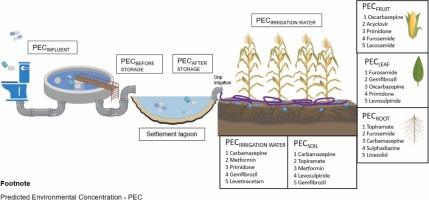
The reuse of treated wastewater for irrigation can inadvertently introduce a suite of emerging contaminants such as pharmaceuticals into agri-ecosystems. However, current monitoring efforts to characterize exposure usually focus on a limited range of analytes. A modelling framework was developed that employs a sequence of pre-developed models to predict accumulative potential in a model crop, Zea mays (corn), using chemical structure and excretion rate as the only model inputs. Z. mays was selected as the model crop as it is a major food source, stands as one of the highest cultivated crops globally, and is characterized as having a medium uptake potential. The framework was used to predict uptake in Z. mays in three regions characteristic of high wastewater reuse (Australia, the US and the Middle East). Despite regional and plant specific differences, 66.7% of the calculated concentrations were within a factor of ten of those reported in the literature. Topiramate, furosemide, and gemfibrozil were observed to accumulate to the greatest extent in Z. mays, predicted concentrations ranged between 50.27-418.0 (ng/g dw) for the top 10. Acids predominantly accumulated in leaves and fruit whereas a higher proportion of bases were predicted to accumulate in the roots. To the best of our knowledge 56.7% of the 30 highest-ranked pharmaceuticals have not been previously documented in existing literature or monitoring campaigns. This presented framework demonstrates a method to assess risk posed by pharmaceutical compounds with limited experimental data.
期刊介绍:
The Journal of Hazardous Materials serves as a global platform for promoting cutting-edge research in the field of Environmental Science and Engineering. Our publication features a wide range of articles, including full-length research papers, review articles, and perspectives, with the aim of enhancing our understanding of the dangers and risks associated with various materials concerning public health and the environment. It is important to note that the term "environmental contaminants" refers specifically to substances that pose hazardous effects through contamination, while excluding those that do not have such impacts on the environment or human health. Moreover, we emphasize the distinction between wastes and hazardous materials in order to provide further clarity on the scope of the journal. We have a keen interest in exploring specific compounds and microbial agents that have adverse effects on the environment.



 京公网安备 11010802042870号
京ICP备2023020795号-1
京公网安备 11010802042870号
京ICP备2023020795号-1

 分享
分享
 求助内容:
求助内容: 应助结果提醒方式:
 扫码关注我们
