{"title":"Improved identification of chlorinated disinfection byproducts by the sequential elution and absorption mode","authors":"Rong Qin, Yiming Feng, Shasha Zhuo, Qing-Long Fu","doi":"10.1016/j.jhazmat.2025.138337","DOIUrl":null,"url":null,"abstract":"<div><div>Fourier transform ion cyclotron resonance mass spectrometry (FT-ICR MS) has been extensively employed to characterize the chemodiversty of dissolved organic matter (DOM) including chlorinated disinfection byproducts (Cl<sub><em>n</em></sub>-DBPs). However, little is known about the combined effects of the sequential solid phase extraction (SPE) and absorption mode of Fourier transform data processing on the identification of Cl<sub><em>n</em></sub>-DBPs. In this study, the identification of Cl<sub><em>n</em></sub>-DBPs by the sequential SPE extraction and absorption mode were systematically compared using a typical swimming pool water. The sequential SPE extraction was more effective in extracting DOM molecules including Cl<sub><em>n</em></sub>-DBPs than the traditional extraction, yielding 48.2 % ± 2.1 % and 87.3 % ± 3.8 % more DOM molecules and Cl<sub><em>n</em></sub>-DBPs molecules, respectively. Moreover, a total of 274 nitrogenous Cl<sub><em>n</em></sub>-DBPs were identified by the sequential SPE extraction with 80 more than that by the traditional SPE. The absorption mode improved the resolution and the signal-to-noise values of DOM peaks by factors of 1.87–1.98 and 1.52–1.60, respectively. The number of resolved Cl-related mass doublets within 2 mDa mass difference in the absorption mode was 537 more than that in the magnitude mode. Overall, the combination of sequential elution and absorption modes facilitated the detection of more molecules of DOM and Cl<sub><em>n</em></sub>-DBPs compared to traditional SPE in magnitude mode, with an increase of 92.7 % ± 2.1 % and 121.7 % ± 5.6 %, respectively. These results have highlighted the great potential of the sequential elution combined with absorption mode in improving the identification of Cl<sub><em>n</em></sub>-DBPs and their precursors, facilitating the application of FT-ICR MS in the nontargeted analysis of emerging contaminants including Cl<sub><em>n</em></sub>-DBPs at the molecular level.</div></div>","PeriodicalId":361,"journal":{"name":"Journal of Hazardous Materials","volume":"493 ","pages":"Article 138337"},"PeriodicalIF":11.3000,"publicationDate":"2025-08-05","publicationTypes":"Journal Article","fieldsOfStudy":null,"isOpenAccess":false,"openAccessPdf":"","citationCount":"0","resultStr":null,"platform":"Semanticscholar","paperid":null,"PeriodicalName":"Journal of Hazardous Materials","FirstCategoryId":"93","ListUrlMain":"https://www.sciencedirect.com/science/article/pii/S030438942501252X","RegionNum":1,"RegionCategory":"环境科学与生态学","ArticlePicture":[],"TitleCN":null,"AbstractTextCN":null,"PMCID":null,"EPubDate":"2025/4/18 0:00:00","PubModel":"Epub","JCR":"Q1","JCRName":"ENGINEERING, ENVIRONMENTAL","Score":null,"Total":0}
引用次数: 0
Abstract
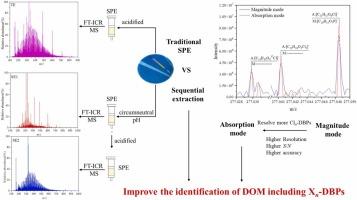
Fourier transform ion cyclotron resonance mass spectrometry (FT-ICR MS) has been extensively employed to characterize the chemodiversty of dissolved organic matter (DOM) including chlorinated disinfection byproducts (Cln-DBPs). However, little is known about the combined effects of the sequential solid phase extraction (SPE) and absorption mode of Fourier transform data processing on the identification of Cln-DBPs. In this study, the identification of Cln-DBPs by the sequential SPE extraction and absorption mode were systematically compared using a typical swimming pool water. The sequential SPE extraction was more effective in extracting DOM molecules including Cln-DBPs than the traditional extraction, yielding 48.2 % ± 2.1 % and 87.3 % ± 3.8 % more DOM molecules and Cln-DBPs molecules, respectively. Moreover, a total of 274 nitrogenous Cln-DBPs were identified by the sequential SPE extraction with 80 more than that by the traditional SPE. The absorption mode improved the resolution and the signal-to-noise values of DOM peaks by factors of 1.87–1.98 and 1.52–1.60, respectively. The number of resolved Cl-related mass doublets within 2 mDa mass difference in the absorption mode was 537 more than that in the magnitude mode. Overall, the combination of sequential elution and absorption modes facilitated the detection of more molecules of DOM and Cln-DBPs compared to traditional SPE in magnitude mode, with an increase of 92.7 % ± 2.1 % and 121.7 % ± 5.6 %, respectively. These results have highlighted the great potential of the sequential elution combined with absorption mode in improving the identification of Cln-DBPs and their precursors, facilitating the application of FT-ICR MS in the nontargeted analysis of emerging contaminants including Cln-DBPs at the molecular level.
期刊介绍:
The Journal of Hazardous Materials serves as a global platform for promoting cutting-edge research in the field of Environmental Science and Engineering. Our publication features a wide range of articles, including full-length research papers, review articles, and perspectives, with the aim of enhancing our understanding of the dangers and risks associated with various materials concerning public health and the environment. It is important to note that the term "environmental contaminants" refers specifically to substances that pose hazardous effects through contamination, while excluding those that do not have such impacts on the environment or human health. Moreover, we emphasize the distinction between wastes and hazardous materials in order to provide further clarity on the scope of the journal. We have a keen interest in exploring specific compounds and microbial agents that have adverse effects on the environment.



 京公网安备 11010802042870号
京ICP备2023020795号-1
京公网安备 11010802042870号
京ICP备2023020795号-1

 分享
分享
 求助内容:
求助内容: 应助结果提醒方式:
 扫码关注我们
