{"title":"Polyethylene microplastics impair chicken growth through gut microbiota-induced hepatic fatty acid metabolism dysfunction","authors":"Jiaping Xu, Qiuyue Zhang, Yu Wang, Zhipeng Cheng, Hongkai Zhu, Hongzhi Zhao, Yiming Yao, Liting Hua, Biting Qiao, Leicheng Zhao, Yongcheng Li, Lei Wang, Hongwen Sun","doi":"10.1016/j.jhazmat.2025.138335","DOIUrl":null,"url":null,"abstract":"<div><div>Microplastics (MPs) negatively impact various terrestrial animals, but their comprehensive effects on <em>Gallus gallus domesticus</em>, key agricultural and ecological species connecting people and the environment, are not well-documented. This study investigates the effects of polyethylene (PE) MPs and phthalate esters (PAEs) on chicken growth, liver metabolism, and gut microbiota using multi-omics and 16S rRNA sequencing technology. Results show that PE MPs, particularly those containing PAEs, significantly reduced body weight gain and hepatic triglyceride levels by up to 71.2 % and 50.1 %, respectively (<em>p</em> < 0.05). The clean MPs affected energy metabolism, while PAE-spiked MPs disrupted fatty acid metabolism and triggered immune and inflammatory responses in the liver. Key genes related to fatty acid metabolism such as FAN, SCD and ELOVL5 were significantly downregulated, leading to imbalances in lipid metabolism. These disruptions in PAE-spiked MPs exposure were associated with the altered gut microbiota balance, including increased <em>Firmicutes</em>/<em>Bacteroidetes</em> ratios and changes in <em>Actinobacteriota</em> and <em>Proteobacteria</em> abundance. Totally, the study highlights a \"Trojan Horse\" effect, where MPs act as carriers for PAEs, intensifying toxicity through gut-liver axis interactions. The findings emphasize the role of gut microbiota in mediating liver dysfunction and impaired growth.</div></div>","PeriodicalId":361,"journal":{"name":"Journal of Hazardous Materials","volume":"493 ","pages":"Article 138335"},"PeriodicalIF":11.3000,"publicationDate":"2025-08-05","publicationTypes":"Journal Article","fieldsOfStudy":null,"isOpenAccess":false,"openAccessPdf":"","citationCount":"0","resultStr":null,"platform":"Semanticscholar","paperid":null,"PeriodicalName":"Journal of Hazardous Materials","FirstCategoryId":"93","ListUrlMain":"https://www.sciencedirect.com/science/article/pii/S0304389425012506","RegionNum":1,"RegionCategory":"环境科学与生态学","ArticlePicture":[],"TitleCN":null,"AbstractTextCN":null,"PMCID":null,"EPubDate":"2025/4/18 0:00:00","PubModel":"Epub","JCR":"Q1","JCRName":"ENGINEERING, ENVIRONMENTAL","Score":null,"Total":0}
引用次数: 0
Abstract
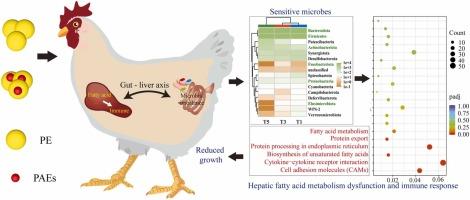
Microplastics (MPs) negatively impact various terrestrial animals, but their comprehensive effects on Gallus gallus domesticus, key agricultural and ecological species connecting people and the environment, are not well-documented. This study investigates the effects of polyethylene (PE) MPs and phthalate esters (PAEs) on chicken growth, liver metabolism, and gut microbiota using multi-omics and 16S rRNA sequencing technology. Results show that PE MPs, particularly those containing PAEs, significantly reduced body weight gain and hepatic triglyceride levels by up to 71.2 % and 50.1 %, respectively (p < 0.05). The clean MPs affected energy metabolism, while PAE-spiked MPs disrupted fatty acid metabolism and triggered immune and inflammatory responses in the liver. Key genes related to fatty acid metabolism such as FAN, SCD and ELOVL5 were significantly downregulated, leading to imbalances in lipid metabolism. These disruptions in PAE-spiked MPs exposure were associated with the altered gut microbiota balance, including increased Firmicutes/Bacteroidetes ratios and changes in Actinobacteriota and Proteobacteria abundance. Totally, the study highlights a "Trojan Horse" effect, where MPs act as carriers for PAEs, intensifying toxicity through gut-liver axis interactions. The findings emphasize the role of gut microbiota in mediating liver dysfunction and impaired growth.
期刊介绍:
The Journal of Hazardous Materials serves as a global platform for promoting cutting-edge research in the field of Environmental Science and Engineering. Our publication features a wide range of articles, including full-length research papers, review articles, and perspectives, with the aim of enhancing our understanding of the dangers and risks associated with various materials concerning public health and the environment. It is important to note that the term "environmental contaminants" refers specifically to substances that pose hazardous effects through contamination, while excluding those that do not have such impacts on the environment or human health. Moreover, we emphasize the distinction between wastes and hazardous materials in order to provide further clarity on the scope of the journal. We have a keen interest in exploring specific compounds and microbial agents that have adverse effects on the environment.



 京公网安备 11010802042870号
京ICP备2023020795号-1
京公网安备 11010802042870号
京ICP备2023020795号-1

 分享
分享
 求助内容:
求助内容: 应助结果提醒方式:
 扫码关注我们
