Yao Yu , Yan Wang , Darrell W.S. Tang , Sha Xue , Mengjuan Liu , Violette Geissen , Xiaomei Yang
{"title":"Soil C-N and microbial community were altered by polybutylene adipate terephthalate microplastics","authors":"Yao Yu , Yan Wang , Darrell W.S. Tang , Sha Xue , Mengjuan Liu , Violette Geissen , Xiaomei Yang","doi":"10.1016/j.jhazmat.2025.138328","DOIUrl":null,"url":null,"abstract":"<div><div>The risks posed by biodegradable plastics to the plant-soil system have been increasingly studied due to potentially hazardous effects on soil properties and nutrient cycling. In this study, we investigated the effects of Poly (butylene adipate-co-terephthalate) microplastics (PBAT-MPs) on soil carbon, nitrogen and microbial communities under different levels of contamination (0 % (control), 0.1 %, 0.2 %, 0.5 % and 1 %), in soils planted with soybean (<em>Glycine max</em> (<em>Linn.</em>) <em>Merr.</em>) and maize (<em>Zea mays L.</em>). The results showed that PBAT-MPs significantly altered soil dissolved organic carbon, dissolved organic nitrogen and nitrate nitrogen contents, and that these effects varied by plant type and growth stage (<em>p</em> < 0.05). PBAT-MPs significantly increased soil microbial biomass carbon and nitrogen for both plants (<em>p</em> < 0.05), except for microbial biomass nitrogen at the soybean flowering stage. PBAT-MPs altered the β-diversity and composition of bacterial and fungal communities, increasing the relative abundances of <em>Proteobacteria</em> but decreasing the relative abundances of <em>Acidobacteriota</em> for both plants. FAPROTAX analysis showed that PBAT-MPs had significant effects on functional bacterial groups related to the nitrogen and carbon cycle, that varied by plant type and growth stage. These results suggest that biodegradable microplastics may have plant-specific effects on soil microbial communities and microbial metabolism, and thereby influence soil carbon and nitrogen cycling.</div></div>","PeriodicalId":361,"journal":{"name":"Journal of Hazardous Materials","volume":"493 ","pages":"Article 138328"},"PeriodicalIF":11.3000,"publicationDate":"2025-08-05","publicationTypes":"Journal Article","fieldsOfStudy":null,"isOpenAccess":false,"openAccessPdf":"","citationCount":"0","resultStr":null,"platform":"Semanticscholar","paperid":null,"PeriodicalName":"Journal of Hazardous Materials","FirstCategoryId":"93","ListUrlMain":"https://www.sciencedirect.com/science/article/pii/S0304389425012439","RegionNum":1,"RegionCategory":"环境科学与生态学","ArticlePicture":[],"TitleCN":null,"AbstractTextCN":null,"PMCID":null,"EPubDate":"2025/4/18 0:00:00","PubModel":"Epub","JCR":"Q1","JCRName":"ENGINEERING, ENVIRONMENTAL","Score":null,"Total":0}
引用次数: 0
Abstract
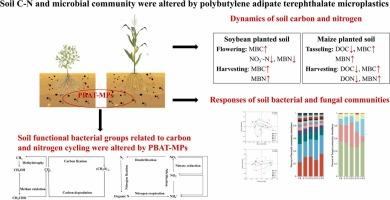
The risks posed by biodegradable plastics to the plant-soil system have been increasingly studied due to potentially hazardous effects on soil properties and nutrient cycling. In this study, we investigated the effects of Poly (butylene adipate-co-terephthalate) microplastics (PBAT-MPs) on soil carbon, nitrogen and microbial communities under different levels of contamination (0 % (control), 0.1 %, 0.2 %, 0.5 % and 1 %), in soils planted with soybean (Glycine max (Linn.) Merr.) and maize (Zea mays L.). The results showed that PBAT-MPs significantly altered soil dissolved organic carbon, dissolved organic nitrogen and nitrate nitrogen contents, and that these effects varied by plant type and growth stage (p < 0.05). PBAT-MPs significantly increased soil microbial biomass carbon and nitrogen for both plants (p < 0.05), except for microbial biomass nitrogen at the soybean flowering stage. PBAT-MPs altered the β-diversity and composition of bacterial and fungal communities, increasing the relative abundances of Proteobacteria but decreasing the relative abundances of Acidobacteriota for both plants. FAPROTAX analysis showed that PBAT-MPs had significant effects on functional bacterial groups related to the nitrogen and carbon cycle, that varied by plant type and growth stage. These results suggest that biodegradable microplastics may have plant-specific effects on soil microbial communities and microbial metabolism, and thereby influence soil carbon and nitrogen cycling.
由于可生物降解塑料对土壤性质和养分循环的潜在危险影响,对植物-土壤系统构成的风险已经得到越来越多的研究。本研究研究了聚己二酸丁二酯微塑料(PBAT-MPs)在不同污染水平(0%(对照)、0.1%、0.2%、0.5%和1%)下对大豆(Glycine max (Linn.))土壤碳、氮和微生物群落的影响。玉米(Zea mays L.)。结果表明,PBAT-MPs显著改变了土壤溶解有机碳、溶解有机氮和硝态氮含量,且这些影响因植物类型和生长阶段而异(p<0.05)。PBAT-MPs显著增加了两种植物的土壤微生物生物量碳和氮(p<0.05),但大豆开花期的微生物生物量氮除外。PBAT-MPs改变了细菌和真菌群落的β-多样性和组成,增加了变形菌门的相对丰度,降低了酸性菌门的相对丰度。FAPROTAX分析显示,PBAT-MPs对氮和碳循环相关的功能菌群有显著影响,且随植物类型和生长阶段的不同而不同。这些结果表明,可生物降解微塑料可能对土壤微生物群落和微生物代谢具有植物特异性作用,从而影响土壤碳氮循环。
期刊介绍:
The Journal of Hazardous Materials serves as a global platform for promoting cutting-edge research in the field of Environmental Science and Engineering. Our publication features a wide range of articles, including full-length research papers, review articles, and perspectives, with the aim of enhancing our understanding of the dangers and risks associated with various materials concerning public health and the environment. It is important to note that the term "environmental contaminants" refers specifically to substances that pose hazardous effects through contamination, while excluding those that do not have such impacts on the environment or human health. Moreover, we emphasize the distinction between wastes and hazardous materials in order to provide further clarity on the scope of the journal. We have a keen interest in exploring specific compounds and microbial agents that have adverse effects on the environment.



 京公网安备 11010802042870号
京ICP备2023020795号-1
京公网安备 11010802042870号
京ICP备2023020795号-1

 分享
分享
 求助内容:
求助内容: 应助结果提醒方式:
 扫码关注我们
