Liping Tan , Rufei Gao , Yan Su , Yan Zhang , Yanqing Geng , Qiuju Liu , Yidan Ma , Xuemei Chen , Fangfang Li , Junlin He
{"title":"Multigenerational exposure to DEHP drives dysregulation of imprinted gene Snurf to impair decidualization","authors":"Liping Tan , Rufei Gao , Yan Su , Yan Zhang , Yanqing Geng , Qiuju Liu , Yidan Ma , Xuemei Chen , Fangfang Li , Junlin He","doi":"10.1016/j.jhazmat.2025.138336","DOIUrl":null,"url":null,"abstract":"<div><div>Phthalate-induced female reproductive health issues, particularly those related to di (2-ethylhexyl) phthalate (DEHP), are growing global concerns. Although most studies have focused on single-generation exposure, studies on prolonged DEHP exposure across multiple generations are limited. This study assessed the effects of multigenerational DEHP exposure on endometrial decidualization, which is crucial for embryo implantation. The results showed that sustained DEHP exposure over three generations exacerbated decidualization injury and led to adverse pregnancy outcomes. RNA sequencing revealed upregulation of the imprinted gene <em>Snurf</em> in the decidua, with changes that may not depend on alterations in DNA methylation. Knockdown of <em>Snurf</em> significantly alleviated <em>in vitro</em> decidualization deficiency induced by mono(2-ethylhexyl) phthalate (MEHP), the biologically active metabolite of DEHP. Proteomic analysis and the AlphaFold 3 algorithm indicated that <em>Stn1</em> is a downstream target of <em>Snurf</em>, with silencing <em>Stn1</em> resensitizing <em>Snurf</em>-knockdown stromal cells to MEHP. Human decidual stromal cells (hDSCs) from healthy participants showed sensitivity to MEHP, with the inhibition of decidualization. Epidemiological data from the 2017–2018 National Health and Nutrition Examination Survey (NHANES) indicated a positive association between DEHP exposure and female infertility. This study highlighted the cumulative toxic effects of multigenerational DEHP exposure on female reproduction and revealed the contribution of imprinted genes.</div></div>","PeriodicalId":361,"journal":{"name":"Journal of Hazardous Materials","volume":"493 ","pages":"Article 138336"},"PeriodicalIF":11.3000,"publicationDate":"2025-08-05","publicationTypes":"Journal Article","fieldsOfStudy":null,"isOpenAccess":false,"openAccessPdf":"","citationCount":"0","resultStr":null,"platform":"Semanticscholar","paperid":null,"PeriodicalName":"Journal of Hazardous Materials","FirstCategoryId":"93","ListUrlMain":"https://www.sciencedirect.com/science/article/pii/S0304389425012518","RegionNum":1,"RegionCategory":"环境科学与生态学","ArticlePicture":[],"TitleCN":null,"AbstractTextCN":null,"PMCID":null,"EPubDate":"2025/4/18 0:00:00","PubModel":"Epub","JCR":"Q1","JCRName":"ENGINEERING, ENVIRONMENTAL","Score":null,"Total":0}
引用次数: 0
Abstract
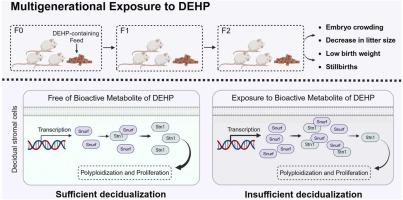
Phthalate-induced female reproductive health issues, particularly those related to di (2-ethylhexyl) phthalate (DEHP), are growing global concerns. Although most studies have focused on single-generation exposure, studies on prolonged DEHP exposure across multiple generations are limited. This study assessed the effects of multigenerational DEHP exposure on endometrial decidualization, which is crucial for embryo implantation. The results showed that sustained DEHP exposure over three generations exacerbated decidualization injury and led to adverse pregnancy outcomes. RNA sequencing revealed upregulation of the imprinted gene Snurf in the decidua, with changes that may not depend on alterations in DNA methylation. Knockdown of Snurf significantly alleviated in vitro decidualization deficiency induced by mono(2-ethylhexyl) phthalate (MEHP), the biologically active metabolite of DEHP. Proteomic analysis and the AlphaFold 3 algorithm indicated that Stn1 is a downstream target of Snurf, with silencing Stn1 resensitizing Snurf-knockdown stromal cells to MEHP. Human decidual stromal cells (hDSCs) from healthy participants showed sensitivity to MEHP, with the inhibition of decidualization. Epidemiological data from the 2017–2018 National Health and Nutrition Examination Survey (NHANES) indicated a positive association between DEHP exposure and female infertility. This study highlighted the cumulative toxic effects of multigenerational DEHP exposure on female reproduction and revealed the contribution of imprinted genes.
期刊介绍:
The Journal of Hazardous Materials serves as a global platform for promoting cutting-edge research in the field of Environmental Science and Engineering. Our publication features a wide range of articles, including full-length research papers, review articles, and perspectives, with the aim of enhancing our understanding of the dangers and risks associated with various materials concerning public health and the environment. It is important to note that the term "environmental contaminants" refers specifically to substances that pose hazardous effects through contamination, while excluding those that do not have such impacts on the environment or human health. Moreover, we emphasize the distinction between wastes and hazardous materials in order to provide further clarity on the scope of the journal. We have a keen interest in exploring specific compounds and microbial agents that have adverse effects on the environment.



 京公网安备 11010802042870号
京ICP备2023020795号-1
京公网安备 11010802042870号
京ICP备2023020795号-1

 分享
分享
 求助内容:
求助内容: 应助结果提醒方式:
 扫码关注我们
