Linjun Qin , Wuyuxin Zhu , Lili Yang , Minghui Zheng , Guorui Liu
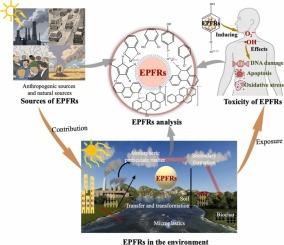
{"title":"Persistent free radicals in the environment","authors":"Linjun Qin , Wuyuxin Zhu , Lili Yang , Minghui Zheng , Guorui Liu","doi":"10.1016/j.jhazmat.2025.138332","DOIUrl":null,"url":null,"abstract":"<div><div>Environmentally persistent free radicals (EPFRs) are environmental pollutants whose potential DNA damage and apoptosis toxicity may be mediated by reactive oxygen species (ROS). The currently available knowledge of their environmental characteristics and transformation mechanisms is not sufficient to understand the environmental behaviors and health effects of EPFRs and should be further expanded. This review offers a comprehensive review of the current state of EPFRs, including characterization methods, formation mechanisms, and environmental behavior of EPFRs. Electron paramagnetic resonance (EPR) spectroscopy directly probes EPFRs in environmental matrices. EPFRs can be simply categorized by g value, but structure confirmation solely by EPR is challenging because the complexity of environmental matrices results in the absence of a hyperfine splitting spectrum. Combined advanced EPR and multi-spectroscopic methods enable the structural identification of EPFRs in environmental samples. The environmental behavior and ecological impacts of EPFRs have been progressively studied. This review highlights the important role of EPFRs in natural environments and emphasizes the necessity of further research on EPFRs.</div></div>","PeriodicalId":361,"journal":{"name":"Journal of Hazardous Materials","volume":"493 ","pages":"Article 138332"},"PeriodicalIF":11.3000,"publicationDate":"2025-08-05","publicationTypes":"Journal Article","fieldsOfStudy":null,"isOpenAccess":false,"openAccessPdf":"","citationCount":"0","resultStr":null,"platform":"Semanticscholar","paperid":null,"PeriodicalName":"Journal of Hazardous Materials","FirstCategoryId":"93","ListUrlMain":"https://www.sciencedirect.com/science/article/pii/S0304389425012476","RegionNum":1,"RegionCategory":"环境科学与生态学","ArticlePicture":[],"TitleCN":null,"AbstractTextCN":null,"PMCID":null,"EPubDate":"2025/4/17 0:00:00","PubModel":"Epub","JCR":"Q1","JCRName":"ENGINEERING, ENVIRONMENTAL","Score":null,"Total":0}
引用次数: 0
Abstract
Environmentally persistent free radicals (EPFRs) are environmental pollutants whose potential DNA damage and apoptosis toxicity may be mediated by reactive oxygen species (ROS). The currently available knowledge of their environmental characteristics and transformation mechanisms is not sufficient to understand the environmental behaviors and health effects of EPFRs and should be further expanded. This review offers a comprehensive review of the current state of EPFRs, including characterization methods, formation mechanisms, and environmental behavior of EPFRs. Electron paramagnetic resonance (EPR) spectroscopy directly probes EPFRs in environmental matrices. EPFRs can be simply categorized by g value, but structure confirmation solely by EPR is challenging because the complexity of environmental matrices results in the absence of a hyperfine splitting spectrum. Combined advanced EPR and multi-spectroscopic methods enable the structural identification of EPFRs in environmental samples. The environmental behavior and ecological impacts of EPFRs have been progressively studied. This review highlights the important role of EPFRs in natural environments and emphasizes the necessity of further research on EPFRs.
期刊介绍:
The Journal of Hazardous Materials serves as a global platform for promoting cutting-edge research in the field of Environmental Science and Engineering. Our publication features a wide range of articles, including full-length research papers, review articles, and perspectives, with the aim of enhancing our understanding of the dangers and risks associated with various materials concerning public health and the environment. It is important to note that the term "environmental contaminants" refers specifically to substances that pose hazardous effects through contamination, while excluding those that do not have such impacts on the environment or human health. Moreover, we emphasize the distinction between wastes and hazardous materials in order to provide further clarity on the scope of the journal. We have a keen interest in exploring specific compounds and microbial agents that have adverse effects on the environment.



 京公网安备 11010802042870号
京ICP备2023020795号-1
京公网安备 11010802042870号
京ICP备2023020795号-1

 分享
分享
 求助内容:
求助内容: 应助结果提醒方式:
 扫码关注我们
