Shirin Saffar-Avval, Mahsa Modiri Gharehveran, Rodrigo Alvarez Ruiz, Linda S. Lee, Brian P. Chaplin
{"title":"Matrix Effects on Electrochemical Oxidation of Per- and Polyfluoroalkyl Substances in Sludge Centrate","authors":"Shirin Saffar-Avval, Mahsa Modiri Gharehveran, Rodrigo Alvarez Ruiz, Linda S. Lee, Brian P. Chaplin","doi":"10.1021/acs.est.4c13720","DOIUrl":null,"url":null,"abstract":"This study investigated the electrochemical oxidation of per- and polyfluoroalkyl substances (PFAS) using a Ti<sub>4</sub>O<sub>7</sub> anode in centrate from sludge dewatering. Synthetic solutions containing perfluorooctanoic acid (PFOA), other PFAS, and inorganic constituents (phosphate, ammonium, chloride, carbonate, and acetate salts) found in centrate were studied to assess their impact on the oxidation process. PFOA removal decreased from 95% in a stable electrolyte (NaClO<sub>4</sub>) to 81% in a Na<sub>2</sub>HPO<sub>4</sub> electrolyte and 30% in a solution mimicking concentrated centrate. X-ray photoelectron spectroscopy detected phosphate and nitrogen species on the electrode surface. At potentials required to oxidize PFAS (>3.0 V/SHE), phosphate and ammonium were oxidized to radicals that blocked electrode sites, inhibiting PFAS removal and shifting PFOA oxidation from first-order kinetics. The kinetics were accurately modeled using a Langmuir–Hinshelwood approach with a transient inhibition term. Results suggested that phosphate, ammonium, and bicarbonate ions reduced hydroxyl radical availability, thereby limiting PFOA defluorination. In concentrated centrate, 95% of the chemical oxygen demand and 93% of total PFAS were removed after 233 s of electrolysis at 30 mA cm<sup>–2</sup>. However, partial degradation of perfluorohexanoic acid and accumulation of perfluoroheptanoic acid, attributed to inorganic electrode fouling, suggested the need for a multistage reactor system for more complete PFAS mineralization.","PeriodicalId":36,"journal":{"name":"环境科学与技术","volume":"22 1","pages":""},"PeriodicalIF":11.3000,"publicationDate":"2025-04-17","publicationTypes":"Journal Article","fieldsOfStudy":null,"isOpenAccess":false,"openAccessPdf":"","citationCount":"0","resultStr":null,"platform":"Semanticscholar","paperid":null,"PeriodicalName":"环境科学与技术","FirstCategoryId":"1","ListUrlMain":"https://doi.org/10.1021/acs.est.4c13720","RegionNum":1,"RegionCategory":"环境科学与生态学","ArticlePicture":[],"TitleCN":null,"AbstractTextCN":null,"PMCID":null,"EPubDate":"","PubModel":"","JCR":"Q1","JCRName":"ENGINEERING, ENVIRONMENTAL","Score":null,"Total":0}
引用次数: 0
Abstract
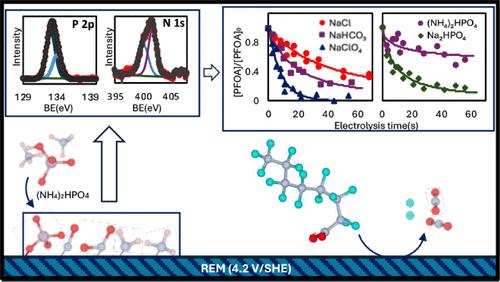
This study investigated the electrochemical oxidation of per- and polyfluoroalkyl substances (PFAS) using a Ti4O7 anode in centrate from sludge dewatering. Synthetic solutions containing perfluorooctanoic acid (PFOA), other PFAS, and inorganic constituents (phosphate, ammonium, chloride, carbonate, and acetate salts) found in centrate were studied to assess their impact on the oxidation process. PFOA removal decreased from 95% in a stable electrolyte (NaClO4) to 81% in a Na2HPO4 electrolyte and 30% in a solution mimicking concentrated centrate. X-ray photoelectron spectroscopy detected phosphate and nitrogen species on the electrode surface. At potentials required to oxidize PFAS (>3.0 V/SHE), phosphate and ammonium were oxidized to radicals that blocked electrode sites, inhibiting PFAS removal and shifting PFOA oxidation from first-order kinetics. The kinetics were accurately modeled using a Langmuir–Hinshelwood approach with a transient inhibition term. Results suggested that phosphate, ammonium, and bicarbonate ions reduced hydroxyl radical availability, thereby limiting PFOA defluorination. In concentrated centrate, 95% of the chemical oxygen demand and 93% of total PFAS were removed after 233 s of electrolysis at 30 mA cm–2. However, partial degradation of perfluorohexanoic acid and accumulation of perfluoroheptanoic acid, attributed to inorganic electrode fouling, suggested the need for a multistage reactor system for more complete PFAS mineralization.
采用Ti4O7阳极对污泥脱水浓缩液中的全氟烷基和多氟烷基物质(PFAS)进行了电化学氧化研究。研究了在浓缩物中发现的含有全氟辛酸(PFOA)、其他PFAS和无机成分(磷酸盐、铵、氯化物、碳酸盐和乙酸盐)的合成溶液,以评估它们对氧化过程的影响。PFOA去除率从稳定电解质(NaClO4)的95%下降到Na2HPO4电解质的81%和模拟浓缩液的30%。x射线光电子能谱检测了电极表面的磷酸盐和氮。在氧化PFAS所需的电位(>3.0 V/SHE)下,磷酸盐和铵被氧化成自由基,阻断电极位点,抑制PFAS的去除,使PFOA的氧化从一级动力学转移。采用Langmuir-Hinshelwood方法精确地模拟了动力学,并引入了瞬态抑制项。结果表明,磷酸盐、铵离子和碳酸氢盐离子降低了羟基自由基的可用性,从而限制了PFOA的脱氟。在浓溶液中,30 mA cm-2电解233 s后,95%的化学需氧量和93%的总PFAS被去除。然而,由于无机电极污染,全氟己酸的部分降解和全氟庚酸的积累表明,需要多级反应器系统来实现更完全的PFAS矿化。
期刊介绍:
Environmental Science & Technology (ES&T) is a co-sponsored academic and technical magazine by the Hubei Provincial Environmental Protection Bureau and the Hubei Provincial Academy of Environmental Sciences.
Environmental Science & Technology (ES&T) holds the status of Chinese core journals, scientific papers source journals of China, Chinese Science Citation Database source journals, and Chinese Academic Journal Comprehensive Evaluation Database source journals. This publication focuses on the academic field of environmental protection, featuring articles related to environmental protection and technical advancements.



 京公网安备 11010802042870号
京ICP备2023020795号-1
京公网安备 11010802042870号
京ICP备2023020795号-1

 分享
分享
 求助内容:
求助内容: 应助结果提醒方式:
 扫码关注我们
