Adarsh K. Mourya, Rudra P. Singh, Atul V. Wankhade
{"title":"Tailoring Photocatalytic Efficiency: DFNS/WO3 Nanocomposite with Engineered Interface for Enhanced Oxygen Evolution","authors":"Adarsh K. Mourya, Rudra P. Singh, Atul V. Wankhade","doi":"10.1021/acs.iecr.4c05001","DOIUrl":null,"url":null,"abstract":"Here, we report the synthesis of novel DFNS/WO<sub>3</sub> photocatalysts through a hydrothermal method. A thorough exploration of the crystal phase purity, optical absorption properties, and morphology of DFNS/WO<sub>3</sub> was undertaken, employing techniques such as powder X-ray diffraction (P-XRD), <sup>29</sup>Si cross-polarization magic angle spinning NMR (<sup>29</sup>Si CPMAS NMR), transmission electron microscopy (TEM), field emission scanning electron microscopy (FE-SEM), ultraviolet-visible diffuse reflectance spectroscopy (UV-DRS), and Brunauer–Emmett–Teller (BET) analysis. This comprehensive characterization revealed the existence of a distinctive interface between WO<sub>3</sub> nanoparticles and the dendritic fibrous nanosilica (DFNS) surface. In photocatalytic water-splitting experiments, the DFNS/WO<sub>3</sub> nanocomposite, featuring 7 wt% of WO<sub>3</sub> on DFNS, demonstrated a remarkable increase in oxygen evolution rate (1863 μmol h<sup>–1</sup> g<sup>–1</sup><sub>cat</sub>) compared to pure WO<sub>3</sub> (361 μmol h<sup>–1</sup> g<sup>–1</sup><sub>cat</sub>), marking a notable five-time improvement. This study presents an innovative approach to developing an efficient photocatalytic system by incorporating DFNS/WO<sub>3</sub> nanocomposites, where WO<sub>3</sub> possesses an optimal band gap of 2.96 eV, making it highly suitable for photocatalytic water splitting. The DFNS/WO<sub>3</sub> photocatalyst demonstrates remarkable catalytic activity, stability, and reusability, addressing key considerations for practical applications. This study provides an innovative strategy for designing advanced photocatalytic systems capable of efficient and sustainable oxygen evolution under visible light.","PeriodicalId":39,"journal":{"name":"Industrial & Engineering Chemistry Research","volume":"219 1","pages":""},"PeriodicalIF":3.9000,"publicationDate":"2025-04-18","publicationTypes":"Journal Article","fieldsOfStudy":null,"isOpenAccess":false,"openAccessPdf":"","citationCount":"0","resultStr":null,"platform":"Semanticscholar","paperid":null,"PeriodicalName":"Industrial & Engineering Chemistry Research","FirstCategoryId":"5","ListUrlMain":"https://doi.org/10.1021/acs.iecr.4c05001","RegionNum":3,"RegionCategory":"工程技术","ArticlePicture":[],"TitleCN":null,"AbstractTextCN":null,"PMCID":null,"EPubDate":"","PubModel":"","JCR":"Q2","JCRName":"ENGINEERING, CHEMICAL","Score":null,"Total":0}
引用次数: 0
Abstract
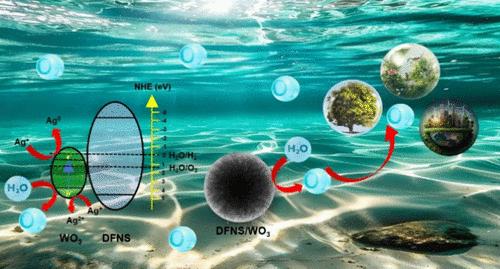
Here, we report the synthesis of novel DFNS/WO3 photocatalysts through a hydrothermal method. A thorough exploration of the crystal phase purity, optical absorption properties, and morphology of DFNS/WO3 was undertaken, employing techniques such as powder X-ray diffraction (P-XRD), 29Si cross-polarization magic angle spinning NMR (29Si CPMAS NMR), transmission electron microscopy (TEM), field emission scanning electron microscopy (FE-SEM), ultraviolet-visible diffuse reflectance spectroscopy (UV-DRS), and Brunauer–Emmett–Teller (BET) analysis. This comprehensive characterization revealed the existence of a distinctive interface between WO3 nanoparticles and the dendritic fibrous nanosilica (DFNS) surface. In photocatalytic water-splitting experiments, the DFNS/WO3 nanocomposite, featuring 7 wt% of WO3 on DFNS, demonstrated a remarkable increase in oxygen evolution rate (1863 μmol h–1 g–1cat) compared to pure WO3 (361 μmol h–1 g–1cat), marking a notable five-time improvement. This study presents an innovative approach to developing an efficient photocatalytic system by incorporating DFNS/WO3 nanocomposites, where WO3 possesses an optimal band gap of 2.96 eV, making it highly suitable for photocatalytic water splitting. The DFNS/WO3 photocatalyst demonstrates remarkable catalytic activity, stability, and reusability, addressing key considerations for practical applications. This study provides an innovative strategy for designing advanced photocatalytic systems capable of efficient and sustainable oxygen evolution under visible light.
期刊介绍:
ndustrial & Engineering Chemistry, with variations in title and format, has been published since 1909 by the American Chemical Society. Industrial & Engineering Chemistry Research is a weekly publication that reports industrial and academic research in the broad fields of applied chemistry and chemical engineering with special focus on fundamentals, processes, and products.



 京公网安备 11010802042870号
京ICP备2023020795号-1
京公网安备 11010802042870号
京ICP备2023020795号-1

 分享
分享
 求助内容:
求助内容: 应助结果提醒方式:
 扫码关注我们
