Hualong Wu, Jiahao Dong, Jiantao Li, Guiyang Gao, Liang Lin, Ailin Liu, Hongfei Zheng, Guanyi Wang, Junxiang Liu, Laisen Wang, Jie Lin, Khalil Amine, Dong-Liang Peng, Qingshui Xie, Jun Lu
{"title":"Modulating Surface Anionic Redox Chemistry toward Highly Stable Li-Rich Cathodes with Negligible Oxygen Loss","authors":"Hualong Wu, Jiahao Dong, Jiantao Li, Guiyang Gao, Liang Lin, Ailin Liu, Hongfei Zheng, Guanyi Wang, Junxiang Liu, Laisen Wang, Jie Lin, Khalil Amine, Dong-Liang Peng, Qingshui Xie, Jun Lu","doi":"10.1021/acsnano.5c00630","DOIUrl":null,"url":null,"abstract":"Low initial Coulombic efficiency and severe capacity/voltage fading during cycling caused by serious irreversible oxygen release, especially in the initial cycle, and resultantly induced unstable electrode/electrolyte interfacial chemistry, largely prohibit the commercial application of high-capacity Li-rich layered oxide cathodes (LLOs). In this work, a dual reductive gas interface cotreatment strategy is applied to regulate the lattice oxygen redox activity and reversibility with a multiple defective structure design including Li/O/TM (TM = transition metal) vacancies and the intrinsic TM doping as well as a full-surface protective layer, which can suppress the irreversible TM migration and then undesirable phase transformation, resisting the corrosion of electrolyte during cycling effectively. Importantly, the introduced reversible SO<sub>3</sub><sup>2–</sup>/SO<sub>4</sub><sup>2–</sup> redox couple that provides extra capacity compensation could alleviate the distortion of oxygen-central octahedral structure and structural collapse caused by immoderate oxygen oxidation. Thus, the lattice oxygen redox chemistry is optimized, with negligible oxygen loss during the initial cycle. And the designed AS-LLO cathode with greatly enhanced structure stability shows high-capacity retentions of 99.2% at 0.3C after 100 cycles and 82.4% even after 1000 cycles at 5C. This work provides a guideline for manipulating the oxygen redox chemistry to achieve long-lifespan Li-rich layered oxide cathodes for high-energy-density lithium batteries.","PeriodicalId":21,"journal":{"name":"ACS Nano","volume":"29 1","pages":""},"PeriodicalIF":16.0000,"publicationDate":"2025-04-17","publicationTypes":"Journal Article","fieldsOfStudy":null,"isOpenAccess":false,"openAccessPdf":"","citationCount":"0","resultStr":null,"platform":"Semanticscholar","paperid":null,"PeriodicalName":"ACS Nano","FirstCategoryId":"88","ListUrlMain":"https://doi.org/10.1021/acsnano.5c00630","RegionNum":1,"RegionCategory":"材料科学","ArticlePicture":[],"TitleCN":null,"AbstractTextCN":null,"PMCID":null,"EPubDate":"","PubModel":"","JCR":"Q1","JCRName":"CHEMISTRY, MULTIDISCIPLINARY","Score":null,"Total":0}
引用次数: 0
Abstract
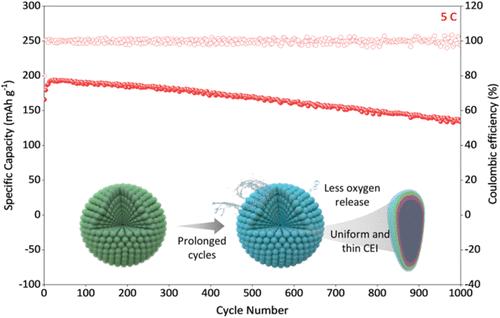
Low initial Coulombic efficiency and severe capacity/voltage fading during cycling caused by serious irreversible oxygen release, especially in the initial cycle, and resultantly induced unstable electrode/electrolyte interfacial chemistry, largely prohibit the commercial application of high-capacity Li-rich layered oxide cathodes (LLOs). In this work, a dual reductive gas interface cotreatment strategy is applied to regulate the lattice oxygen redox activity and reversibility with a multiple defective structure design including Li/O/TM (TM = transition metal) vacancies and the intrinsic TM doping as well as a full-surface protective layer, which can suppress the irreversible TM migration and then undesirable phase transformation, resisting the corrosion of electrolyte during cycling effectively. Importantly, the introduced reversible SO32–/SO42– redox couple that provides extra capacity compensation could alleviate the distortion of oxygen-central octahedral structure and structural collapse caused by immoderate oxygen oxidation. Thus, the lattice oxygen redox chemistry is optimized, with negligible oxygen loss during the initial cycle. And the designed AS-LLO cathode with greatly enhanced structure stability shows high-capacity retentions of 99.2% at 0.3C after 100 cycles and 82.4% even after 1000 cycles at 5C. This work provides a guideline for manipulating the oxygen redox chemistry to achieve long-lifespan Li-rich layered oxide cathodes for high-energy-density lithium batteries.
期刊介绍:
ACS Nano, published monthly, serves as an international forum for comprehensive articles on nanoscience and nanotechnology research at the intersections of chemistry, biology, materials science, physics, and engineering. The journal fosters communication among scientists in these communities, facilitating collaboration, new research opportunities, and advancements through discoveries. ACS Nano covers synthesis, assembly, characterization, theory, and simulation of nanostructures, nanobiotechnology, nanofabrication, methods and tools for nanoscience and nanotechnology, and self- and directed-assembly. Alongside original research articles, it offers thorough reviews, perspectives on cutting-edge research, and discussions envisioning the future of nanoscience and nanotechnology.



 京公网安备 11010802042870号
京ICP备2023020795号-1
京公网安备 11010802042870号
京ICP备2023020795号-1

 分享
分享
 求助内容:
求助内容: 应助结果提醒方式:
 扫码关注我们
