Yuxin Zhu , Qingxia Miao , Heng Lyu , Yiling Zheng , Wenyu Liu , Yunmei Li , Junda Li , Fangfang Chen , Song Miao
{"title":"An approach for mapping phytoplankton communities in freshwater lakes based on phytoplankton absorption features","authors":"Yuxin Zhu , Qingxia Miao , Heng Lyu , Yiling Zheng , Wenyu Liu , Yunmei Li , Junda Li , Fangfang Chen , Song Miao","doi":"10.1016/j.watres.2025.123665","DOIUrl":null,"url":null,"abstract":"<div><div>Phytoplankton communities play a crucial role in the lake ecosystem due to their varying characteristics, functions, and impacts of different phytoplankton groups. Understanding the composition of phytoplankton groups in freshwater lakes is essential for comprehending geochemical processes and managing water quality. In this study, an improved Diagnostic Pigment Analysis method for freshwater lakes was developed and the proportion of five major phytoplankton groups—Dinophyta, Cryptophyta, Chlorophyta, Cyanophyta, and Bacillariophyta—was derived through the absorption-decomposition method. The validation results demonstrated that the developed algorithm had satisfactory estimation accuracy for all five groups. Among all the phytoplankton groups, Cyanophyta achieved the best performance, with Median Absolute Percentage Error (MAPE) of 14.22 %, and Bias of 8.37 %. In contrast, Cryptophyta exhibited the poorest accuracy, with MAPE as high as 40.24 %. The MAPE values ranged from 10.91 % to 33.65 %, and the Bias values ranged from 1.06 % to 9.38 %. Meanwhile, the developed algorithm was successfully applied to the Ocean and Land Color Instrument (OLCI) images for mapping the spatial distribution of phytoplankton communities in Lake Taihu, demonstrating its ability to be applied to satellite imagery. This proposed algorithm provided a new approach to quantitatively determine the composition of phytoplankton communities in freshwater lakes, which can obtain valuable insights from observing the composition and succession patterns of these communities from satellite platforms.</div></div>","PeriodicalId":443,"journal":{"name":"Water Research","volume":"282 ","pages":"Article 123665"},"PeriodicalIF":12.4000,"publicationDate":"2025-08-15","publicationTypes":"Journal Article","fieldsOfStudy":null,"isOpenAccess":false,"openAccessPdf":"","citationCount":"0","resultStr":null,"platform":"Semanticscholar","paperid":null,"PeriodicalName":"Water Research","FirstCategoryId":"93","ListUrlMain":"https://www.sciencedirect.com/science/article/pii/S0043135425005755","RegionNum":1,"RegionCategory":"环境科学与生态学","ArticlePicture":[],"TitleCN":null,"AbstractTextCN":null,"PMCID":null,"EPubDate":"2025/4/17 0:00:00","PubModel":"Epub","JCR":"Q1","JCRName":"ENGINEERING, ENVIRONMENTAL","Score":null,"Total":0}
引用次数: 0
Abstract
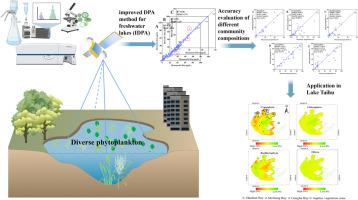
Phytoplankton communities play a crucial role in the lake ecosystem due to their varying characteristics, functions, and impacts of different phytoplankton groups. Understanding the composition of phytoplankton groups in freshwater lakes is essential for comprehending geochemical processes and managing water quality. In this study, an improved Diagnostic Pigment Analysis method for freshwater lakes was developed and the proportion of five major phytoplankton groups—Dinophyta, Cryptophyta, Chlorophyta, Cyanophyta, and Bacillariophyta—was derived through the absorption-decomposition method. The validation results demonstrated that the developed algorithm had satisfactory estimation accuracy for all five groups. Among all the phytoplankton groups, Cyanophyta achieved the best performance, with Median Absolute Percentage Error (MAPE) of 14.22 %, and Bias of 8.37 %. In contrast, Cryptophyta exhibited the poorest accuracy, with MAPE as high as 40.24 %. The MAPE values ranged from 10.91 % to 33.65 %, and the Bias values ranged from 1.06 % to 9.38 %. Meanwhile, the developed algorithm was successfully applied to the Ocean and Land Color Instrument (OLCI) images for mapping the spatial distribution of phytoplankton communities in Lake Taihu, demonstrating its ability to be applied to satellite imagery. This proposed algorithm provided a new approach to quantitatively determine the composition of phytoplankton communities in freshwater lakes, which can obtain valuable insights from observing the composition and succession patterns of these communities from satellite platforms.
期刊介绍:
Water Research, along with its open access companion journal Water Research X, serves as a platform for publishing original research papers covering various aspects of the science and technology related to the anthropogenic water cycle, water quality, and its management worldwide. The audience targeted by the journal comprises biologists, chemical engineers, chemists, civil engineers, environmental engineers, limnologists, and microbiologists. The scope of the journal include:
•Treatment processes for water and wastewaters (municipal, agricultural, industrial, and on-site treatment), including resource recovery and residuals management;
•Urban hydrology including sewer systems, stormwater management, and green infrastructure;
•Drinking water treatment and distribution;
•Potable and non-potable water reuse;
•Sanitation, public health, and risk assessment;
•Anaerobic digestion, solid and hazardous waste management, including source characterization and the effects and control of leachates and gaseous emissions;
•Contaminants (chemical, microbial, anthropogenic particles such as nanoparticles or microplastics) and related water quality sensing, monitoring, fate, and assessment;
•Anthropogenic impacts on inland, tidal, coastal and urban waters, focusing on surface and ground waters, and point and non-point sources of pollution;
•Environmental restoration, linked to surface water, groundwater and groundwater remediation;
•Analysis of the interfaces between sediments and water, and between water and atmosphere, focusing specifically on anthropogenic impacts;
•Mathematical modelling, systems analysis, machine learning, and beneficial use of big data related to the anthropogenic water cycle;
•Socio-economic, policy, and regulations studies.




 京公网安备 11010802042870号
京ICP备2023020795号-1
京公网安备 11010802042870号
京ICP备2023020795号-1

 分享
分享
 求助内容:
求助内容: 应助结果提醒方式:
 扫码关注我们
