Synthesis of high strength, high elasticity, self-healing deep eutectic ionic elastomers based on multiple non-covalent interactions by using biobased glycerol monomer HPA for strain sensors
{"title":"Synthesis of high strength, high elasticity, self-healing deep eutectic ionic elastomers based on multiple non-covalent interactions by using biobased glycerol monomer HPA for strain sensors","authors":"Deyang Wang, Jinqing Qu","doi":"10.1016/j.polymer.2025.128423","DOIUrl":null,"url":null,"abstract":"<div><div>Deep eutectic ionic elastomers (DEIEs) have emerged as a research focus in flexible ionic conductors due to their advantages, including rapid and convenient preparation processes, excellent mechanical and electrical properties. However, there remains an obvious research gap in developing DEIEs with superior comprehensive mechanical properties using greener biobased monomers and simpler formulations. In this study, two novel LiTFSI(lithium bis(trifluoromethane sulfonimide))-based polymerizable deep eutectic solvents systems: HPA(2-hydroxy-3-phenoxypropyl acrylate)/LiTFSI and HEA (2-hydroxyethyl acrylate)/LiTFSI were successfully discovered. Notably, the biobased monomer HPA was utilized for the first time in constructing PDES (polymerizable deep eutectic solvents), and then DEIEs were successfully prepared by UV-initiated free radical random copolymerization using these 2 kinds of PDES. The DEIEs’ polymer networks exhibit various non-covalent interactions, such as hydrogen bonds, dipole-dipole interactions, and π-π interactions, which endow them with high mechanical strength (2.76 MPa), good stretchability (687%), and high elasticity. These abundant physical interactions also confer the material with good self-healing capabilities. Moreover, the DEIEs demonstrate good transparency, sufficient ionic conductivity, and a wide operating temperature range. This material can not only be used for sensing and detecting conventional human physiological activities but also maintains stable sensing performance under complex conditions, such as mechanical damage and low-temperature environments, showcasing significant potential in flexible sensing applications.</div></div>","PeriodicalId":405,"journal":{"name":"Polymer","volume":"328 ","pages":"Article 128423"},"PeriodicalIF":4.5000,"publicationDate":"2025-04-18","publicationTypes":"Journal Article","fieldsOfStudy":null,"isOpenAccess":false,"openAccessPdf":"","citationCount":"0","resultStr":null,"platform":"Semanticscholar","paperid":null,"PeriodicalName":"Polymer","FirstCategoryId":"92","ListUrlMain":"https://www.sciencedirect.com/science/article/pii/S0032386125004094","RegionNum":2,"RegionCategory":"化学","ArticlePicture":[],"TitleCN":null,"AbstractTextCN":null,"PMCID":null,"EPubDate":"","PubModel":"","JCR":"Q2","JCRName":"POLYMER SCIENCE","Score":null,"Total":0}
引用次数: 0
Abstract
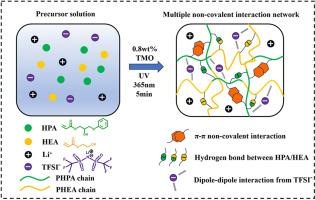
Deep eutectic ionic elastomers (DEIEs) have emerged as a research focus in flexible ionic conductors due to their advantages, including rapid and convenient preparation processes, excellent mechanical and electrical properties. However, there remains an obvious research gap in developing DEIEs with superior comprehensive mechanical properties using greener biobased monomers and simpler formulations. In this study, two novel LiTFSI(lithium bis(trifluoromethane sulfonimide))-based polymerizable deep eutectic solvents systems: HPA(2-hydroxy-3-phenoxypropyl acrylate)/LiTFSI and HEA (2-hydroxyethyl acrylate)/LiTFSI were successfully discovered. Notably, the biobased monomer HPA was utilized for the first time in constructing PDES (polymerizable deep eutectic solvents), and then DEIEs were successfully prepared by UV-initiated free radical random copolymerization using these 2 kinds of PDES. The DEIEs’ polymer networks exhibit various non-covalent interactions, such as hydrogen bonds, dipole-dipole interactions, and π-π interactions, which endow them with high mechanical strength (2.76 MPa), good stretchability (687%), and high elasticity. These abundant physical interactions also confer the material with good self-healing capabilities. Moreover, the DEIEs demonstrate good transparency, sufficient ionic conductivity, and a wide operating temperature range. This material can not only be used for sensing and detecting conventional human physiological activities but also maintains stable sensing performance under complex conditions, such as mechanical damage and low-temperature environments, showcasing significant potential in flexible sensing applications.
期刊介绍:
Polymer is an interdisciplinary journal dedicated to publishing innovative and significant advances in Polymer Physics, Chemistry and Technology. We welcome submissions on polymer hybrids, nanocomposites, characterisation and self-assembly. Polymer also publishes work on the technological application of polymers in energy and optoelectronics.
The main scope is covered but not limited to the following core areas:
Polymer Materials
Nanocomposites and hybrid nanomaterials
Polymer blends, films, fibres, networks and porous materials
Physical Characterization
Characterisation, modelling and simulation* of molecular and materials properties in bulk, solution, and thin films
Polymer Engineering
Advanced multiscale processing methods
Polymer Synthesis, Modification and Self-assembly
Including designer polymer architectures, mechanisms and kinetics, and supramolecular polymerization
Technological Applications
Polymers for energy generation and storage
Polymer membranes for separation technology
Polymers for opto- and microelectronics.




 京公网安备 11010802042870号
京ICP备2023020795号-1
京公网安备 11010802042870号
京ICP备2023020795号-1

 分享
分享
 求助内容:
求助内容: 应助结果提醒方式:
 扫码关注我们
