Anticoagulant rodenticide exposure in endangered American badgers (Taxidea taxus) and fishers (Pekania pennanti) from British Columbia, Canada, 1998 to 2018
Sofi Hindmarch , John Elliott , Richard Weir , Sandi Lee , France Maisonneuve
{"title":"Anticoagulant rodenticide exposure in endangered American badgers (Taxidea taxus) and fishers (Pekania pennanti) from British Columbia, Canada, 1998 to 2018","authors":"Sofi Hindmarch , John Elliott , Richard Weir , Sandi Lee , France Maisonneuve","doi":"10.1016/j.envpol.2025.126278","DOIUrl":null,"url":null,"abstract":"<div><div>Anticoagulant rodenticide (AR) concentrations in livers of 69 samples of two mustelid species, collected 1998 to 2018 from locations in British Columbia, Canada are presented. The American badger <em>Taxidea taxus</em> is endangered in Canada, and fisher <em>Pekania pennanti</em> populations are at-risk. Using a high performance liquid chromatography method, we measured liver concentrations of the following second generation ARs (SGARs): brodifacoum, bromadiolone, difethialone and the first generation (FGAR) compounds: warfarin, diphacinone and chlorophacinone in 59 badgers and 10 fishers. Of the 59 badgers analyzed, 69 % (n = 41) contained residues of one or more ARs. The mean total AR exposure was 201 ng/g (wet weight) (range: 4.0–214 ng/g) with an average of three compounds detected (range 1–6) per individual. Male badgers had twice the concentration levels as females (182 ± 300 ng/g versus 93 ± 170 ng/g). The SGARs bromadiolone (n = 33) and brodifacoum (n = 21) were the most common ARs detected. Four badgers had AR levels >1000 ng/g and eight had >500 ng/g in their livers. The highest average concentrations were from badgers collected in the East Kootenay region (FGAR: 165 ± 210 ng/g, SGAR: 295 ± 517 ng/g). Six female badgers were lactating and all were exposed to rodenticides. We found no spatial relationship between development and exposure levels in badgers. In Fishers, one juvenile female was exposed to warfarin (5 ng/g) and bromadiolone (528 ng/g), and an adult female tested positive for brodifacoum (13 ng/g). Regardless of the lower incidences of exposure, finding such high levels of SGARs was surprising given that fishers are a shy forest carnivore species.</div></div>","PeriodicalId":311,"journal":{"name":"Environmental Pollution","volume":"375 ","pages":"Article 126278"},"PeriodicalIF":7.3000,"publicationDate":"2025-06-15","publicationTypes":"Journal Article","fieldsOfStudy":null,"isOpenAccess":false,"openAccessPdf":"","citationCount":"0","resultStr":null,"platform":"Semanticscholar","paperid":null,"PeriodicalName":"Environmental Pollution","FirstCategoryId":"93","ListUrlMain":"https://www.sciencedirect.com/science/article/pii/S0269749125006517","RegionNum":2,"RegionCategory":"环境科学与生态学","ArticlePicture":[],"TitleCN":null,"AbstractTextCN":null,"PMCID":null,"EPubDate":"2025/4/18 0:00:00","PubModel":"Epub","JCR":"Q1","JCRName":"ENVIRONMENTAL SCIENCES","Score":null,"Total":0}
引用次数: 0
Abstract
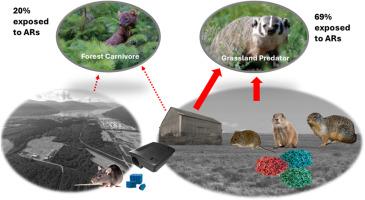
Anticoagulant rodenticide (AR) concentrations in livers of 69 samples of two mustelid species, collected 1998 to 2018 from locations in British Columbia, Canada are presented. The American badger Taxidea taxus is endangered in Canada, and fisher Pekania pennanti populations are at-risk. Using a high performance liquid chromatography method, we measured liver concentrations of the following second generation ARs (SGARs): brodifacoum, bromadiolone, difethialone and the first generation (FGAR) compounds: warfarin, diphacinone and chlorophacinone in 59 badgers and 10 fishers. Of the 59 badgers analyzed, 69 % (n = 41) contained residues of one or more ARs. The mean total AR exposure was 201 ng/g (wet weight) (range: 4.0–214 ng/g) with an average of three compounds detected (range 1–6) per individual. Male badgers had twice the concentration levels as females (182 ± 300 ng/g versus 93 ± 170 ng/g). The SGARs bromadiolone (n = 33) and brodifacoum (n = 21) were the most common ARs detected. Four badgers had AR levels >1000 ng/g and eight had >500 ng/g in their livers. The highest average concentrations were from badgers collected in the East Kootenay region (FGAR: 165 ± 210 ng/g, SGAR: 295 ± 517 ng/g). Six female badgers were lactating and all were exposed to rodenticides. We found no spatial relationship between development and exposure levels in badgers. In Fishers, one juvenile female was exposed to warfarin (5 ng/g) and bromadiolone (528 ng/g), and an adult female tested positive for brodifacoum (13 ng/g). Regardless of the lower incidences of exposure, finding such high levels of SGARs was surprising given that fishers are a shy forest carnivore species.
期刊介绍:
Environmental Pollution is an international peer-reviewed journal that publishes high-quality research papers and review articles covering all aspects of environmental pollution and its impacts on ecosystems and human health.
Subject areas include, but are not limited to:
• Sources and occurrences of pollutants that are clearly defined and measured in environmental compartments, food and food-related items, and human bodies;
• Interlinks between contaminant exposure and biological, ecological, and human health effects, including those of climate change;
• Contaminants of emerging concerns (including but not limited to antibiotic resistant microorganisms or genes, microplastics/nanoplastics, electronic wastes, light, and noise) and/or their biological, ecological, or human health effects;
• Laboratory and field studies on the remediation/mitigation of environmental pollution via new techniques and with clear links to biological, ecological, or human health effects;
• Modeling of pollution processes, patterns, or trends that is of clear environmental and/or human health interest;
• New techniques that measure and examine environmental occurrences, transport, behavior, and effects of pollutants within the environment or the laboratory, provided that they can be clearly used to address problems within regional or global environmental compartments.




 京公网安备 11010802042870号
京ICP备2023020795号-1
京公网安备 11010802042870号
京ICP备2023020795号-1

 分享
分享
 求助内容:
求助内容: 应助结果提醒方式:
 扫码关注我们
