Lijun Fan , Tiancheng Han , Xianxing Huang , Yukai Zhang , Weiwei Zhai , Daoyong Zhang , Xiangliang Pan
{"title":"Contradictions in dissolved black carbon research: A critical review of its sources, structures, analytical methods, and environmental behaviors","authors":"Lijun Fan , Tiancheng Han , Xianxing Huang , Yukai Zhang , Weiwei Zhai , Daoyong Zhang , Xiangliang Pan","doi":"10.1016/j.envpol.2025.126276","DOIUrl":null,"url":null,"abstract":"<div><div>Dissolved black carbon (DBC) represents the most active component within the black carbon (BC) continuum and plays a vital role in the global carbon cycle and the removal of inorganic and organic contaminants due to its prolonged residence time and unique condensed aromatic structure. Significant progress has been made in understanding DBC source, molecular structure, analytical methods, stability, and environmental behavior, particularly its photochemical and microbial transformation. However, substantial uncertainties persist, including ambiguities in its definition, limitations in isolation and quantification methods, and unidentified sources. These limitations have led to lots of inconsistencies regarding its stability, environmental transport pathways, and transformation mechanisms. This review critically examines the current landscape of DBC research, with a focus on: (1) key contradictions in DBC cycling processes, including debates over its recalcitrance, mismatched isotopic signatures, and imbalances in the marine DBC budget; (2) limitations for DBC isolation and quantification methods in natural environments; and (3) photochemical and microbial transformation processes, and its interactions with environmental pollutants. By synthesizing recent insights, this review aims to enhance the understanding of DBC's structures, turnover, and environmental behavior, as well as its implications for the global carbon cycle. To address existing challenges, future studies are suggested to prioritize resolving these contradictions, developing standardized analytical approaches, and achieving a clearer elucidation of DBC cycling processes across diverse environments.</div></div>","PeriodicalId":311,"journal":{"name":"Environmental Pollution","volume":"374 ","pages":"Article 126276"},"PeriodicalIF":7.3000,"publicationDate":"2025-06-01","publicationTypes":"Journal Article","fieldsOfStudy":null,"isOpenAccess":false,"openAccessPdf":"","citationCount":"0","resultStr":null,"platform":"Semanticscholar","paperid":null,"PeriodicalName":"Environmental Pollution","FirstCategoryId":"93","ListUrlMain":"https://www.sciencedirect.com/science/article/pii/S0269749125006499","RegionNum":2,"RegionCategory":"环境科学与生态学","ArticlePicture":[],"TitleCN":null,"AbstractTextCN":null,"PMCID":null,"EPubDate":"2025/4/18 0:00:00","PubModel":"Epub","JCR":"Q1","JCRName":"ENVIRONMENTAL SCIENCES","Score":null,"Total":0}
引用次数: 0
Abstract
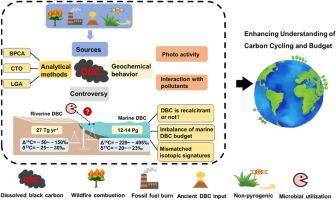
Dissolved black carbon (DBC) represents the most active component within the black carbon (BC) continuum and plays a vital role in the global carbon cycle and the removal of inorganic and organic contaminants due to its prolonged residence time and unique condensed aromatic structure. Significant progress has been made in understanding DBC source, molecular structure, analytical methods, stability, and environmental behavior, particularly its photochemical and microbial transformation. However, substantial uncertainties persist, including ambiguities in its definition, limitations in isolation and quantification methods, and unidentified sources. These limitations have led to lots of inconsistencies regarding its stability, environmental transport pathways, and transformation mechanisms. This review critically examines the current landscape of DBC research, with a focus on: (1) key contradictions in DBC cycling processes, including debates over its recalcitrance, mismatched isotopic signatures, and imbalances in the marine DBC budget; (2) limitations for DBC isolation and quantification methods in natural environments; and (3) photochemical and microbial transformation processes, and its interactions with environmental pollutants. By synthesizing recent insights, this review aims to enhance the understanding of DBC's structures, turnover, and environmental behavior, as well as its implications for the global carbon cycle. To address existing challenges, future studies are suggested to prioritize resolving these contradictions, developing standardized analytical approaches, and achieving a clearer elucidation of DBC cycling processes across diverse environments.
期刊介绍:
Environmental Pollution is an international peer-reviewed journal that publishes high-quality research papers and review articles covering all aspects of environmental pollution and its impacts on ecosystems and human health.
Subject areas include, but are not limited to:
• Sources and occurrences of pollutants that are clearly defined and measured in environmental compartments, food and food-related items, and human bodies;
• Interlinks between contaminant exposure and biological, ecological, and human health effects, including those of climate change;
• Contaminants of emerging concerns (including but not limited to antibiotic resistant microorganisms or genes, microplastics/nanoplastics, electronic wastes, light, and noise) and/or their biological, ecological, or human health effects;
• Laboratory and field studies on the remediation/mitigation of environmental pollution via new techniques and with clear links to biological, ecological, or human health effects;
• Modeling of pollution processes, patterns, or trends that is of clear environmental and/or human health interest;
• New techniques that measure and examine environmental occurrences, transport, behavior, and effects of pollutants within the environment or the laboratory, provided that they can be clearly used to address problems within regional or global environmental compartments.




 京公网安备 11010802042870号
京ICP备2023020795号-1
京公网安备 11010802042870号
京ICP备2023020795号-1

 分享
分享
 求助内容:
求助内容: 应助结果提醒方式:
 扫码关注我们
