Libing Liu , Sen Lu , Zhiyuan Jin , Jiangwei Lou , Weijun Zhang , Dongsheng Wang
{"title":"Hydrolysis of Al13 and its coagulation mechanism: Role of speciation stability and transformation","authors":"Libing Liu , Sen Lu , Zhiyuan Jin , Jiangwei Lou , Weijun Zhang , Dongsheng Wang","doi":"10.1016/j.watres.2025.123672","DOIUrl":null,"url":null,"abstract":"<div><div>Al<sub>13</sub> ([AlO<sub>4</sub>Al<sub>12</sub>(OH)<sub>24</sub>(H<sub>2</sub>O)<sub>12</sub>]<sup>7+</sup>) is widely recognized as one of the advantageous species of Al-based coagulants, and its transformation process and micro-interface interaction with pollutants in water treatment continue to attract the attention of researchers. Based on relevant literatures in the past decades, this review summarizes and discusses the characterization methods, stability and aggregation, coagulation performance and mechanism of Al<sub>13</sub>. The technique development and method establishment such as <sup>27</sup>Al nuclear magnetic resonance, electrospray ionization mass spectrometry, and Al-Ferron complexation timed spectrophotometry provide technical support for qualitative and quantitative detection of the species transformation of Al<sub>13</sub>. Al<sub>13</sub> pre-formed by forced hydrolysis is of high structural stability, and solution pH, high Al concentration, and high temperature are important factors affecting its further hydrolysis, aggregation, dissociation or polymerization. Under circumneutral pH conditions in practical water treatment processes, unlike traditional Al salts which undergo extensive hydrolysis to generate Al(OH)<sub>3</sub>, Al<sub>13</sub> transforms into Al<sub>13</sub> aggregates. This is the key for Al<sub>13</sub> to exert its superior coagulation performance and makes it shows significantly higher efficiency than traditional Al salts in removing particulate matter and organic substances. Specifically, Al<sub>13</sub> shows a broader effective dosage range and pH range compared with AlCl<sub>3</sub> through the coagulation mechanisms such as electrostatic patch, in-situ aggregation bridging, and complexation adsorption. Furthermore, the flocs formed by Al<sub>13</sub> coagulation exhibit a more compact crystalline structure and higher strength, which helps reduce residual Al concentrations. A comprehensive investigation into the hydrolysis characteristics of Al<sub>13</sub> and its role in coagulation is crucial for optimizing coagulation processes, while also providing a theoretical foundation for developing novel high-efficiency composite coagulants.</div></div>","PeriodicalId":443,"journal":{"name":"Water Research","volume":"281 ","pages":"Article 123672"},"PeriodicalIF":12.4000,"publicationDate":"2025-08-01","publicationTypes":"Journal Article","fieldsOfStudy":null,"isOpenAccess":false,"openAccessPdf":"","citationCount":"0","resultStr":null,"platform":"Semanticscholar","paperid":null,"PeriodicalName":"Water Research","FirstCategoryId":"93","ListUrlMain":"https://www.sciencedirect.com/science/article/pii/S0043135425005810","RegionNum":1,"RegionCategory":"环境科学与生态学","ArticlePicture":[],"TitleCN":null,"AbstractTextCN":null,"PMCID":null,"EPubDate":"2025/4/17 0:00:00","PubModel":"Epub","JCR":"Q1","JCRName":"ENGINEERING, ENVIRONMENTAL","Score":null,"Total":0}
引用次数: 0
Abstract
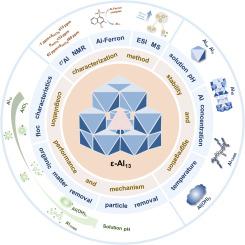
Al13 ([AlO4Al12(OH)24(H2O)12]7+) is widely recognized as one of the advantageous species of Al-based coagulants, and its transformation process and micro-interface interaction with pollutants in water treatment continue to attract the attention of researchers. Based on relevant literatures in the past decades, this review summarizes and discusses the characterization methods, stability and aggregation, coagulation performance and mechanism of Al13. The technique development and method establishment such as 27Al nuclear magnetic resonance, electrospray ionization mass spectrometry, and Al-Ferron complexation timed spectrophotometry provide technical support for qualitative and quantitative detection of the species transformation of Al13. Al13 pre-formed by forced hydrolysis is of high structural stability, and solution pH, high Al concentration, and high temperature are important factors affecting its further hydrolysis, aggregation, dissociation or polymerization. Under circumneutral pH conditions in practical water treatment processes, unlike traditional Al salts which undergo extensive hydrolysis to generate Al(OH)3, Al13 transforms into Al13 aggregates. This is the key for Al13 to exert its superior coagulation performance and makes it shows significantly higher efficiency than traditional Al salts in removing particulate matter and organic substances. Specifically, Al13 shows a broader effective dosage range and pH range compared with AlCl3 through the coagulation mechanisms such as electrostatic patch, in-situ aggregation bridging, and complexation adsorption. Furthermore, the flocs formed by Al13 coagulation exhibit a more compact crystalline structure and higher strength, which helps reduce residual Al concentrations. A comprehensive investigation into the hydrolysis characteristics of Al13 and its role in coagulation is crucial for optimizing coagulation processes, while also providing a theoretical foundation for developing novel high-efficiency composite coagulants.
期刊介绍:
Water Research, along with its open access companion journal Water Research X, serves as a platform for publishing original research papers covering various aspects of the science and technology related to the anthropogenic water cycle, water quality, and its management worldwide. The audience targeted by the journal comprises biologists, chemical engineers, chemists, civil engineers, environmental engineers, limnologists, and microbiologists. The scope of the journal include:
•Treatment processes for water and wastewaters (municipal, agricultural, industrial, and on-site treatment), including resource recovery and residuals management;
•Urban hydrology including sewer systems, stormwater management, and green infrastructure;
•Drinking water treatment and distribution;
•Potable and non-potable water reuse;
•Sanitation, public health, and risk assessment;
•Anaerobic digestion, solid and hazardous waste management, including source characterization and the effects and control of leachates and gaseous emissions;
•Contaminants (chemical, microbial, anthropogenic particles such as nanoparticles or microplastics) and related water quality sensing, monitoring, fate, and assessment;
•Anthropogenic impacts on inland, tidal, coastal and urban waters, focusing on surface and ground waters, and point and non-point sources of pollution;
•Environmental restoration, linked to surface water, groundwater and groundwater remediation;
•Analysis of the interfaces between sediments and water, and between water and atmosphere, focusing specifically on anthropogenic impacts;
•Mathematical modelling, systems analysis, machine learning, and beneficial use of big data related to the anthropogenic water cycle;
•Socio-economic, policy, and regulations studies.




 京公网安备 11010802042870号
京ICP备2023020795号-1
京公网安备 11010802042870号
京ICP备2023020795号-1

 分享
分享
 求助内容:
求助内容: 应助结果提醒方式:
 扫码关注我们
