Chirag Shah MD, Shauna R. Campbell DO, Erin Murphy MD, Steve Braunstein MD, PhD, Matthew S. Dietz DO, Odion Binitie MD, Zachary J. Kastenberg MD, Jane Yanagawa MD, Jennifer Halpern MD, Bela Kis MD, PhD, Stephen Hunt MD, Fereshteh Yazdanpanah MD, Ajay Gupta MD, Matteo Trucco MD
{"title":"Consensus recommendations regarding local and metastasis-directed therapies in the management of relapsed/recurrent Ewing sarcoma","authors":"Chirag Shah MD, Shauna R. Campbell DO, Erin Murphy MD, Steve Braunstein MD, PhD, Matthew S. Dietz DO, Odion Binitie MD, Zachary J. Kastenberg MD, Jane Yanagawa MD, Jennifer Halpern MD, Bela Kis MD, PhD, Stephen Hunt MD, Fereshteh Yazdanpanah MD, Ajay Gupta MD, Matteo Trucco MD","doi":"10.1002/cncr.35858","DOIUrl":null,"url":null,"abstract":"<p>Limited randomized or prospective data are available to guide local/metastasis directed therapy (LMDT) in relapsed/recurrent Ewing sarcoma (RR-ES), resulting in uncertainty regarding best clinical practice for these patients. This report reviews the available literature on LMDT approaches and provides consensus recommendations regarding therapeutic decision making, timing, and indications for the use of LMDT in the management of RR-ES. LMDT should be considered on a case-by-case basis to assess appropriateness, optimal timing/modality, palliative versus curative intent, and its role in relation to chemotherapy. One commonly used LMDT is radiotherapy (RT), which can be delivered through standard, hypofractionated, or stereotactic techniques based on factors including prior RT, tumor size, and/or location. Chemotherapy can be combined with RT, although prospective data are limited in the relapse setting. Surgery for LMDT not only addresses the tumor but also provides tissue for analysis, though the potential surgical morbidity based on location, extent of resection, and recovery complications should be considered. Interventional radiology approaches also can procure tumor tissue while delivering LMDT; there are several different procedures available based on the location, size, and extent of disease. Finally, a combination of LMDT approaches can be used for patients with RR-ES. Decisions regarding the management of RR-ES should involve a multidisciplinary team and factor in the burden of disease, progression-free interval, life expectancy, toxicity profiles of LMDT, and quality of life. In such patients, informed and shared decision making with patients and their families is paramount.</p>","PeriodicalId":138,"journal":{"name":"Cancer","volume":"131 9","pages":""},"PeriodicalIF":5.1000,"publicationDate":"2025-04-18","publicationTypes":"Journal Article","fieldsOfStudy":null,"isOpenAccess":false,"openAccessPdf":"https://onlinelibrary.wiley.com/doi/epdf/10.1002/cncr.35858","citationCount":"0","resultStr":null,"platform":"Semanticscholar","paperid":null,"PeriodicalName":"Cancer","FirstCategoryId":"3","ListUrlMain":"https://acsjournals.onlinelibrary.wiley.com/doi/10.1002/cncr.35858","RegionNum":2,"RegionCategory":"医学","ArticlePicture":[],"TitleCN":null,"AbstractTextCN":null,"PMCID":null,"EPubDate":"","PubModel":"","JCR":"Q1","JCRName":"ONCOLOGY","Score":null,"Total":0}
引用次数: 0
Abstract
Limited randomized or prospective data are available to guide local/metastasis directed therapy (LMDT) in relapsed/recurrent Ewing sarcoma (RR-ES), resulting in uncertainty regarding best clinical practice for these patients. This report reviews the available literature on LMDT approaches and provides consensus recommendations regarding therapeutic decision making, timing, and indications for the use of LMDT in the management of RR-ES. LMDT should be considered on a case-by-case basis to assess appropriateness, optimal timing/modality, palliative versus curative intent, and its role in relation to chemotherapy. One commonly used LMDT is radiotherapy (RT), which can be delivered through standard, hypofractionated, or stereotactic techniques based on factors including prior RT, tumor size, and/or location. Chemotherapy can be combined with RT, although prospective data are limited in the relapse setting. Surgery for LMDT not only addresses the tumor but also provides tissue for analysis, though the potential surgical morbidity based on location, extent of resection, and recovery complications should be considered. Interventional radiology approaches also can procure tumor tissue while delivering LMDT; there are several different procedures available based on the location, size, and extent of disease. Finally, a combination of LMDT approaches can be used for patients with RR-ES. Decisions regarding the management of RR-ES should involve a multidisciplinary team and factor in the burden of disease, progression-free interval, life expectancy, toxicity profiles of LMDT, and quality of life. In such patients, informed and shared decision making with patients and their families is paramount.
期刊介绍:
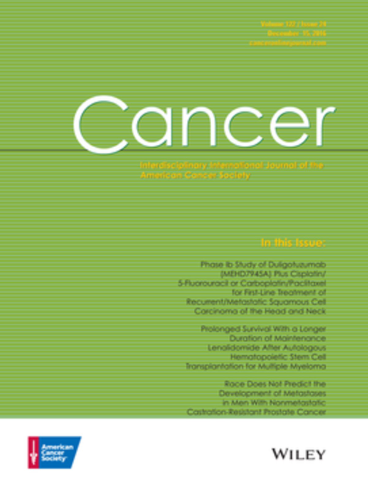
The CANCER site is a full-text, electronic implementation of CANCER, an Interdisciplinary International Journal of the American Cancer Society, and CANCER CYTOPATHOLOGY, a Journal of the American Cancer Society.
CANCER publishes interdisciplinary oncologic information according to, but not limited to, the following disease sites and disciplines: blood/bone marrow; breast disease; endocrine disorders; epidemiology; gastrointestinal tract; genitourinary disease; gynecologic oncology; head and neck disease; hepatobiliary tract; integrated medicine; lung disease; medical oncology; neuro-oncology; pathology radiation oncology; translational research



 京公网安备 11010802042870号
京ICP备2023020795号-1
京公网安备 11010802042870号
京ICP备2023020795号-1

 分享
分享
 求助内容:
求助内容: 应助结果提醒方式:
 扫码关注我们
