Asthma treatment response modified by fine particulate matter, nitrogen dioxide, and ozone among Black children: A reanalysis of the AsthmaNet Best African American Response to Asthma Drugs trial
Lizbeth F. Gómez PhD MPH , Ellen J. Kinnee MS , Michael T. Young PhD , Joel D. Kaufman MD, MPH , Anne M. Fitzpatrick PhD, MSCR, APRN , Sharmilee M. Nyenhuis MD, FAAAAI , Julian Solway MD , Steven R. White MD , Edward T. Naureckas MD , Wanda Phipatanakul MD, MS , Michael E. Wechsler MD, MMSc , Susan J. Kunselman MS , David T. Mauger MS, PhD , Leslie A. McClure MS, PhD , Usama Bilal MD, MPH, PhD , Stephen C. Lazarus MD, FCCP, FERS , Fernando Holguin MD, MPH , Jane E. Clougherty MSc, ScD
{"title":"Asthma treatment response modified by fine particulate matter, nitrogen dioxide, and ozone among Black children: A reanalysis of the AsthmaNet Best African American Response to Asthma Drugs trial","authors":"Lizbeth F. Gómez PhD MPH , Ellen J. Kinnee MS , Michael T. Young PhD , Joel D. Kaufman MD, MPH , Anne M. Fitzpatrick PhD, MSCR, APRN , Sharmilee M. Nyenhuis MD, FAAAAI , Julian Solway MD , Steven R. White MD , Edward T. Naureckas MD , Wanda Phipatanakul MD, MS , Michael E. Wechsler MD, MMSc , Susan J. Kunselman MS , David T. Mauger MS, PhD , Leslie A. McClure MS, PhD , Usama Bilal MD, MPH, PhD , Stephen C. Lazarus MD, FCCP, FERS , Fernando Holguin MD, MPH , Jane E. Clougherty MSc, ScD","doi":"10.1016/j.jaci.2025.04.009","DOIUrl":null,"url":null,"abstract":"<div><h3>Background</h3><div>Asthma morbidity significantly affects children of all racial backgrounds; however, Black children experience a greater disease burden than children from other racial groups. Despite the known influence of air pollution on asthma outcomes, its role in the efficacy of asthma treatments remains underexplored.</div></div><div><h3>Objective</h3><div>We sought to examine how exposure to particulate matter <2.5 μm (PM<sub>2.5</sub>), nitrogen dioxide (NO<sub>2</sub>), and ozone (O<sub>3</sub>) influenced treatment outcomes in the National Institutes of Health AsthmaNet Best African American Response to Asthma Drugs trial.</div></div><div><h3>Methods</h3><div>The trial randomized 224 Black children to 4 asthma treatments consisting of an inhaled corticosteroid (ICS) and long-acting β-agonist (LABA) administered in a randomized crossover fashion. Treatment efficacy was assessed by the frequency of asthma exacerbations, percent predicted FEV<sub>1</sub>, and annualized asthma control days. Residential exposures to PM<sub>2.5</sub>, NO<sub>2</sub>, and O<sub>3</sub> were estimated using a validated spatiotemporal model. Mixed-effects models were used to evaluate the interaction between pollution exposure and treatment efficacy, adjusting for age, household triggers, and trial site.</div></div><div><h3>Results</h3><div>PM<sub>2.5</sub>, NO<sub>2</sub>, and O<sub>3</sub> exposures ranged substantially across participants from 2.28 to 15.3 μg/m<sup>3</sup>, 2.34 to 63.7 ppm, and 2.57 to 23.7 ppb, respectively. NO<sub>2</sub> and PM<sub>2.5</sub> exposures were not associated with increased exacerbations post-treatment (<em>P</em> for interaction = .15 and .08, respectively). However, NO<sub>2</sub> exposure significantly modified the effect of high-dose ICS+LABA therapy on lung function. Children with below median NO<sub>2</sub> exposures while receiving ICS+LABA therapy had a reduction of 5.86 (95% CI 1.16, 10.56) in percent predicted FEV<sub>1</sub> compared with children with above median NO<sub>2</sub> exposures.</div></div><div><h3>Conclusion</h3><div>Residential high NO<sub>2</sub> exposure may significantly attenuate the efficacy of ICS+LABA therapy on lung function in Black children. These findings suggest the need to consider environmental factors in clinical trials and asthma management strategies.</div></div>","PeriodicalId":14936,"journal":{"name":"Journal of Allergy and Clinical Immunology","volume":"156 2","pages":"Pages 330-338"},"PeriodicalIF":11.2000,"publicationDate":"2025-08-01","publicationTypes":"Journal Article","fieldsOfStudy":null,"isOpenAccess":false,"openAccessPdf":"","citationCount":"0","resultStr":null,"platform":"Semanticscholar","paperid":null,"PeriodicalName":"Journal of Allergy and Clinical Immunology","FirstCategoryId":"3","ListUrlMain":"https://www.sciencedirect.com/science/article/pii/S0091674925004166","RegionNum":1,"RegionCategory":"医学","ArticlePicture":[],"TitleCN":null,"AbstractTextCN":null,"PMCID":null,"EPubDate":"2025/4/15 0:00:00","PubModel":"Epub","JCR":"Q1","JCRName":"ALLERGY","Score":null,"Total":0}
引用次数: 0
Abstract
Background
Asthma morbidity significantly affects children of all racial backgrounds; however, Black children experience a greater disease burden than children from other racial groups. Despite the known influence of air pollution on asthma outcomes, its role in the efficacy of asthma treatments remains underexplored.
Objective
We sought to examine how exposure to particulate matter <2.5 μm (PM2.5), nitrogen dioxide (NO2), and ozone (O3) influenced treatment outcomes in the National Institutes of Health AsthmaNet Best African American Response to Asthma Drugs trial.
Methods
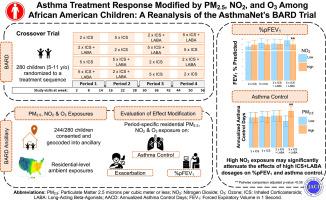
The trial randomized 224 Black children to 4 asthma treatments consisting of an inhaled corticosteroid (ICS) and long-acting β-agonist (LABA) administered in a randomized crossover fashion. Treatment efficacy was assessed by the frequency of asthma exacerbations, percent predicted FEV1, and annualized asthma control days. Residential exposures to PM2.5, NO2, and O3 were estimated using a validated spatiotemporal model. Mixed-effects models were used to evaluate the interaction between pollution exposure and treatment efficacy, adjusting for age, household triggers, and trial site.
Results
PM2.5, NO2, and O3 exposures ranged substantially across participants from 2.28 to 15.3 μg/m3, 2.34 to 63.7 ppm, and 2.57 to 23.7 ppb, respectively. NO2 and PM2.5 exposures were not associated with increased exacerbations post-treatment (P for interaction = .15 and .08, respectively). However, NO2 exposure significantly modified the effect of high-dose ICS+LABA therapy on lung function. Children with below median NO2 exposures while receiving ICS+LABA therapy had a reduction of 5.86 (95% CI 1.16, 10.56) in percent predicted FEV1 compared with children with above median NO2 exposures.
Conclusion
Residential high NO2 exposure may significantly attenuate the efficacy of ICS+LABA therapy on lung function in Black children. These findings suggest the need to consider environmental factors in clinical trials and asthma management strategies.
期刊介绍:
The Journal of Allergy and Clinical Immunology is a prestigious publication that features groundbreaking research in the fields of Allergy, Asthma, and Immunology. This influential journal publishes high-impact research papers that explore various topics, including asthma, food allergy, allergic rhinitis, atopic dermatitis, primary immune deficiencies, occupational and environmental allergy, and other allergic and immunologic diseases. The articles not only report on clinical trials and mechanistic studies but also provide insights into novel therapies, underlying mechanisms, and important discoveries that contribute to our understanding of these diseases. By sharing this valuable information, the journal aims to enhance the diagnosis and management of patients in the future.



 京公网安备 11010802042870号
京ICP备2023020795号-1
京公网安备 11010802042870号
京ICP备2023020795号-1

 分享
分享
 求助内容:
求助内容: 应助结果提醒方式:
 扫码关注我们
