Panpan Mu , Xiaoguang Zhang , Gang Fang , Guosai Jiang , Zhe Tan , Haile Yan , De’an Pan
{"title":"Pathways and mechanism of (NH4)2Me(SO4)2 formation during the process of (NH4)2S sulfide removal of Ni, Co, and Zn in MnSO4 electrolyte","authors":"Panpan Mu , Xiaoguang Zhang , Gang Fang , Guosai Jiang , Zhe Tan , Haile Yan , De’an Pan","doi":"10.1016/j.seppur.2025.133028","DOIUrl":null,"url":null,"abstract":"<div><div>In the process of removing Ni, Co, and Zn from manganese sulfate electrolyte solution, the metal sulfides produced are mixed with ammonium metal sulfate. The reasons and roles behind the formation of ammonium metal sulfate are not fully understood, and this study explores this aspect. Experimental verification, density functional theory (DFT) calculations, and molecular dynamics simulations reveal that NH<sub>4</sub><sup>+</sup> and SO<sub>4</sub><sup>2-</sup> exhibit a stronger binding affinity to low-concentration metal ions compared to S<sup>2-</sup>, which is crucial for the formation of ammonium metal sulfate. Furthermore, the formation order of ammonium metal sulfate is Zn, Ni, Co, and Mn. In the process of sulfurization and impurity removal of manganese sulfate electrolyte solution, the formation of ammonium metal sulfate is conducive to the removal of Ni, Co, and Zn impurities, which helps to purify the manganese electrolyte and increases the manganese impurity ratio from 48.51 to 75.05. This study clarifies the phase transition characteristics during the impurity removal process of manganese sulfate electrolyte, reveals the formation pathway and practical application of the metal ammonium sulfate mixture, and provides an optimized approach for sulfurization-based heavy metal removal.</div></div>","PeriodicalId":427,"journal":{"name":"Separation and Purification Technology","volume":"372 ","pages":"Article 133028"},"PeriodicalIF":9.0000,"publicationDate":"2025-11-01","publicationTypes":"Journal Article","fieldsOfStudy":null,"isOpenAccess":false,"openAccessPdf":"","citationCount":"0","resultStr":null,"platform":"Semanticscholar","paperid":null,"PeriodicalName":"Separation and Purification Technology","FirstCategoryId":"5","ListUrlMain":"https://www.sciencedirect.com/science/article/pii/S1383586625016259","RegionNum":1,"RegionCategory":"工程技术","ArticlePicture":[],"TitleCN":null,"AbstractTextCN":null,"PMCID":null,"EPubDate":"2025/4/18 0:00:00","PubModel":"Epub","JCR":"Q1","JCRName":"ENGINEERING, CHEMICAL","Score":null,"Total":0}
引用次数: 0
Abstract
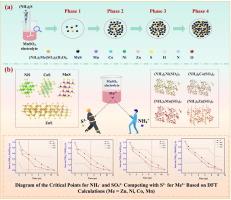
In the process of removing Ni, Co, and Zn from manganese sulfate electrolyte solution, the metal sulfides produced are mixed with ammonium metal sulfate. The reasons and roles behind the formation of ammonium metal sulfate are not fully understood, and this study explores this aspect. Experimental verification, density functional theory (DFT) calculations, and molecular dynamics simulations reveal that NH4+ and SO42- exhibit a stronger binding affinity to low-concentration metal ions compared to S2-, which is crucial for the formation of ammonium metal sulfate. Furthermore, the formation order of ammonium metal sulfate is Zn, Ni, Co, and Mn. In the process of sulfurization and impurity removal of manganese sulfate electrolyte solution, the formation of ammonium metal sulfate is conducive to the removal of Ni, Co, and Zn impurities, which helps to purify the manganese electrolyte and increases the manganese impurity ratio from 48.51 to 75.05. This study clarifies the phase transition characteristics during the impurity removal process of manganese sulfate electrolyte, reveals the formation pathway and practical application of the metal ammonium sulfate mixture, and provides an optimized approach for sulfurization-based heavy metal removal.
期刊介绍:
Separation and Purification Technology is a premier journal committed to sharing innovative methods for separation and purification in chemical and environmental engineering, encompassing both homogeneous solutions and heterogeneous mixtures. Our scope includes the separation and/or purification of liquids, vapors, and gases, as well as carbon capture and separation techniques. However, it's important to note that methods solely intended for analytical purposes are not within the scope of the journal. Additionally, disciplines such as soil science, polymer science, and metallurgy fall outside the purview of Separation and Purification Technology. Join us in advancing the field of separation and purification methods for sustainable solutions in chemical and environmental engineering.




 京公网安备 11010802042870号
京ICP备2023020795号-1
京公网安备 11010802042870号
京ICP备2023020795号-1

 分享
分享
 求助内容:
求助内容: 应助结果提醒方式:
 扫码关注我们
