Jiazheng Chen, Arijit Sarkar, Md Sazzadur Rahman, Victoria Ravel, Aaron D. Franklin, Tania Roy
{"title":"Robust Memcapacitive Synapse Array for Energy-Efficient Motion Detection","authors":"Jiazheng Chen, Arijit Sarkar, Md Sazzadur Rahman, Victoria Ravel, Aaron D. Franklin, Tania Roy","doi":"10.1021/acsnano.5c02340","DOIUrl":null,"url":null,"abstract":"Emerging neuromorphic systems offer a promising alternative for memory and sensing compared to traditional configurations, but face challenges with scalability and energy efficiency. Capacitive memories show great potential for addressing energy concerns due to their leakage-free nature. However, there is a lack of research on their scalability and robustness. In this work, we present a high-yield memcapacitor array that demonstrates reliable memory characteristics while also being capable of precisely sensing different types of vehicle motion with only a few picowatts of power consumption. Featuring a metal-oxide-semiconductor (MOS) structure with the most aggressively scaled dimensions compared to previously reported memcapacitors, we successfully established a 9 × 9 memcapacitor matrix with a yield of over 92.5%. The device exhibits tunable synaptic plasticity under varying pulsing schemes. We also demonstrate 64 distinct capacitance states and stable performance over 2 × 10<sup>4</sup> electrical pulses. Additionally, we showcase its application in motion sensing for autonomous vehicles, leveraging the short-term potentiation properties of the device. This approach offers a scalable, energy-efficient solution for future motion sensing systems.","PeriodicalId":21,"journal":{"name":"ACS Nano","volume":"108 1","pages":""},"PeriodicalIF":16.0000,"publicationDate":"2025-04-19","publicationTypes":"Journal Article","fieldsOfStudy":null,"isOpenAccess":false,"openAccessPdf":"","citationCount":"0","resultStr":null,"platform":"Semanticscholar","paperid":null,"PeriodicalName":"ACS Nano","FirstCategoryId":"88","ListUrlMain":"https://doi.org/10.1021/acsnano.5c02340","RegionNum":1,"RegionCategory":"材料科学","ArticlePicture":[],"TitleCN":null,"AbstractTextCN":null,"PMCID":null,"EPubDate":"","PubModel":"","JCR":"Q1","JCRName":"CHEMISTRY, MULTIDISCIPLINARY","Score":null,"Total":0}
引用次数: 0
Abstract
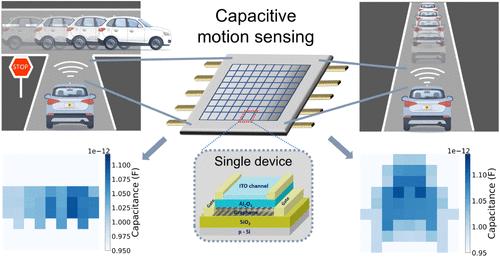
Emerging neuromorphic systems offer a promising alternative for memory and sensing compared to traditional configurations, but face challenges with scalability and energy efficiency. Capacitive memories show great potential for addressing energy concerns due to their leakage-free nature. However, there is a lack of research on their scalability and robustness. In this work, we present a high-yield memcapacitor array that demonstrates reliable memory characteristics while also being capable of precisely sensing different types of vehicle motion with only a few picowatts of power consumption. Featuring a metal-oxide-semiconductor (MOS) structure with the most aggressively scaled dimensions compared to previously reported memcapacitors, we successfully established a 9 × 9 memcapacitor matrix with a yield of over 92.5%. The device exhibits tunable synaptic plasticity under varying pulsing schemes. We also demonstrate 64 distinct capacitance states and stable performance over 2 × 10⁴ electrical pulses. Additionally, we showcase its application in motion sensing for autonomous vehicles, leveraging the short-term potentiation properties of the device. This approach offers a scalable, energy-efficient solution for future motion sensing systems.
期刊介绍:
ACS Nano, published monthly, serves as an international forum for comprehensive articles on nanoscience and nanotechnology research at the intersections of chemistry, biology, materials science, physics, and engineering. The journal fosters communication among scientists in these communities, facilitating collaboration, new research opportunities, and advancements through discoveries. ACS Nano covers synthesis, assembly, characterization, theory, and simulation of nanostructures, nanobiotechnology, nanofabrication, methods and tools for nanoscience and nanotechnology, and self- and directed-assembly. Alongside original research articles, it offers thorough reviews, perspectives on cutting-edge research, and discussions envisioning the future of nanoscience and nanotechnology.



 京公网安备 11010802042870号
京ICP备2023020795号-1
京公网安备 11010802042870号
京ICP备2023020795号-1

 分享
分享
 求助内容:
求助内容: 应助结果提醒方式:
 扫码关注我们
