{"title":"Brain Targeting Bacterial Extracellular Vesicles Enhance Ischemic Stroke Therapy via Efficient ROS Elimination and Suppression of Immune Infiltration","authors":"Mengdi Sun, Jinghan Ma, Ge Zhang, Mingzhu Song, Ruizhen Lv, Jia Liang, Yijie Shi, Liang Zhao","doi":"10.1021/acsnano.4c16161","DOIUrl":null,"url":null,"abstract":"Ischemic stroke (IS) as a detrimental neurological disease is accompanied by oxidative-stress-induced injury, concurrent inflammatory response, overactivated brain immune microenvironment, and disruption of the blood–brain barrier (BBB). This cascade of events ultimately leads to neuronal death and significantly impairs the recovery of neurological function. In this study, we presented extracellular vesicles derived from the gut probiotic <i>Lactobacillus reuteri</i> (LrEVs) integrated with brain targeting, reactive oxygen species (ROS) scavenging, and reduced infiltration of immune cells for effective multiple therapeutic interventions of IS. LrEVs inherited peptidoglycan (PGN) specifically targeted upregulated toll-like receptor 2 (TLR2) in the injured region of the ischemic brain, achieving the effective penetration of the BBB and accumulation in the ischemic brain. In the meantime, LrEVs prevented neuronal apoptosis after stroke by scavenging ROS overproduction and modulating microglial polarization through inhibition of the MAPK and NF-κB pathways. Furthermore, LrEVs inhibited the aggregation of C–C motif chemokine ligand 2 (CCL2), reduced the infiltration of peripheral immune cells such as macrophages and neutrophils into ischemic brain tissue, and suppressed the impairment of BBB, thereby improving the overactivated brain immune microenvironment. The findings provide a vesicle that combines ROS scavenging and modulation of the immune microenvironment, showcasing the potential of gut-probiotic-derived vesicles to treat neurological damage.","PeriodicalId":21,"journal":{"name":"ACS Nano","volume":"10 1","pages":""},"PeriodicalIF":16.0000,"publicationDate":"2025-04-18","publicationTypes":"Journal Article","fieldsOfStudy":null,"isOpenAccess":false,"openAccessPdf":"","citationCount":"0","resultStr":null,"platform":"Semanticscholar","paperid":null,"PeriodicalName":"ACS Nano","FirstCategoryId":"88","ListUrlMain":"https://doi.org/10.1021/acsnano.4c16161","RegionNum":1,"RegionCategory":"材料科学","ArticlePicture":[],"TitleCN":null,"AbstractTextCN":null,"PMCID":null,"EPubDate":"","PubModel":"","JCR":"Q1","JCRName":"CHEMISTRY, MULTIDISCIPLINARY","Score":null,"Total":0}
引用次数: 0
Abstract
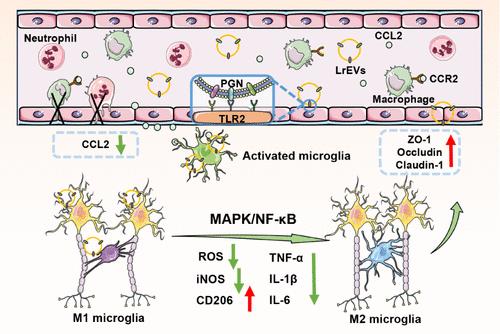
Ischemic stroke (IS) as a detrimental neurological disease is accompanied by oxidative-stress-induced injury, concurrent inflammatory response, overactivated brain immune microenvironment, and disruption of the blood–brain barrier (BBB). This cascade of events ultimately leads to neuronal death and significantly impairs the recovery of neurological function. In this study, we presented extracellular vesicles derived from the gut probiotic Lactobacillus reuteri (LrEVs) integrated with brain targeting, reactive oxygen species (ROS) scavenging, and reduced infiltration of immune cells for effective multiple therapeutic interventions of IS. LrEVs inherited peptidoglycan (PGN) specifically targeted upregulated toll-like receptor 2 (TLR2) in the injured region of the ischemic brain, achieving the effective penetration of the BBB and accumulation in the ischemic brain. In the meantime, LrEVs prevented neuronal apoptosis after stroke by scavenging ROS overproduction and modulating microglial polarization through inhibition of the MAPK and NF-κB pathways. Furthermore, LrEVs inhibited the aggregation of C–C motif chemokine ligand 2 (CCL2), reduced the infiltration of peripheral immune cells such as macrophages and neutrophils into ischemic brain tissue, and suppressed the impairment of BBB, thereby improving the overactivated brain immune microenvironment. The findings provide a vesicle that combines ROS scavenging and modulation of the immune microenvironment, showcasing the potential of gut-probiotic-derived vesicles to treat neurological damage.
期刊介绍:
ACS Nano, published monthly, serves as an international forum for comprehensive articles on nanoscience and nanotechnology research at the intersections of chemistry, biology, materials science, physics, and engineering. The journal fosters communication among scientists in these communities, facilitating collaboration, new research opportunities, and advancements through discoveries. ACS Nano covers synthesis, assembly, characterization, theory, and simulation of nanostructures, nanobiotechnology, nanofabrication, methods and tools for nanoscience and nanotechnology, and self- and directed-assembly. Alongside original research articles, it offers thorough reviews, perspectives on cutting-edge research, and discussions envisioning the future of nanoscience and nanotechnology.



 京公网安备 11010802042870号
京ICP备2023020795号-1
京公网安备 11010802042870号
京ICP备2023020795号-1

 分享
分享
 求助内容:
求助内容: 应助结果提醒方式:
 扫码关注我们
